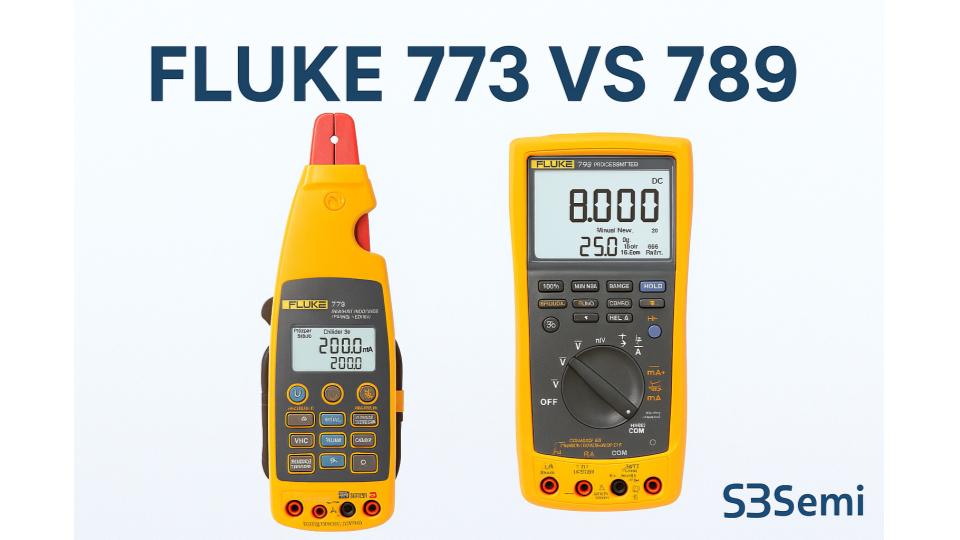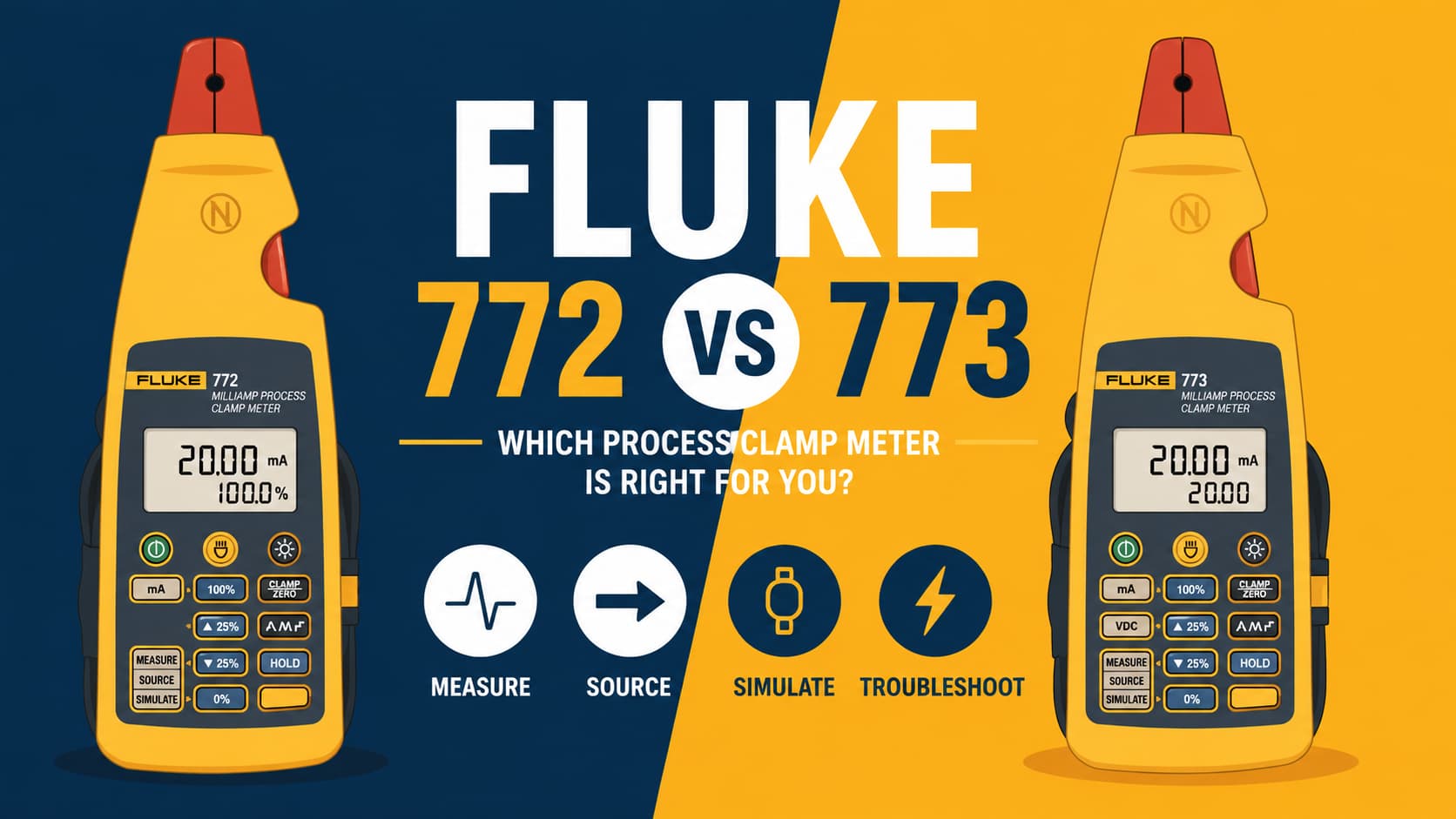
If you work with 4–20 mA process control loops, both the Fluke 772 and Fluke 773 are excellent tools that let you measure current without breaking the loop. This can dramatically reduce troubleshooting time in industrial plants, HVAC controls, and process automation systems.
⚡ Quick Pick: Fluke 773 vs Fluke 772
Choose the Fluke 773 if you need the more versatile process clamp meter with DC voltage measurement, 0-10 V sourcing, and voltage signal simulation in addition to 4-20 mA loop testing.
Choose the Fluke 772 if you mainly work with 4-20 mA current loops and want the lower-cost option without paying for voltage features you may not use.
🏆 Best Overall: Fluke 773
The Fluke 773 includes all the core 4-20 mA clamp, source, and simulation features of the 772, but adds DC voltage measurement and 0-10 V sourcing. It is the better choice for instrumentation, PLC, HVAC, and mixed current/voltage control troubleshooting.
💰 Best Value for Current Loops: Fluke 772
The Fluke 772 is ideal if your work is focused on 4-20 mA loop testing. It can measure loop current without breaking the circuit, source and simulate mA signals, and provide 24 V loop power, making it a strong value for dedicated process technicians.
Bottom line: Buy the Fluke 773 if you want the more complete process clamp meter for both current and voltage signals. Buy the Fluke 772 if you only need excellent 4-20 mA loop capability at a lower cost.
The two meters share the same core platform, but the Fluke 773 adds several voltage measurement and sourcing capabilities that make it a much more versatile troubleshooting instrument.
Comparison Table
| Feature | Fluke 772 | Fluke 773 |
|---|---|---|
| Non-contact 4–20 mA measurement | ✅ | ✅ |
| 4–20 mA Source | ✅ | ✅ |
| 4–20 mA Simulation | ✅ | ✅ |
| 24 V Loop Power | ✅ | ✅ |
| Automatic Ramp Output | ✅ | ✅ |
| 25% Step Output | ✅ | ✅ |
| Remote Clamp Jaw | ✅ | ✅ |
| Dual Backlit Display | ✅ | ✅ |
| Measure DC Voltage | ❌ | ✅ (up to 30 V) |
| Source DC Voltage | ❌ | ✅ (0–10 V) |
| Simulate Voltage Signals | ❌ | ✅ |
| Best For | Process loop technicians | Full instrumentation troubleshooting |
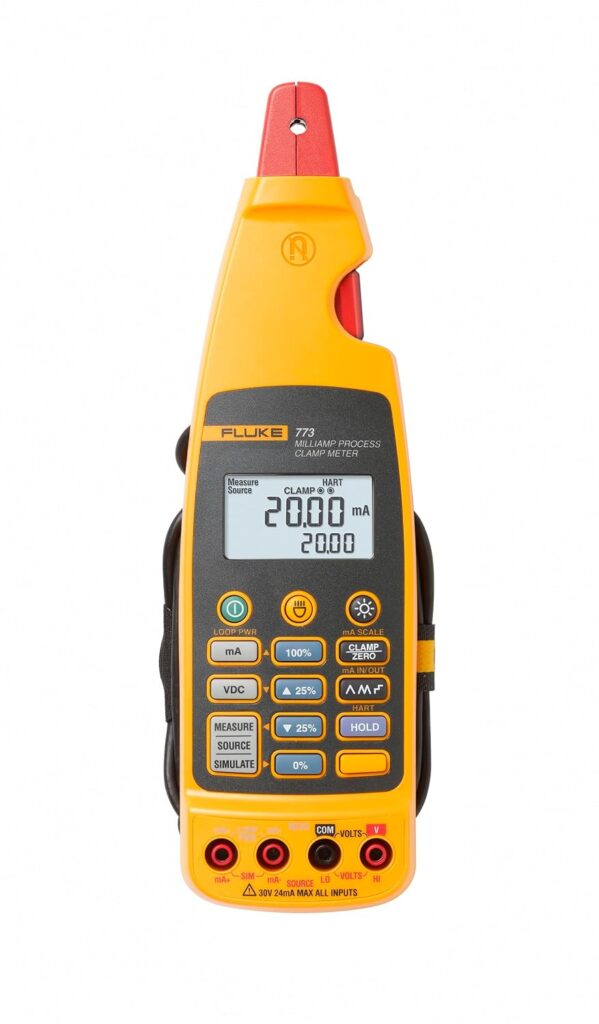
🚀 Upgrade Pick: Fluke 773
If you troubleshoot more than just current loops, the Fluke 773 is worth the upgrade. In addition to all the 4-20 mA capabilities of the 772, it can measure DC voltage and source 0-10 V signals, allowing one instrument to handle a wider range of industrial diagnostics.
- ✓ Everything the Fluke 772 can do
- ✓ Measure DC voltage
- ✓ Source and simulate 0-10 V signals
- ✓ Ideal for PLC, HVAC, and instrumentation work
- ✓ Reduces the number of tools you need to carry
What Both Meters Do Well
Both meters are designed specifically for instrumentation technicians who regularly work on process control loops.
Common features include:
- Measure 4–20 mA without breaking the loop
- Best-in-class 0.2% accuracy
- Source 4–20 mA signals
- Simulate transmitters
- Supply 24 V loop power
- Remote clamp jaw for tight panels
- Dual backlit display showing mA and loop percentage
- Automatic output ramp and step functions
- 99.9 mA measurement capability for legacy systems
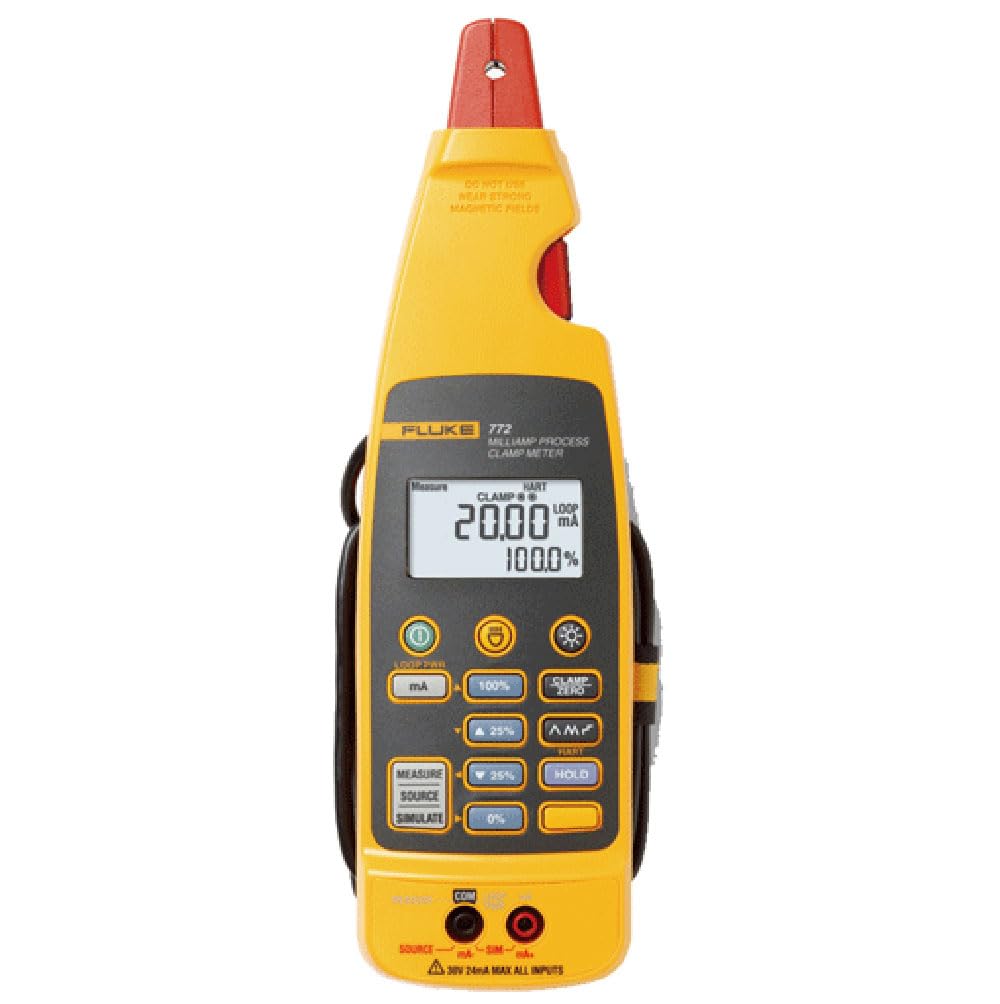
⚡ Need to Measure 4-20 mA Without Breaking the Loop?
The Fluke 772 is purpose-built for process technicians who spend their day troubleshooting current loops. Its unique clamp lets you measure 4-20 mA signals without disconnecting wiring, helping reduce downtime while making diagnostics faster and safer.
- ✓ Measure live 4-20 mA loops non-intrusively
- ✓ Source and simulate current signals
- ✓ Built-in 24 V loop power
- ✓ Remote clamp for crowded control cabinets
- ✓ Excellent value for dedicated process work
Fluke 772 Overview
The Fluke 772 is aimed squarely at process technicians who spend most of their day troubleshooting current loops.
It eliminates the need to disconnect wiring simply to measure loop current, making diagnostics significantly faster and safer.
For many maintenance technicians, it provides everything required for routine transmitter testing.
Pros
- Lower purchase price
- Measures 4–20 mA without breaking the loop
- Sources and simulates mA signals
- Built-in 24 V loop power
- Excellent accuracy
- Remote clamp jaw works well in crowded panels
Cons
- Cannot measure voltage
- Cannot source 0–10 V signals
- Less versatile for mixed-signal troubleshooting
Fluke 773 Overview
The Fluke 773 includes every feature found in the 772 while adding voltage capabilities.
The biggest additions are:
- DC voltage measurement
- 0–10 V sourcing
- Voltage signal simulation
These features make it useful for troubleshooting HVAC controllers, analog PLC I/O, valve positioners, actuators, and many industrial automation systems where both current and voltage signals are encountered. (Instrumart)
Pros
- Everything included in the 772
- Measures DC voltage
- Sources 0–10 V signals
- Simulates voltage outputs
- Replaces multiple field instruments
- Excellent for PLC and instrumentation work
Cons
- Higher purchase price
- Extra features may never be used by technicians who only service current loops
Performance Comparison
Current Loop Troubleshooting
Both meters perform virtually identically when measuring and calibrating 4–20 mA loops.
Winner: Tie
Instrument Calibration
Again, both perform the same for current loop calibration.
Winner: Tie
PLC and HVAC Controls
The Fluke 773 is clearly ahead because it can troubleshoot both voltage and current devices.
Winner: Fluke 773
Overall Value
If your work never involves voltage signals, the 772 delivers nearly identical performance for less money.
If you regularly encounter both signal types, the 773 can replace multiple instruments.
Winner: Depends on your application
Pros and Cons at a Glance
Fluke 772
Advantages
- Lower cost
- Outstanding 4–20 mA capability
- Compact and easy to use
- Excellent for dedicated process technicians
Disadvantages
- No voltage measurement
- No voltage sourcing
- Less flexible in mixed-control environments
Fluke 773
Advantages
- Adds voltage measurement and sourcing
- One tool for current and voltage diagnostics
- Better suited to instrumentation engineers
- Reduces the number of tools carried into the field
Disadvantages
- More expensive
- Additional functions may be unnecessary for current-loop-only work
What Customers Think
Owners of both models consistently praise how much time they save by measuring 4–20 mA loops without breaking the circuit, eliminating unnecessary downtime. The detachable remote jaw is frequently highlighted as a major advantage when working inside crowded control cabinets. Users who own the Fluke 773 often mention that its voltage measurement and 0–10 V sourcing capabilities allow them to leave a second meter behind, making it particularly valuable for PLC, HVAC, and instrumentation work. By contrast, technicians whose work focuses exclusively on current loops generally feel the Fluke 772 provides all the functionality they need at a lower cost. Community discussions echo this view, with many noting that the primary reason to upgrade to the 773 is its added voltage capabilities.
Which Should You Buy?
Buy the Fluke 772 if:
- You mainly troubleshoot 4–20 mA loops.
- You work primarily with transmitters.
- You don’t need voltage sourcing or measurement.
- You want the best value.
Buy the Fluke 773 if:
- You service PLCs and industrial control systems.
- You work with both voltage and current analog signals.
- You want one tool instead of multiple instruments.
- You frequently troubleshoot HVAC controls or valve positioners.
Final Verdict
For technicians whose work revolves around 4–20 mA process loops, the Fluke 772 remains an outstanding value and performs almost identically to the 773 in current-loop applications.
However, if your job regularly involves 0–10 V control signals, PLC analog I/O, HVAC systems, or mixed instrumentation, the Fluke 773 is the more capable long-term investment. Its additional voltage functions make it a true all-in-one process troubleshooting tool rather than simply a loop clamp meter.