Air moves through ducts every time a heating or cooling system runs. Static pressure is the force that air pushes against the walls of those ducts, and it tells you a lot about how well a system is working. When static pressure is too high, the blower works harder, energy bills climb, and parts wear out faster.
A static pressure meter, sometimes called a manometer, measures that pressure in inches of water column. Most HVAC technicians use one to check pressure drop across filters, coils, and the whole duct system. I also see them used for testing draft in flue pipes and checking gas pressure on some models. Without a reading, you’re guessing at whether a system is choking on a dirty coil or an undersized return duct.
If you’re shopping for one, resolution and accuracy matter most. Look for a meter that reads to at least 0.01 inches of water column, since normal system readings often fall between 0.1 and 1.0. Pay attention to whether the meter has one port or two, because a dual-port model lets you measure the difference between two points at once. I’d also check the pressure range, the type of tubing and probes included, and whether the display is easy to read in a dark mechanical room. Battery life and auto-shutoff are small features that make a difference on long service days.
I tested several static pressure meters across furnaces, air handlers, and duct runs to find the ones that give reliable readings and hold up to daily use.
Best Static Pressure Meters
Below is my full list of the best static pressure meters. I looked at accuracy, range, and how easy each one is to read in the field, so you can pick the right tool for your HVAC work.
Leaton Dual-Port Digital Manometer
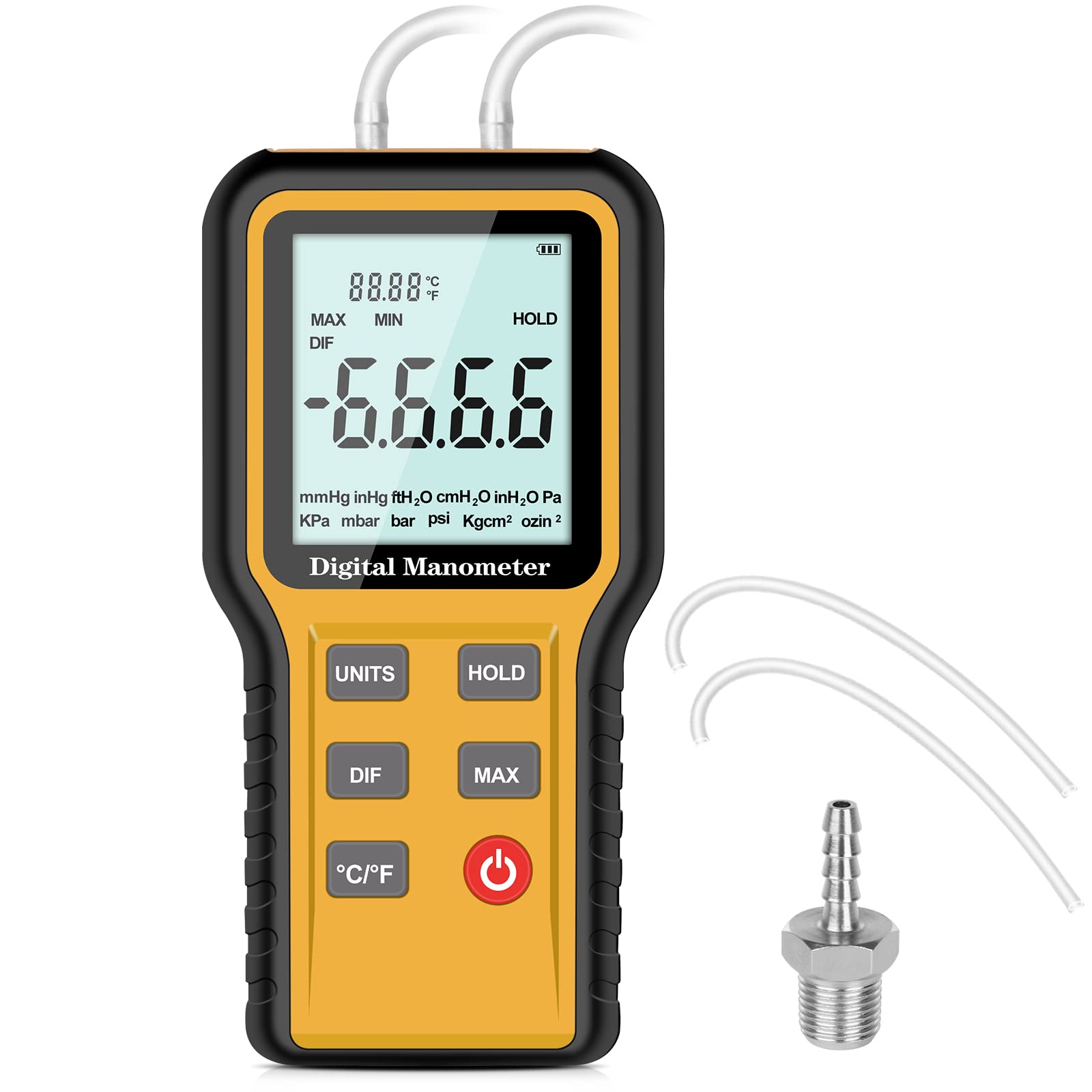
This is a solid pick if you need reliable static pressure readings for HVAC work, duct testing, or gas checks without paying professional-lab prices.
Pros
- Two ports let me read one pipe or compare two at once
- Backlit screen stayed readable in dark crawl spaces and attics
- Everything I needed came in the box, battery included
Cons
- Accuracy is good, but not lab-grade like pricier meters
- The 9V battery adds a little bulk to the housing
- Included tubing is short for larger duct runs
I pulled this out for a duct static pressure test on a two-stage furnace, and it took me maybe a minute to set up. Both hoses pushed on snug, I picked inches of water column from the unit list, and the reading settled fast.
The response time is quick enough that I could watch pressure change as the blower ramped up. That matters when you’re chasing a lazy pressure switch or a clogged filter.
Reading the screen was never a problem. The display is wide, the digits are large, and the backlight helped when I was working under a low ceiling with one hand on a flashlight.
I also used it to check gas pressure at a water heater. Switching units took one button press, and the hold function let me freeze a number so I could write it down instead of squinting at the meter sideways.
Where it falls a bit short is precision. For general service work and troubleshooting, the numbers were consistent and repeatable across several tests. But if you’re doing certification work or need documented calibration, a higher-end instrument makes more sense.
The plastic case feels sturdy rather than fragile, and it survived being tossed in my tool bag between jobs. The included carry case helps keep the hoses and fitting together, which is easy to lose otherwise.
| What I checked | How it did |
|---|---|
| Duct static pressure | Fast, steady readings |
| Gas line pressure | Easy unit switching |
| Low-pressure lab use | Fine for gases, not liquids |
For most technicians, homeowners with a furnace problem, or students running airflow tests, this meter covers the basics well at a fair price.
Klein Tools ET180 Digital Manometer
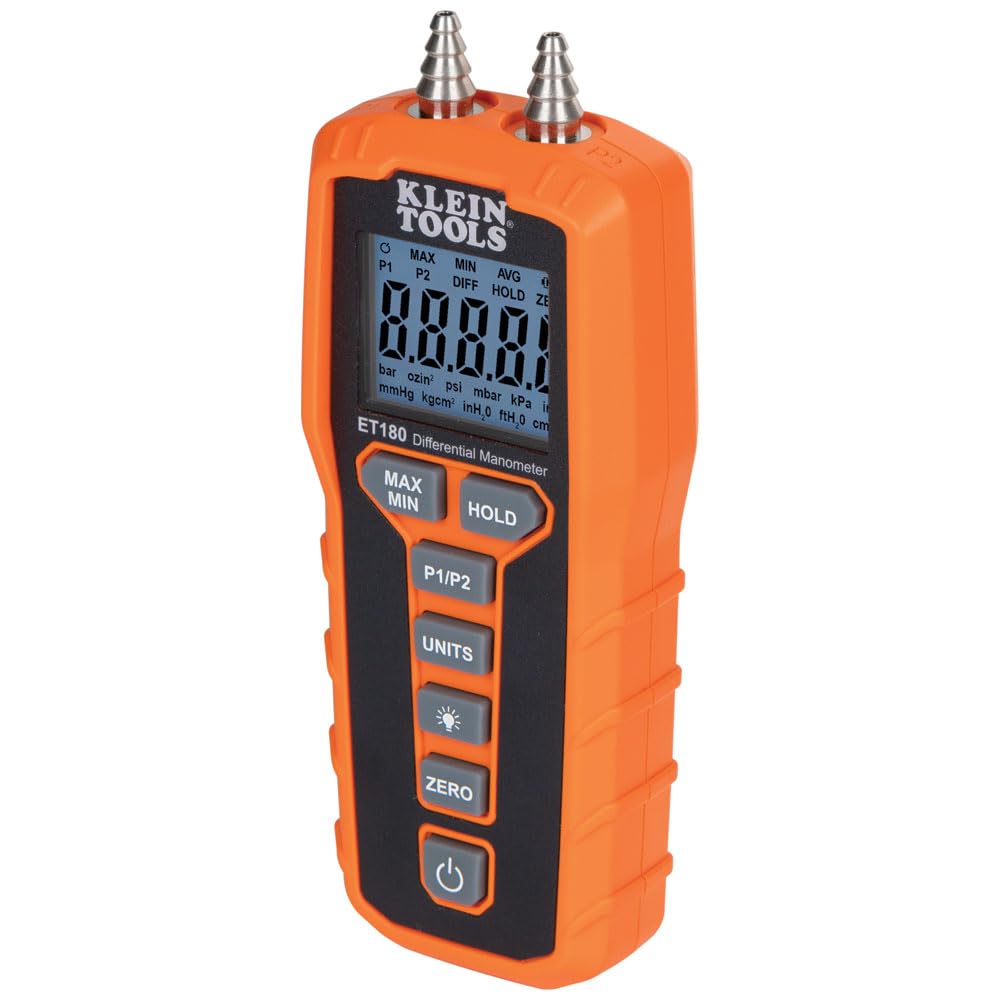
If you check gas pressure or duct static on a regular basis, this dual-port manometer covers the job without any fuss.
Pros
- Two ports let me read static pressure or the difference between them
- Magnet on the back holds it to a furnace cabinet so my hands stay free
- Eleven measurement units, so I never have to do conversion math
Cons
- The included tubing runs short for bigger equipment
- Port 1 and port 2 readings can’t be seen side by side
- The manual takes a few reads before the button layout clicks
I pulled the ET180 out of its zip case for a gas furnace call last week, and the setup took maybe a minute. Two ports on top, a short piece of silicone tubing, and I had manifold pressure on screen.
The backlit display is the part I appreciate most. Crawl spaces and mechanical rooms are usually dim, and I could read the numbers without holding a flashlight in my teeth.
That magnet on the back earns its keep. I stuck the meter to the side of an air handler while I drilled test ports, then came back to a steady reading instead of a meter sitting on the floor.
Switching units is simple once you learn the buttons. I mostly stay on inches of water column, but the psi and kPa options have come in handy on other jobs.
A few things worth knowing before you buy. The tubing that comes in the box is fine for close-up work, but I bought a longer length for duct testing.
And while you can read either port on its own, the screen shows one value at a time. If you want both numbers in front of you at once, this isn’t the meter for that.
The min, max, and average functions have been more useful than I expected, especially when pressure bounces around during startup. The hold button freezes a reading so I can write it down or snap a photo.
Build quality feels like what I expect from Klein. The ABS body has taken a couple of drops on my end and kept working, and it’s light enough that I forget it’s in my pouch.
For HVAC techs, plumbers checking gas appliances, or anyone testing building pressure, I think this one is a solid pick at its price.
Fieldpiece Job Link Dual Port Manometer Kit
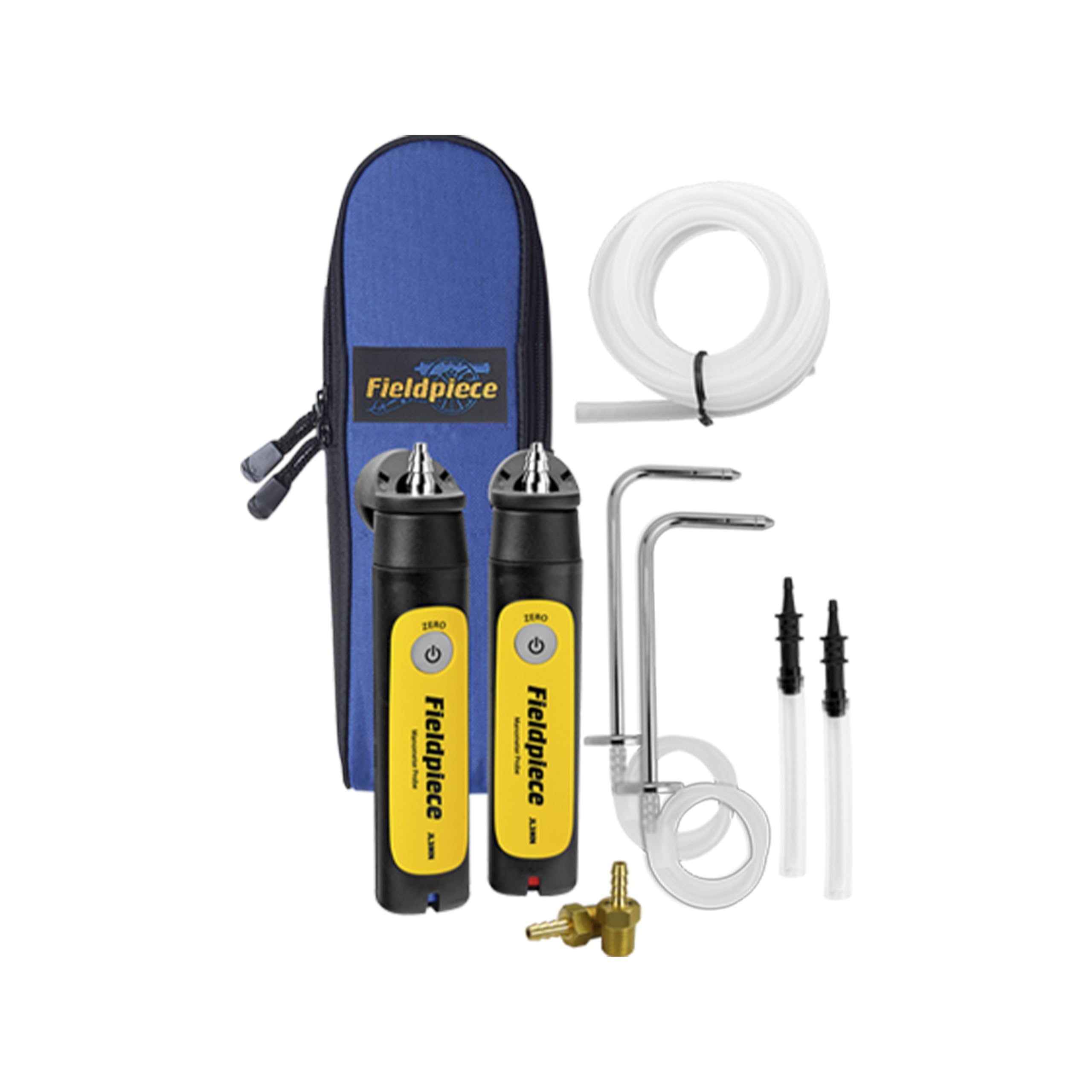
If you check total external static pressure on a regular basis and want to leave the hoses behind, this wireless kit is worth the money.
Pros
- Two separate probes let me read supply and return at the same time
- Wireless signal held up across a large house and through walls
- Small hoses and no tangled lines make setup much faster
Cons
- You need the phone app, so a glitch can stop your work
- Some users report trouble getting the probes to zero
- Costs more than a basic corded manometer
I clipped one probe into the return side and the other into the supply plenum, then walked back to the air handler with my phone. Both readings showed up right away, along with the total external static pressure. No math, no hose running across the floor.
The short hoses are a small detail that ended up mattering a lot. Since each probe sits right at the test port, I stopped fighting with six feet of tubing every time I moved to a new spot.
Range is the other thing I noticed. In a two-story home, I stood at the thermostat and still had a live signal from the probes down in the basement, which made it easy to watch pressure change while I adjusted the fan speed.
The P1–P2 switch is handy when I only care about one port. I used it on a furnace gas valve to check manifold pressure by itself, and the reading settled quickly instead of bouncing around.
My one real complaint is the app dependence. When the phone connection drops, you’re stuck waiting, and a few people have run into zeroing issues out of the box. It’s worth testing the probes on the bench before you rely on them at a customer’s house.
For the price, I think it earns a spot in the bag. Being able to save readings and hand a customer a simple report has made the airflow conversation a lot easier for me.
UEi EM201SPKIT Static Pressure Kit
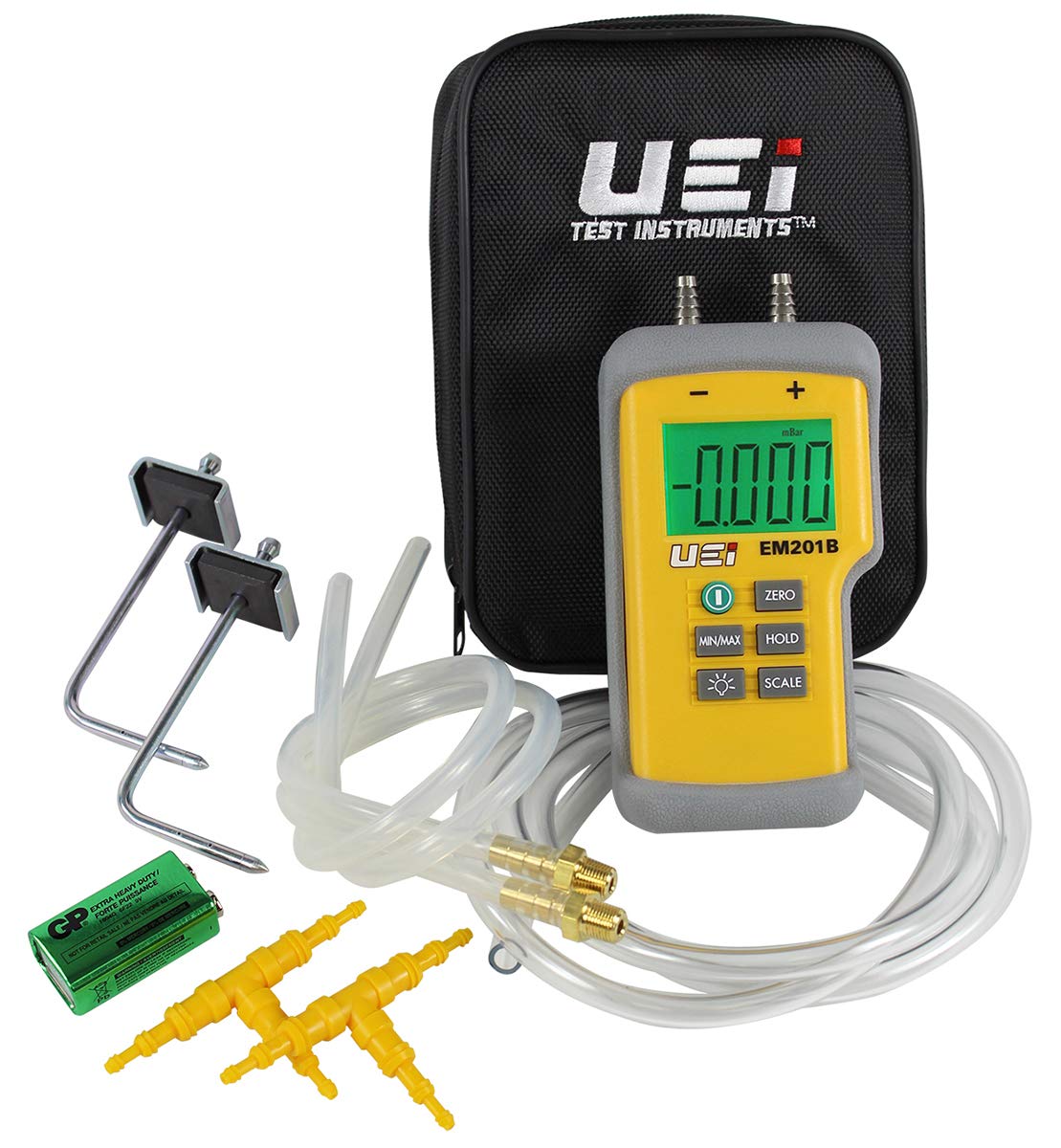
If you check duct static pressure on a regular basis, this kit gives you the meter and the probes you need in one package.
Pros
- Comes with magnetic probes, tees, and tubing, so nothing else to buy
- Readings settle fast and stay steady
- Backlit screen is easy to read in a dim mechanical room
Cons
- The housing feels thin and light
- Some buyers report missing pieces in the box
- Costs more than basic manometers
I pulled this out for a simple job first: measuring total external static on a gas furnace. The magnetic tips stuck to the sheet metal right away, which meant I did not need a third hand while I drilled and set my test ports.
Getting a reading took under a minute. I zeroed the EM201B, plugged in both tubes, and watched the number stop moving almost instantly. That quick response matters when you are checking pressure drop across a dirty filter and a customer is standing next to you.
The backlight surprised me in a good way. Most basements and attics I work in have bad lighting, and I could still read the display without pulling out a flashlight.
Where I have a complaint is the shell. The plastic is on the thin side, and it does not feel as tough as the price suggests. I would not toss it loose in a truck bin, but the zippered pouch handles that problem.
A few people have mentioned getting a kit without every fitting included. Mine arrived complete, but it is worth opening the pouch and counting parts before your first call.
Here is what comes in the case:
| Item | Quantity |
|---|---|
| EM201B dual input manometer | 1 |
| Magnetic static pressure probes (ASP1) | 2 |
| Stepped tee fittings (TF100) | 2 |
| Pressure tubes with brass fittings (BF100) | 2 |
| 60 in pressure tube | 1 |
| Zippered pouch and 9V battery | 1 each |
For gas supply pressure and draft checks, the differential mode does the job without extra setup. I used it on a water heater draft test and got numbers I trusted.
My take: this is a solid pick for a tech who wants accurate static pressure readings without piecing a kit together. Just treat the meter with a little care and it should hold up for years.
Buying Guide
Picking a static pressure meter comes down to matching the tool to the work you do most. Here is what I look at before I buy.
Measurement Range and Resolution
Most HVAC work falls between 0 and 10 inches of water column. If you test duct systems or filters, that range is plenty.
I also check resolution. A meter that reads to 0.001 in. w.c. is helpful for low-pressure readings, while 0.01 is fine for general checks.
Accuracy
Look for a stated accuracy figure, usually given as a percentage of the reading or of full scale. Tighter numbers cost more, so I decide based on whether I need documentation for reports.
Key Features to Compare
| Feature | Why It Matters |
|---|---|
| Single vs. dual port | Dual ports measure differential pressure across a filter or coil |
| Auto-zero | Keeps readings honest between tests |
| Backlit display | Useful in attics and crawl spaces |
| Data logging | Stores readings for later review |
| Unit options | Switching between in. w.c., Pa, and psi saves math |
| App connection | Lets me record and share results from a phone |
Build and Power
I want a housing that survives a drop and a magnet or hook so I can go hands-free. Battery type matters too, since replaceable AAs are easy to swap on a job site.
What Comes in the Box
Static pressure tips, hoses, and a carrying case are often included. If they are not, factor that added cost into your budget.
Frequently Asked Questions
Picking the right meter comes down to knowing which tool reads duct pressure, how accurate you need it to be, and what range covers a typical residential system. Below I answer the questions I hear most often from technicians and homeowners who are testing airflow problems.
What tool is used to measure static pressure in an HVAC system?
A manometer is the standard tool. It measures the pressure difference between two points, usually the supply side and return side of the air handler.
You connect the manometer to static pressure tips, which are small probes you insert into the duct through a drilled test port. The probe faces perpendicular to the airflow so it reads only static pressure, not velocity pressure.
Some technicians still use a Magnehelic gauge, which is a mechanical dial version. Both work, but the digital models handle the math for you.
What type of manometer is most accurate for checking static pressure?
A dual-port digital manometer with an accuracy rating of ±1% of reading or better is what I recommend. Look for a resolution of 0.001 in. w.c. so you can see small changes in the system.
Analog gauges like the Magnehelic are typically rated around ±2% of full scale. On a 0–1 in. w.c. gauge, that means the error stays at about 0.02 in. w.c. no matter where the needle sits, which matters more at low readings.
Digital models with a resolution of 0.01 in. w.c. are fine for basic checks. They just won’t show you the finer differences when you’re comparing filter or coil drops.
Can a digital manometer be used to measure static pressure?
Yes, and it’s the most common choice today. Most digital manometers made for HVAC work read static pressure, differential pressure, and often velocity when paired with a Pitot tube.
The main advantage is the dual-port setup. You connect one hose to the supply side and one to the return side, and the meter shows total external static pressure as a single number.
Many also log readings, hold a value on screen, and connect to a phone app. That helps when you’re testing alone and can’t watch the display and the probe at the same time.
How do you measure static pressure in residential ductwork?
I start by drilling two 3/8-inch test ports in the sheet metal. One goes on the return side before the air handler, and one goes on the supply side after the coil.
Both ports should be placed away from the blower and past any sharp turns. I stay at least 6 inches from the equipment cabinet when there’s room.
Then I insert the static pressure tips, hook the hoses to the manometer, and run the system on high fan speed. The reading I get is total external static pressure, which I compare to the number on the equipment nameplate.
If I want to find the restriction, I take separate readings across the filter, the coil, and each duct trunk. The component with the biggest drop is usually the problem.
What pressure range should an HVAC static pressure meter measure?
A range of 0 to 5 in. w.c. covers nearly all residential work. Most systems are designed for 0.5 in. w.c. total external static, and even a badly restricted system rarely climbs past 2 in. w.c.
If you also test gas pressure or work on commercial equipment, a meter rated to 15 or 60 in. w.c. gives you room to grow. Just make sure the resolution stays fine enough at the low end.
Accuracy at low pressures matters more than a high ceiling. A meter that reads to 200 in. w.c. but only resolves to 0.1 in. w.c. is close to useless for duct testing.
What is the difference between a gas pressure manometer and an HVAC static pressure meter?
They use the same basic technology, but they’re built for different ranges. Gas pressure manometers commonly read up to 60 in. w.c. or higher because gas line and manifold pressures run much higher than duct pressures.
A static pressure meter is tuned for the 0 to 5 in. w.c. range, where duct readings live. It offers finer resolution in that window.
Plenty of meters do both. If you buy one, check that it still resolves to 0.01 in. w.c. or better at low pressure, and confirm the material is rated for natural gas and propane before you connect it to a gas valve.