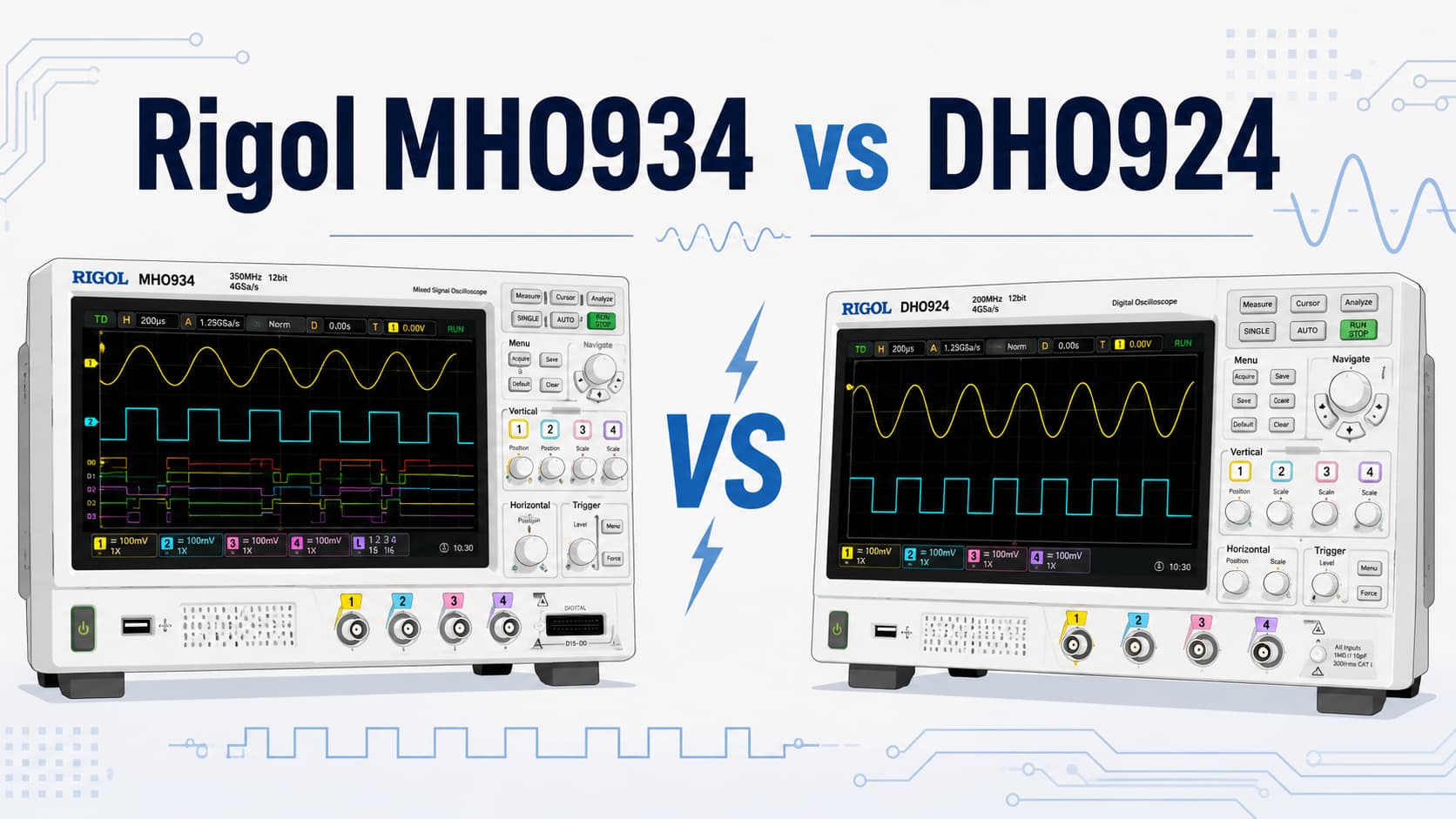
The Rigol MHO934 and DHO924 both carry the DNA of Rigol’s 12-bit oscilloscope platforms, but they’re built for different tiers of bench work. The DHO924 is the flagship of the mid-range DHO900 series, while the MHO934 sits a step above it as part of Rigol’s newer MHO900 series, with meaningfully higher bandwidth, sample rate, and memory, plus mixed-domain capability that goes beyond what a standard oscilloscope offers. This isn’t a close call in every category — it’s a comparison between a very capable mid-tier scope and a genuinely higher-tier instrument, and understanding exactly where that gap matters is the key to not overspending or underbuying.
Below, we break down what each platform actually delivers, where the MHO934’s added capability is worth paying for, and when the DHO924 is the smarter, more proportionate choice.
Short answer: if your bench work involves higher-speed digital signals, RF-adjacent measurements, or you want frequency-domain analysis alongside your waveform capture, the MHO934 is the better long-term instrument. If your work fits comfortably within 250 MHz and standard time-domain oscilloscope tasks, the DHO924 delivers excellent capability without paying for headroom you won’t use.
Quick Pick
Rigol DHO924 — 250 MHz bandwidth, 12-bit resolution, and deep memory on Rigol’s proven DHO900 platform for general R&D and embedded work.
Rigol MHO934 — 350 MHz bandwidth, 4 GSa/s sampling, deeper memory, and mixed-domain spectrum analysis for demanding, higher-speed applications.
Quick Verdict
The DHO924 and MHO934 are not competing head-to-head for the same buyer — they’re positioned for different levels of measurement demand. The DHO924 offers a genuinely capable 250 MHz, 12-bit platform that covers the majority of R&D, embedded, and educational bench work without excess cost. The MHO934 steps up meaningfully in bandwidth, sample rate, memory depth, and adds real-time spectrum analysis on top of standard oscilloscope acquisition, making it the more future-proof choice for engineers pushing into higher-speed digital design or RF-adjacent troubleshooting.
If you’re unsure which tier you need, think about your actual signal speeds and whether frequency-domain visibility would add value to your workflow. If the answer is “not really,” the DHO924 is very likely the smarter purchase.
Comparison Table
| Spec | Rigol MHO934 | Rigol DHO924 |
|---|---|---|
| Bandwidth | 350 MHz | 250 MHz |
| Channels | 4 analog (16 digital optional via PLA2216 probe) | 4 analog (16 digital optional via PLA2216 probe) |
| ADC Resolution | 12-bit | 12-bit |
| Max Real-Time Sample Rate | 4 GSa/s | 1.25 GSa/s |
| Memory Depth | 100 Mpts standard, up to 500 Mpts optional | Up to 50 Mpts |
| Waveform Capture Rate | Up to 1,000,000 wfms/s | Up to 1,000,000 wfms/s |
| Spectrum Analysis | Real-time mixed-domain spectrum analysis | Not included |
| Display | 7″ capacitive touchscreen, 1024×600, Flex Knob | 7″ capacitive touchscreen, 1024×600 |
| Serial Decode | I2C, SPI, RS232/UART, CAN, LIN | I2C, SPI, RS232/UART |
| Connectivity | USB Host/Device, LAN, HDMI, WiFi & Bluetooth, USB-C power | USB Host/Device, LAN, HDMI, USB-C power |
| Optional AFG | 2-channel, up to 100 MHz, with Bode plot | Not included on base model |
| Platform | MHO900 series | DHO900 series |
Rigol MHO934 Overview
The MHO934 sits at the top of what Rigol positions as a mixed-domain oscilloscope platform, combining traditional time-domain waveform acquisition with real-time spectrum analysis in a single instrument. For engineers working on higher-speed digital designs, RF-adjacent troubleshooting, or signal integrity verification, that dual capability means you’re not reaching for a separate spectrum analyzer to understand frequency-domain behavior alongside your waveform captures.
The core numbers back up the premium positioning: 350 MHz of analog bandwidth, a 4 GSa/s sample rate, and 100 Mpts of standard memory depth (expandable to 500 Mpts), all built on the same 12-bit ADC architecture that gives Rigol’s newer scopes their improved small-signal fidelity over older 8-bit designs. The MHO934 also includes WiFi and Bluetooth connectivity, a Flex Knob for faster navigation, and support for an optional 2-channel arbitrary function generator with Bode plot analysis, which is genuinely useful for characterizing switch-mode power supply loops and feedback networks.
Rigol MHO934
Best overall for higher-speed and mixed-domain work
The MHO934 makes sense if your work regularly pushes past 250 MHz, if you need deep memory for long capture windows, or if built-in spectrum analysis would genuinely save you from reaching for a second instrument. It’s the platform to choose if you want meaningful headroom for several years of evolving project requirements rather than buying to exactly match today’s needs.
It’s worth being direct here: the MHO934’s mixed-domain spectrum analysis and higher bandwidth are powerful, but they’re also the kind of capability that’s easy to pay for and rarely use if your actual bench work doesn’t call for it. Don’t upgrade to this tier just because the spec sheet looks more impressive.
Rigol MHO934 Pros
Pros
- 350 MHz bandwidth and 4 GSa/s sample rate for higher-speed signals
- 100 Mpts standard memory, expandable to 500 Mpts
- Real-time mixed-domain spectrum analysis built in
- WiFi and Bluetooth connectivity for flexible bench setups
- CAN/LIN decode included alongside standard serial protocols
Cons
- Priced at a meaningfully higher tier than the DHO924
- Digital channels and AFG require optional add-on hardware
- More capability than many general bench tasks will actually use
Rigol DHO924 Overview
The DHO924 is the top standard model in Rigol’s DHO900 series, offering 250 MHz of bandwidth, a 1.25 GSa/s sample rate, and up to 50 Mpts of memory depth on the same 12-bit ADC platform that underpins Rigol’s current oscilloscope generation. For most R&D, embedded systems, and educational bench work, 250 MHz is comfortably more bandwidth than the signals involved will ever approach, which makes the DHO924 a strong middle-ground choice between entry-level scopes and premium mixed-domain instruments like the MHO934.
Like other DHO-series scopes, the DHO924 uses a 7-inch capacitive touchscreen and USB-C power input, and supports an optional 16-channel digital probe for mixed-signal debugging. It doesn’t include a built-in arbitrary function generator on the base model — that capability is reserved for the DHO924S variant — nor does it offer the MHO934’s real-time spectrum analysis. For engineers who need straightforward, high-quality time-domain measurement without frequency-domain tools, that’s rarely a meaningful gap.
Rigol DHO924
Best value for standard R&D and embedded bench work
The DHO924 is the right call if your work sits comfortably within 250 MHz and you don’t need built-in spectrum analysis. You still get the same 12-bit resolution advantage as the MHO934, along with a proven, widely deployed DHO900 platform, at a noticeably lower price tier for the vast majority of general-purpose test and debug work.
Don’t assume you need the MHO934’s extra headroom by default. If your current and near-future projects don’t require spectrum analysis or bandwidth past 250 MHz, the DHO924 does the job just as well for meaningfully less investment.
Rigol DHO924 Pros
Pros
- 250 MHz bandwidth covers the majority of general R&D and embedded work
- Same 12-bit ADC resolution advantage as the MHO934
- Proven DHO900 platform with strong touchscreen usability
- Notably lower price tier than the MHO934
Cons
- No built-in spectrum analysis capability
- Lower sample rate and memory depth than the MHO934
- No built-in AFG on this base model (available on DHO924S)
- Less headroom for future higher-speed project requirements
Key Differences
The gap between these two scopes is substantial and spans several specs rather than a single differentiator. Bandwidth jumps from 250 MHz on the DHO924 to 350 MHz on the MHO934. Sample rate more than triples, from 1.25 GSa/s to 4 GSa/s. Standard memory depth doubles from 50 Mpts to 100 Mpts, with the MHO934 offering an upgrade path to 500 Mpts that the DHO924 doesn’t provide.
The most functionally distinct difference, though, is the MHO934’s mixed-domain architecture — its ability to perform real-time spectrum analysis alongside standard oscilloscope acquisition. That’s not a spec bump so much as an added measurement discipline, and it’s the single biggest reason an engineer might choose the MHO934 over a scope with otherwise comparable time-domain performance.
Real-World Performance Comparisons
For general digital and analog debugging under 250 MHz, both scopes will get the job done, and the DHO924’s 1.25 GSa/s sample rate is more than adequate for accurate waveform reconstruction within its bandwidth range. Where the MHO934 pulls ahead is in higher-speed digital work — fast serial buses, clock integrity checks near or above 250 MHz, and any measurement where its 4 GSa/s sample rate and deeper memory let you capture longer, more detailed records without sacrificing resolution.
The MHO934’s spectrum analysis capability changes the nature of certain troubleshooting tasks entirely. Instead of inferring frequency content from a time-domain waveform, you can view it directly, which is particularly useful for tracking down EMI issues, characterizing oscillator stability, or verifying that a switching power supply isn’t radiating unwanted harmonics. The DHO924 doesn’t offer an equivalent workflow, so for engineers who need that visibility regularly, the difference isn’t incremental — it’s a different measurement approach entirely.
Neither scope should be treated as a replacement for a dedicated spectrum analyzer in demanding RF work — the MHO934’s spectrum capability is a strong complement to time-domain analysis, not a substitute for purpose-built RF test equipment in every scenario.
Customer Opinions: Amazon and Reddit Summary
Feedback on the DHO924 generally centers on it being a well-rounded, capable scope for its price tier — reviewers frequently point to the 12-bit resolution and touchscreen interface as clear upgrades over older 8-bit scopes, with the 250 MHz bandwidth described as ample for typical R&D and embedded work. Some technical buyers note they would consider the DHO924S instead if they wanted the built-in AFG, but otherwise sentiment toward the DHO924 itself is consistently positive.
MHO934 buyers and forum discussion tend to emphasize the value of having spectrum analysis built into the same instrument as the oscilloscope, particularly among engineers who previously juggled a separate spectrum analyzer for frequency-domain checks. Some reviewers note the higher price point is a real consideration and recommend it specifically to buyers who know they’ll use the extra bandwidth, memory, and spectrum tools rather than as a default upgrade pick.
Which Should You Buy?
This decision comes down to how demanding your actual measurement needs are, not which scope has better specs on paper — the MHO934 is legitimately the more capable instrument, but that capability is only worth paying for if you’ll use it.
Buy the Rigol MHO934 if…
- Your work regularly involves signals approaching or exceeding 250 MHz
- You want built-in real-time spectrum analysis alongside oscilloscope acquisition
- You need deep memory for long, detailed capture windows
- You’re troubleshooting EMI, oscillator stability, or switching power supply harmonics
- You want a platform with headroom for several years of evolving project demands
Buy the Rigol DHO924 if…
- Your signals stay comfortably within 250 MHz
- You don’t need built-in frequency-domain analysis
- You want strong 12-bit performance without paying for premium-tier headroom
- You’re doing general R&D, embedded, or educational bench work
Final Verdict
The Rigol MHO934 and DHO924 aren’t really competing for the same buyer — they represent two different tiers of measurement capability. The DHO924 is an excellent, well-priced scope for the majority of general electronics work, offering the same 12-bit resolution advantage as its pricier sibling without the premium cost. The MHO934 justifies its higher price tier specifically for engineers who need higher bandwidth, deeper memory, and built-in spectrum analysis — capability that’s genuinely valuable if you’ll use it, and unnecessary expense if you won’t.
Ready to Decide?
Compare final pricing and availability below