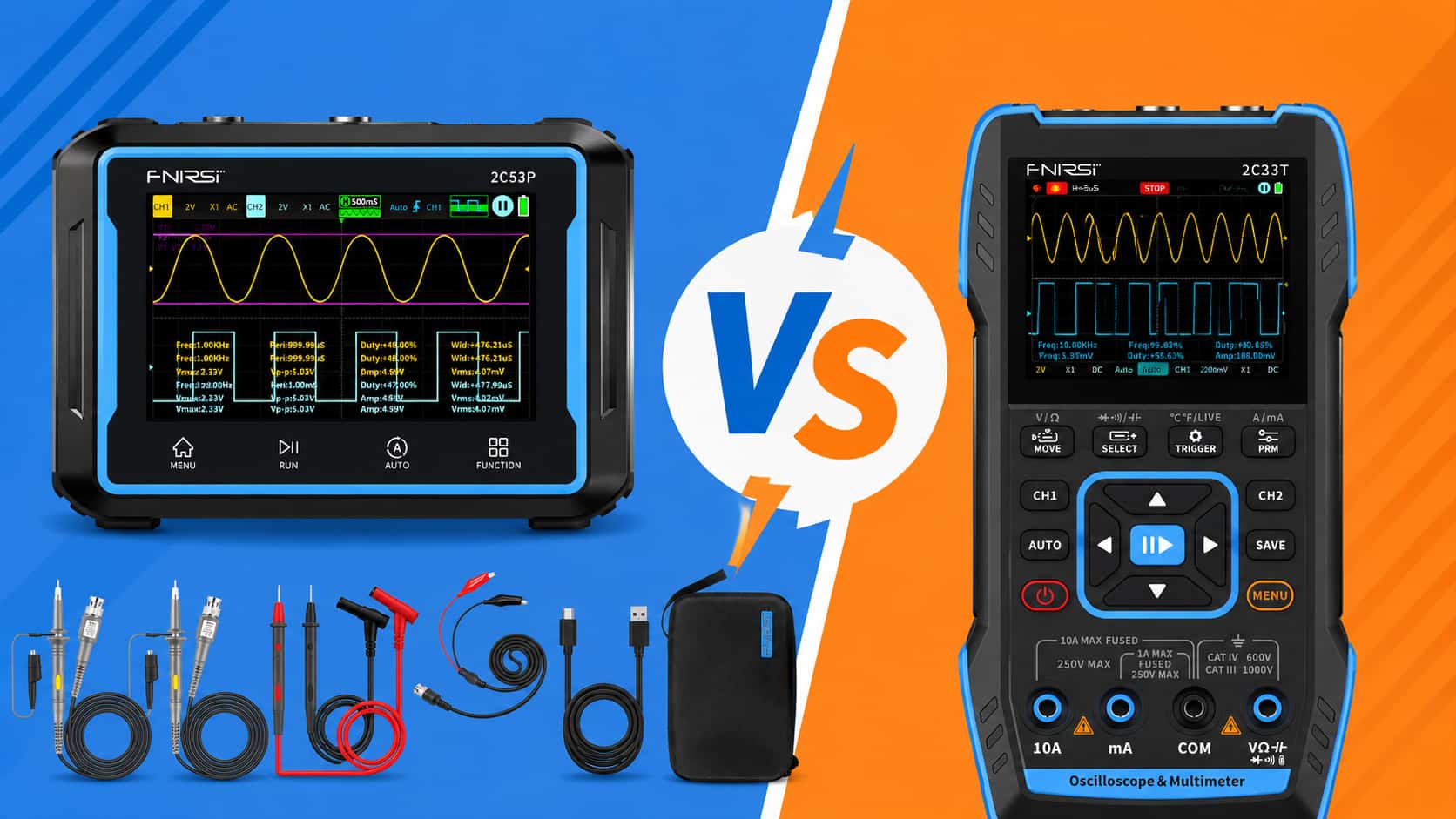
The FNIRSI 2C53P and 2C53T both pack an oscilloscope, a multimeter, and a signal generator into a single handheld unit, and both share the same core scope engine: 50MHz bandwidth and a 250MS/s sampling rate. Where they diverge is everything around that engine, the interface you touch, the signal generator behind it, and the battery that keeps it running on the bench or in the field.
That makes this comparison less about raw capability and more about which trade-offs fit your workflow. If you already own a FNIRSI unit or have handled similar 3-in-1 testers, you know the format: reasonable accuracy for the price, dual ceramic fuse protection, and enough function coverage to replace three separate boxes on a crowded bench. The question here is whether the 2C53P’s touchscreen and stronger signal generator are worth the premium over the 2C53T’s compact, button-driven design.
Best for most people: the FNIRSI 2C53T covers the same oscilloscope and multimeter specs at a lower price, and it’s the sensible default unless you specifically need the 2C53P’s larger touchscreen or its far more capable signal generator.
Same 50MHz scope core and true-RMS multimeter as the 2C53P, in a smaller button-operated body with noticeably longer battery life. Best for general bench and field diagnostics on a tighter budget.
Check 2C53T Price on AmazonSame scope core, plus a 4.3-inch touchscreen and a signal generator that reaches 10MHz instead of 50kHz. Best if you do signal injection work or prefer touch navigation.
View 2C53P on AmazonQuick Verdict
Both units will get you accurate waveform capture and solid multimeter readings for general electronics work, automotive diagnostics, and repair bench use. The 2C53T is the better default: it matches the 2C53P on bandwidth, sampling rate, and multimeter resolution, costs less, and runs longer on a charge thanks to its simpler screen. The 2C53P earns its higher price with a larger IPS touchscreen that makes waveform navigation and math functions faster to reach, and a signal generator that can output up to 10MHz instead of being capped at 50kHz, a meaningful difference if you test digital logic lines, clock signals, or filter circuits rather than just basic analog waveforms.
FNIRSI 2C53P vs 2C53T at a Glance
| Spec | FNIRSI 2C53P | FNIRSI 2C53T |
|---|---|---|
| Oscilloscope bandwidth | 50MHz | 50MHz |
| Sampling rate | 250MS/s | 250MS/s |
| Channels | 2 (dual channel) | 2 (dual channel) |
| Max input voltage | ±400V peak | ±400V peak |
| Display | 4.3″ IPS touchscreen, 480×272 | 2.8″ color LCD, 320×240, button navigation |
| Multimeter | 4.5-digit, 19999 counts, true RMS | 4.5-digit, 19999-20000 counts, true RMS |
| Signal generator waveforms | 12 types | 13 types |
| Signal generator max frequency | Up to 10MHz (sine) | Up to 50kHz |
| Battery | 4000mAh, roughly 4 hours standby | 3000mAh, roughly 6 hours standby |
| Physical size | Larger, tablet-style | Compact, pocketable |
| Price positioning | Premium | Budget-friendly |
| Best for | Touchscreen workflow, wider signal generation | Value, portability, longer battery life |
FNIRSI 2C53P Overview
The 2C53P takes the tablet form factor and puts a 4.3-inch IPS touchscreen front and center, which changes how you interact with the instrument compared to a traditional button-driven handheld. Menus, channel settings, and math functions are all a tap away rather than buried behind a sequence of physical button presses, which speeds up workflow once you’re used to the layout. The oscilloscope core is built around an FPGA-accelerated architecture paired with an ADC front end, giving it the 50MHz bandwidth and 250MS/s sampling rate that puts it well ahead of budget scopes in this price bracket. It supports waveform screenshot capture, X-Y mode for comparing two signals, and FFT analysis for spotting harmonic content, all useful when you’re chasing noise sources or verifying a filter’s frequency response.
Where the 2C53P separates itself most clearly is the built-in DDS signal generator, which can output 12 waveform types up to 10MHz on a sine wave. That range covers a lot more ground than basic audio-frequency testing: it’s enough to exercise digital logic thresholds, simulate clock or encoder pulses, and drive test signals into RF-adjacent filter and amplifier stages where a 50kHz ceiling would fall short. The multimeter section is a 4.5-digit, 19999-count true RMS meter covering the usual voltage, current, resistance, capacitance, diode, and continuity functions, backed by dual ceramic fuses for overload protection.
Best for engineers and technicians who want touchscreen navigation and a signal generator capable of reaching into the low-MHz range, not just basic audio-frequency waveforms.
Don’t overbuy here if all you need is basic voltage and continuity checks with occasional low-frequency waveform capture. The 2C53T covers that ground at a lower cost.
Skip it if: you need maximum battery runtime for long field sessions, or you’d rather have physical buttons than a touch interface for use with gloves or in bright outdoor light.
FNIRSI 2C53P Pros
- Large 4.3-inch IPS touchscreen makes navigating menus, math functions, and cursor measurements noticeably faster than button-only units
- Signal generator reaches up to 10MHz, wide enough for basic digital logic and clock-line testing, not just low-frequency analog signals
- Same 50MHz / 250MS/s scope core as higher-priced instruments in this class
- Supports X-Y mode and FFT analysis for phase comparison and harmonic content estimation
- 4.5-digit true RMS multimeter with a full function set: voltage, current, resistance, capacitance, diode, and continuity
FNIRSI 2C53P Cons
- Shorter battery life than the 2C53T, roughly 4 hours of standby versus 6
- Larger and heavier tablet-style body is less pocketable for field techs who move between job sites
- Touchscreen-only controls for some functions, like timebase selection, can feel less intuitive than a dedicated button or knob until you learn the layout
- Costs more than the 2C53T for the same core oscilloscope and multimeter performance
FNIRSI 2C53T Overview
The 2C53T takes a different approach to the same core hardware: instead of a touchscreen, it uses a compact 2.8-inch color LCD and a set of 15 physical push buttons, following the same body style as its predecessor, the 2C23T. That button-driven layout has real advantages in the field, it works reliably with gloves on, doesn’t suffer from false touches, and holds up better in bright daylight where touchscreens can wash out. Despite the smaller footprint, the oscilloscope section matches the 2C53P spec for spec: 50MHz bandwidth, 250MS/s sampling, dual channels, and ±400V peak input protection, along with support for math operations, cursor measurement, persistence mode, and X-Y mode.
The multimeter is just as capable, a 4.5-digit, true RMS meter rated at 19999 to 20000 counts depending on the listing, covering AC/DC voltage up to 750V and 999.9V respectively, current up to 9.999A, resistance to 19.99MΩ, and capacitance to 99.99mF. The trade-off shows up in the signal generator: it outputs 13 waveform types, one more than the 2C53P, but tops out at 50kHz rather than 10MHz. For most audio-frequency and general analog testing that’s plenty, but it rules out testing anything that needs a genuine MHz-range stimulus signal. In exchange, the smaller screen draws less power, and FNIRSI rates the 3000mAh battery for around 6 hours of standby time, noticeably longer than the touchscreen model.
Best for most buyers who want the same 50MHz scope and true RMS multimeter performance as the 2C53P without paying for a touchscreen, in a smaller, longer-lasting package.
Don’t overbuy into the 2C53P if your signal generator use is limited to basic audio-range or low-frequency test signals. The 2C53T’s 50kHz ceiling will cover the vast majority of general electronics and automotive diagnostic work.
Skip it if: you regularly need to generate or inject signals above 50kHz, or you strongly prefer touchscreen navigation over physical buttons.
FNIRSI 2C53T Pros
- Matches the 2C53P’s 50MHz bandwidth and 250MS/s sampling rate at a lower price
- Compact, pocketable body suited to field service and bench work with limited space
- Longer battery life, roughly 6 hours of standby versus the 2C53P’s 4
- Physical button controls hold up better with gloves and in bright outdoor lighting
- Same 4.5-digit true RMS multimeter coverage as the 2C53P, with a wide measurement range
FNIRSI 2C53T Cons
- Signal generator tops out at 50kHz, well short of the 2C53P’s 10MHz ceiling
- Smaller 2.8-inch screen is more cramped for detailed waveform inspection or reading multiple on-screen measurements at once
- Button-based menu navigation has a steeper initial learning curve than tapping directly on a touchscreen
Key Differences Between the 2C53P and 2C53T
Strip away the shared oscilloscope core and multimeter section, and the real differences come down to three things: interface, signal generator range, and power management.
- Interface: the 2C53P’s 4.3-inch touchscreen versus the 2C53T’s 2.8-inch screen and 15-button layout. This is as much a workflow preference as a capability gap.
- Signal generator ceiling: 10MHz on the 2C53P versus 50kHz on the 2C53T is the single biggest functional gap between the two, and the one most likely to actually change which model fits your work.
- Battery efficiency: the smaller screen on the 2C53T draws less power, stretching standby time even with a smaller-capacity battery than the 2C53P.
Real-World Performance Comparison
On the bench, the shared 50MHz / 250MS/s scope core means both units capture the same waveform detail on general analog and digital signals, switch-mode power supply ripple, PWM control lines, and audio circuits will look identical on either screen, aside from the obvious size difference. Where the gap opens up is in tasks that lean on the signal generator: simulating an encoder pulse train, exercising a digital input threshold, or sweeping a filter’s passband all sit comfortably within the 2C53P’s 10MHz range but push right up against, or past, the 2C53T’s 50kHz limit. For a technician doing pure diagnostic capture work rather than signal injection, that gap rarely matters. For anyone doing bench-level filter or logic-level testing, it’s the deciding factor.
Battery behavior also plays out differently depending on use case. Field techs doing spot checks across a work shift tend to notice the 2C53T’s longer standby time more than lab-bench users who keep their unit on charge or plugged in most of the day, where the 2C53P’s shorter runtime is rarely a practical issue.
What Users Are Saying: Amazon and Reddit Feedback
Feedback on the 2C53P is generally positive around build quality and how much functionality it packs into one device, with reviewers describing the readings as stable and consistent across all three functions. The most common complaint centers on the touchscreen-only timebase control, which some users find takes a bit of practice to get comfortable with, since it isn’t accessible through any other menu path. Once past that learning curve, most reviewers report being satisfied enough to consider more FNIRSI gear.
The 2C53T’s feedback leans heavily on value and ease of use, with buyers frequently comparing it favorably against its price point and noting it replaced multiple standalone instruments on their bench. Discussion in hobbyist and repair forums tends to echo the spec sheet: it’s viewed as a solid step up from the earlier 2C23T thanks to the added math operations, cursor measurement, and X-Y mode, with the reduced signal generator frequency range being the main trade-off users mention when comparing it to pricier siblings in the lineup.
Which FNIRSI Model Should You Buy?
The honest answer for most buyers is the 2C53T. It delivers the same core scope and multimeter performance for less money, in a smaller package with better battery life. The 2C53P earns its place for a narrower group of buyers who specifically need what its extra cost buys: a larger touchscreen and a signal generator with real reach into the MHz range.
Buy the FNIRSI 2C53P if…
- You need a signal generator that can output well above audio frequencies, into the low-MHz range
- You prefer touchscreen navigation for math functions, cursors, and waveform review
- You do enough bench work that screen size matters more than pocketability
Buy the FNIRSI 2C53T if…
- You want the same 50MHz oscilloscope and true RMS multimeter performance at a lower cost
- You need a compact, pocketable unit for field service or a crowded bench
- Your signal generator needs are limited to basic audio-range or low-frequency test signals
- Longer battery life matters more to your workflow than a larger display
For most technicians, hobbyists, and repair benches, the FNIRSI 2C53T is the smarter buy: identical scope and multimeter specs to the 2C53P, in a smaller, longer-lasting, lower-priced package. Step up to the FNIRSI 2C53P only if you specifically need its touchscreen workflow or its far wider signal generator range.
Final Verdict
Both instruments share the same capable 50MHz, 250MS/s oscilloscope engine and a genuinely useful 4.5-digit true RMS multimeter, so neither is a wrong choice for general electronics and automotive diagnostic work. The decision comes down to whether the 2C53P’s touchscreen and 10MHz signal generator are worth the added cost and reduced battery life for your specific use case. If you’re not sure, the 2C53T’s lower price and matching core specs make it the safer default, with the option to step up later if you find yourself needing the 2C53P’s extra signal generator range.