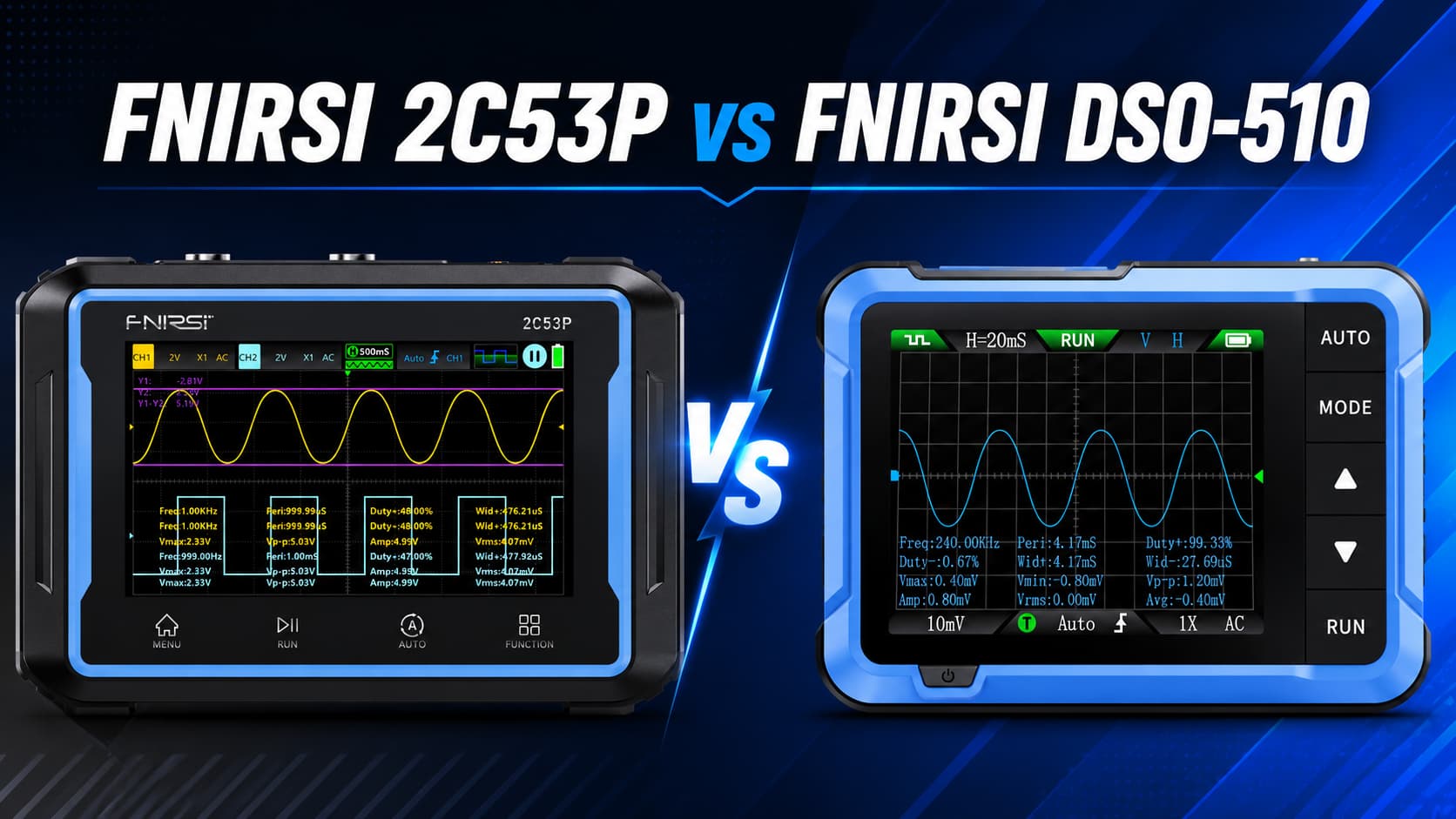
The FNIRSI 2C53P and the FNIRSI DSO-510 both wear the FNIRSI name and both combine an oscilloscope with a signal generator, but they’re built for genuinely different jobs. The 2C53P is a dual-channel, 50MHz instrument with a full multimeter built in. The DSO-510 is a single-channel, 10MHz pocket scope with no multimeter at all, designed for quick signal presence checks rather than detailed measurement work.
That gap matters more here than in most FNIRSI comparisons, because these two aren’t really competing for the same buyer. Before you pick based on price alone, it’s worth understanding exactly what capability you’d be giving up by going with the cheaper option, and whether that trade-off actually fits how you work.
Best for most people: the FNIRSI 2C53P is the smarter buy for anyone doing real diagnostic or repair work, since it adds a second channel, five times the bandwidth, and a built-in multimeter. The DSO-510 only makes sense as a deliberate downgrade for a specific, narrow use case.
Dual-channel 50MHz scope, 250MS/s sampling, and a full 4.5-digit true RMS multimeter in one touchscreen unit. The right choice for anyone doing actual diagnostic or repair work.
View 2C53P on AmazonA pocket-sized single-channel scope and signal generator for basic go/no-go signal checks. Best if you already own a multimeter and just need a tiny, inexpensive waveform viewer.
Check DSO-510 Price on AmazonQuick Verdict
If you’re choosing one instrument to handle general electronics diagnostics, repair work, or bench testing, the 2C53P is the clear pick. It covers everything the DSO-510 does and adds a second channel, a much wider bandwidth and sampling rate, and a genuinely useful multimeter section that the DSO-510 simply doesn’t have. The DSO-510 earns its place only as a deliberate compromise: a very small, very inexpensive tool for spotting whether a signal exists and roughly what shape it takes, not for detailed measurement or side-by-side channel comparison.
FNIRSI 2C53P vs DSO-510 at a Glance
| Spec | FNIRSI 2C53P | FNIRSI DSO-510 |
|---|---|---|
| Oscilloscope bandwidth | 50MHz | 10MHz |
| Sampling rate | 250MS/s | 48MS/s |
| Channels | 2 (dual channel) | 1 (single channel) |
| Max input voltage | ±400V peak | ±400V peak |
| Multimeter | 4.5-digit, 19999 counts, true RMS | Not included |
| Display | 4.3″ IPS touchscreen, 480×272 | 2.8″ LCD, 320×240, button navigation |
| Signal generator waveforms | 12 types | 13 types |
| Signal generator max frequency | Up to 10MHz (sine) | Up to 50kHz |
| Battery | 4000mAh, roughly 4 hours standby | 1000mAh, roughly 4 hours use |
| Physical size | Larger, tablet-style | Very compact, pocket-sized |
| Price positioning | Mid-range | Entry-level / budget |
| Best for | General diagnostic and repair work | Basic signal presence checks on a tight budget |
FNIRSI 2C53P Overview
The 2C53P is built around a dual-channel scope engine with 50MHz bandwidth and a 250MS/s sampling rate, controlled through a 4.3-inch IPS touchscreen. Two channels matter more than most spec sheets let on: comparing a control signal against its output, checking phase relationships with X-Y mode, or verifying that two supply rails rise together all require a second input, something a single-channel scope simply can’t do regardless of its bandwidth. The FPGA-accelerated architecture also supports FFT analysis for harmonic content and persistence mode for catching intermittent glitches.
Beyond the scope function, the 2C53P includes a 4.5-digit, 19999-count true RMS multimeter covering voltage, current, resistance, capacitance, diode, and continuity testing, and a signal generator capable of reaching 10MHz, well beyond basic audio-frequency work. For a technician who wants one instrument to replace a scope, a meter, and a basic generator, this is the more complete tool of the two by a wide margin.
Best for technicians and engineers who need real diagnostic capability: two channels, high bandwidth, and a built-in multimeter, in a single handheld unit.
Don’t overbuy here if you already own a good multimeter and only need an occasional single-channel signal check. That specific, narrow need is exactly what the DSO-510 is built for, at a fraction of the cost.
Skip it if: your only need is confirming a signal is present and roughly what shape it takes, with no interest in a multimeter or a second channel.
FNIRSI 2C53P Pros
- Dual-channel input allows direct comparison between two signals, something no single-channel scope can do
- 50MHz bandwidth and 250MS/s sampling rate capture far more detail than entry-level pocket scopes
- Built-in 4.5-digit true RMS multimeter replaces a separate handheld meter
- Signal generator reaches 10MHz, useful well beyond basic audio-frequency testing
- Larger touchscreen makes cursor measurements, math functions, and menu navigation faster
FNIRSI 2C53P Cons
- Costs meaningfully more than the DSO-510 for buyers who don’t need the extra capability
- Larger, heavier body compared to the DSO-510’s pocket-sized form factor
- Overkill for someone who only needs an occasional single-channel signal check and already owns a multimeter
FNIRSI DSO-510 Overview
The DSO-510 is a much smaller, much simpler instrument, an upgraded version of FNIRSI’s earlier DSO152, built around a single-channel 10MHz scope with a 48MS/s sampling rate and a 2.8-inch LCD. It’s genuinely pocketable, small enough to keep in a toolbox pocket rather than a bag, and it’s operated entirely through physical buttons and a control wheel rather than a touchscreen. It supports infinite persistence for catching intermittent signal behavior and basic waveform saving and export, but with one channel and a lower bandwidth ceiling, it’s best suited to confirming that a signal exists and getting a rough read on its shape, rather than precise measurement work.
There’s no multimeter function on the DSO-510 at all, it’s strictly a 2-in-1 device pairing the oscilloscope with a DDS signal generator that outputs 13 waveform types up to 50kHz. That makes it a fundamentally different tool than the 2C53P rather than a stripped-down version of it. For someone who already owns a separate multimeter and just wants an inexpensive way to glance at a waveform in the field, that narrower focus is a feature, not a limitation.
Best for buyers who want the smallest, least expensive way to check whether a signal is present and roughly what it looks like, and who already have a separate multimeter for everything else.
Don’t overbuy into the 2C53P if your use case genuinely is limited to occasional single-channel spot checks. Paying for a second channel, a wider bandwidth, and a multimeter you won’t use doesn’t make sense if this is truly all you need.
Skip it if: you need to compare two signals at once, require a built-in multimeter, or work with signals above 10MHz.
FNIRSI DSO-510 Pros
- Very compact and lightweight, easily pocketable for field use
- Significantly lower cost than the 2C53P
- Simple button-driven interface with no learning curve for basic operation
- Includes a signal generator alongside the scope function in a genuinely tiny footprint
FNIRSI DSO-510 Cons
- Single channel only, no way to compare two signals side by side
- 10MHz bandwidth and 48MS/s sampling rate are well below the 2C53P’s specs, and below what’s needed for detailed measurement work
- No multimeter function of any kind
- Smaller 2.8-inch screen and button navigation are less convenient for extended use than a touchscreen
Key Differences Between the 2C53P and DSO-510
Unlike a typical same-tier FNIRSI comparison, this pairing isn’t about interface preference, it’s about capability tier.
- Channel count: two channels on the 2C53P versus one on the DSO-510, the single biggest functional gap between the two.
- Bandwidth and sampling rate: the 2C53P’s 50MHz and 250MS/s give it roughly five times the bandwidth and sampling rate of the DSO-510’s 10MHz and 48MS/s.
- Multimeter: the 2C53P includes one, the DSO-510 doesn’t include one at all.
- Size and price: the DSO-510 is smaller and considerably cheaper, reflecting its narrower feature set rather than a different design philosophy.
Real-World Performance Comparison
For basic tasks like confirming a microcontroller’s clock line is toggling or checking that a power supply is producing a clean DC rail, both scopes will get the job done, the DSO-510’s 10MHz bandwidth is plenty for low-frequency digital and power signals. Where the gap becomes obvious is anything involving two related signals: checking input versus output on a filter stage, comparing a PWM control signal against its resulting output ripple, or verifying timing between two digital lines. The DSO-510’s single channel makes all of that impossible without swapping probes back and forth, while the 2C53P captures both simultaneously. The bandwidth gap also shows up with faster digital signals and switch-mode power supply ringing, where the DSO-510’s lower sampling rate can miss fast transients that the 2C53P captures cleanly.
The multimeter gap is just as practical day to day. Anyone using the 2C53P has voltage, resistance, and continuity testing built in without reaching for a second tool. DSO-510 owners need a separate multimeter for anything beyond waveform viewing, which is a reasonable trade-off only if they already have one.
What Users Are Saying: Amazon and Reddit Feedback
Feedback on the 2C53P consistently points to its all-in-one convenience, users appreciate having a capable scope, meter, and generator in one device rather than juggling three separate tools, with the touchscreen’s timebase control being the one recurring point of adjustment for new users. Reviewers generally describe the readings as stable and consistent across all three functions.
Discussion around the DSO-510 and its predecessor, the DSO152, frames it clearly as a budget, entry-level tool. Buyers tend to describe it as adequate for basic hobbyist checks and fieldwork where precision isn’t critical, with independent reviewers noting explicitly that it isn’t the right choice if you need to see exact signal details or make accurate measurements. That framing lines up with the spec sheet, it’s built for quick go/no-go checks, not detailed analysis.
Which FNIRSI Model Should You Buy?
For nearly everyone doing genuine diagnostic, repair, or development work, the 2C53P is the right call, it isn’t just a nicer version of the DSO-510, it’s a fundamentally more capable instrument. The DSO-510 only makes sense for a specific, narrower need: an extremely low-cost, pocket-sized tool for confirming a signal exists when you don’t need precision and already have other test equipment to fill the gaps.
Buy the FNIRSI 2C53P if…
- You need to compare two signals at the same time
- You want a built-in multimeter instead of carrying a separate one
- You work with signals faster than 10MHz or need higher-fidelity waveform capture
- You want one instrument to handle the majority of your bench and field diagnostic work
Buy the FNIRSI DSO-510 if…
- You already own a multimeter and don’t need one built in
- Your checks are limited to a single signal at a time, at frequencies under 10MHz
- Pocket size and the lowest possible price matter more than capability
- You want a basic signal generator paired with a minimal scope for simple projects or teaching
For most technicians and engineers, the FNIRSI 2C53P is the smarter overall buy: two channels, five times the bandwidth and sampling rate, and a full multimeter in one unit. Choose the FNIRSI DSO-510 only if your needs are genuinely limited to basic single-channel signal checks on the tightest possible budget.
Final Verdict
This isn’t a close call between two similarly capable instruments, it’s a decision about how much capability you actually need. The 2C53P covers dual-channel diagnostic work, higher-bandwidth signal capture, and multimeter functions the DSO-510 doesn’t attempt to offer. The DSO-510 fills a real but narrow niche: an inexpensive, pocketable way to confirm a signal is present when that’s genuinely all you need. Match the tool to the work, not just the price tag, and the right choice becomes clear.