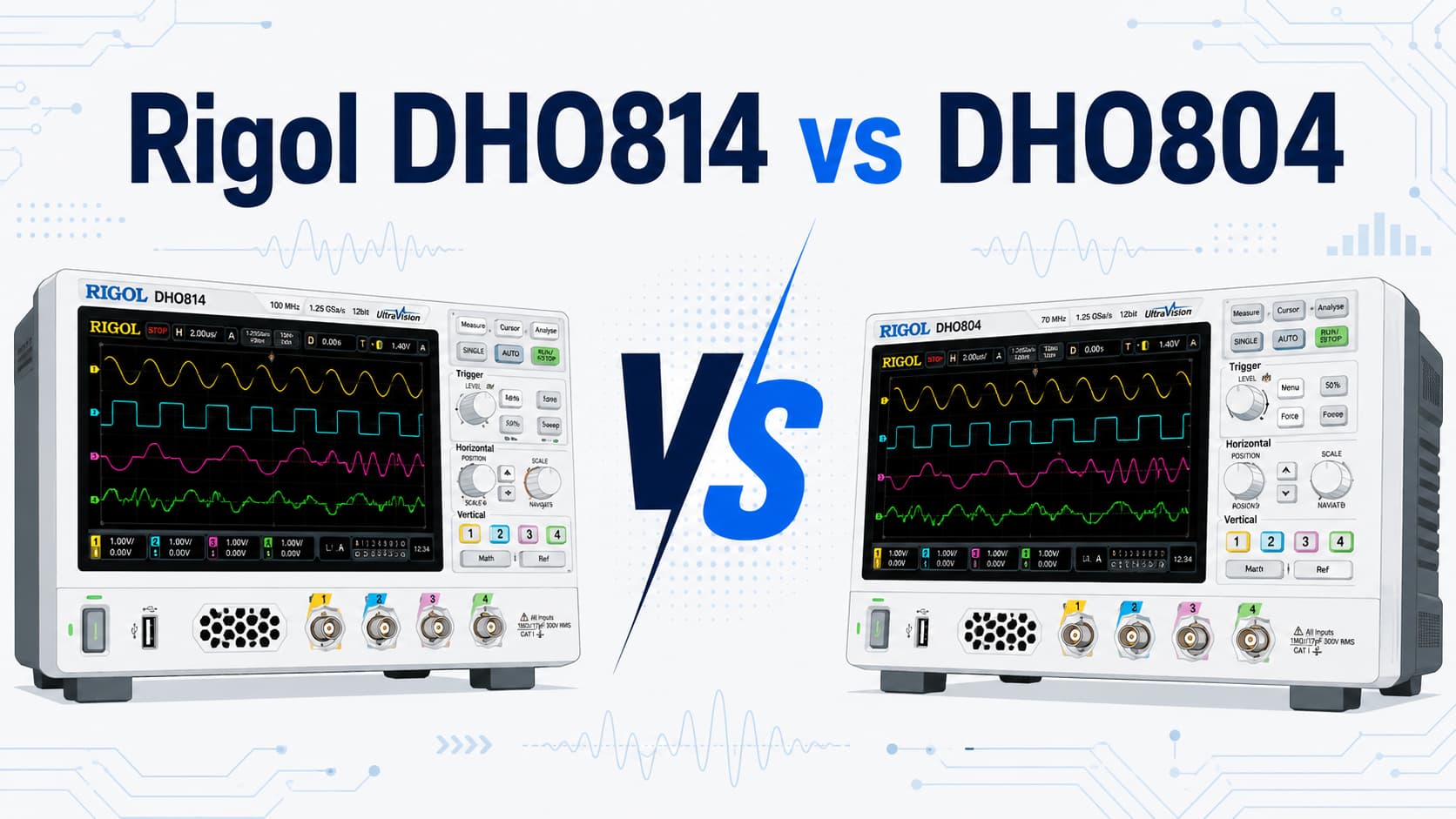
The Rigol DHO804 and DHO814 belong to the same DHO800 platform, share the same touchscreen interface, the same 12-bit ADC, and the same 25 Mpt memory architecture. This isn’t a comparison between two different design philosophies — it’s a comparison between two bandwidth tiers of the exact same instrument. That makes the buying decision simpler than most scope comparisons, but it also means the one spec that actually differs deserves a closer look before you decide which one is worth the price step.
Below we break down what the bandwidth difference means in practice, when it actually matters for your work, and when paying for the extra headroom is money well spent versus money you don’t need to spend.
Short answer: if your work stays under roughly 30-40 MHz in practice — general digital logic, embedded debugging, audio, and most analog troubleshooting — the DHO804 gives you the same platform for less. If you regularly work with faster digital buses, RF-adjacent signals, or want more headroom against probe and circuit loading effects, the DHO814 is the safer long-term buy.
Quick Pick
Rigol DHO804 — same 12-bit platform and touchscreen workflow at 70 MHz bandwidth, ideal if your signals don’t push past that range.
Rigol DHO814 — identical platform with 100 MHz bandwidth for more measurement headroom on faster signals.
Quick Verdict
Because the DHO804 and DHO814 are built on the same hardware platform, this comparison boils down almost entirely to one question: do you need more than 70 MHz of bandwidth? Everything else — the 12-bit ADC, 1.25 GSa/s sample rate, 25 Mpt memory depth, capture rate, touchscreen, and connectivity — is shared between the two models.
If you’re not sure whether your work needs the extra 30 MHz, it usually doesn’t. Most general electronics, embedded, and analog debugging happens well under 70 MHz. The DHO814 earns its higher price tag specifically when you’re working closer to the edge of the DHO804’s range and want margin to spare.
Comparison Table
| Spec | Rigol DHO804 | Rigol DHO814 |
|---|---|---|
| Bandwidth | 70 MHz | 100 MHz |
| Channels | 4 analog | 4 analog |
| ADC Resolution | 12-bit | 12-bit |
| Max Real-Time Sample Rate | 1.25 GSa/s | 1.25 GSa/s |
| Memory Depth | Up to 25 Mpts | Up to 25 Mpts |
| Waveform Capture Rate | Up to 1,000,000 wfms/s | Up to 1,000,000 wfms/s |
| Display | 7″ capacitive touchscreen, 1024×600 | 7″ capacitive touchscreen, 1024×600 |
| Serial Decode | I2C, SPI, RS232/UART | I2C, SPI, RS232/UART |
| Connectivity | USB Host/Device, LAN, HDMI, USB-C power | USB Host/Device, LAN, HDMI, USB-C power |
| Platform | DHO800 series | DHO800 series |
Rigol DHO804 Overview
The DHO804 is the 70 MHz entry point into Rigol’s current-generation DHO800 platform, and it carries every meaningful architectural advantage of that platform: a 12-bit ADC for cleaner small-signal capture, a 1.25 GSa/s sample rate that gives you roughly 9x oversampling within its bandwidth, and 25 Mpts of memory depth for extended capture windows. For the overwhelming majority of embedded debugging, digital logic verification, audio work, and general analog troubleshooting, 70 MHz of bandwidth is more than sufficient headroom.
Where the DHO804 asks you to think twice is at the edges of its range — fast digital buses running near or above its bandwidth ceiling, or signals with fast edges where you want more margin before rise-time errors start creeping into your measurements. For most technicians and engineers working on mainstream digital and analog circuits, though, this is rarely a limiting factor in daily use.
Rigol DHO804
Best value for buyers who don’t need bandwidth headroom past 70 MHz
The DHO804 makes sense if your day-to-day work sits comfortably under its 70 MHz ceiling and you’d rather put your budget toward probes, a second instrument, or simply not overspend on capability you won’t use. You get the full DHO800 platform experience — the touchscreen, the 12-bit resolution, the deep memory — without paying for bandwidth you don’t need.
It’s worth being honest here: bandwidth headroom is one of the easiest specs to overbuy on. If you’re not currently working with signals anywhere near 70 MHz, paying more for the DHO814’s extra 30 MHz mostly buys peace of mind rather than a capability you’ll use regularly.
Rigol DHO804 Pros
Pros
- Full DHO800 platform features at the lower bandwidth tier
- Better value if your signals stay well under 70 MHz
- Same 12-bit ADC, memory depth, and touchscreen as the DHO814
- Sufficient headroom for the vast majority of embedded and analog work
Cons
- Less margin if your signals creep toward the bandwidth ceiling
- Not ideal if you anticipate future projects needing more headroom
Rigol DHO814 Overview
The DHO814 is the 100 MHz version of the exact same platform, and the extra bandwidth is the entire value proposition. Everything else — the 12-bit ADC, 1.25 GSa/s sample rate, 25 Mpt memory, capture rate, and touchscreen interface — carries over unchanged from the DHO804. What you’re paying for is additional frequency headroom and the reduced risk of measurement error on faster signals.
That extra bandwidth matters most when you’re working with faster digital interfaces, higher-speed clock and data lines, or any signal where edge fidelity is important and you don’t want the scope’s own bandwidth limitation contributing to rounded edges or attenuated harmonics in your measurement. It’s also a sensible choice if you expect your projects to grow in complexity or speed over time and would rather not need to upgrade scopes later.
Rigol DHO814
Best overall if you want bandwidth headroom built in
The DHO814 is the better long-term buy if you work with faster signals regularly, or if you’d simply rather have bandwidth margin than not. Because it shares the same platform as the DHO804, you’re not compromising on interface, resolution, or memory to get there — you’re purely paying for additional frequency range.
Don’t feel like the DHO814 is the “correct” choice by default just because it’s the higher-spec option. If your test bench work has never come close to needing more than 70 MHz, the DHO804 will do the identical job for a lower price.
Rigol DHO814 Pros
Pros
- 100 MHz bandwidth gives more margin on faster signals
- Identical platform advantages as the DHO804 (ADC, memory, interface)
- Better long-term fit if project requirements grow over time
- Reduces risk of bandwidth-related measurement error on faster edges
Cons
- Priced higher for a capability many buyers won’t fully use
- No functional advantage over the DHO804 for lower-frequency work
Key Differences
There is exactly one meaningful difference between these two scopes: bandwidth. The DHO804 tops out at 70 MHz, while the DHO814 extends to 100 MHz. Every other spec — the 12-bit ADC, 1.25 GSa/s sample rate, 25 Mpt memory depth, million-waveform-per-second capture rate, and the 7-inch touchscreen — is identical across both models.
This makes the buying decision unusually clean compared to most scope comparisons. You’re not weighing interface preferences, resolution tradeoffs, or ecosystem maturity — you’re deciding whether an extra 30 MHz of bandwidth is worth the price difference for your specific work.
Real-World Performance Comparisons
For most bench tasks — reading digital bus traffic, verifying power rail behavior, general analog signal tracing — both scopes will produce visually identical results, because the signals involved rarely approach either scope’s bandwidth ceiling. The difference becomes visible specifically when you’re measuring signals with fast rise times or frequency content approaching 70 MHz, where the DHO804 will begin to show some rounding of edges and attenuation of higher harmonics that the DHO814 handles with more accuracy.
If you’re doing serial protocol debugging at higher clock speeds, checking clock signal integrity, or working anywhere near the upper end of general digital electronics frequencies, the DHO814’s extra headroom translates into measurements you can trust with less second-guessing. For lower-speed work, the two scopes are functionally interchangeable.
Because both scopes share the same memory depth and capture rate, neither has an advantage when it comes to catching intermittent glitches or capturing long acquisition windows — the entire practical distinction is bandwidth-related.
Customer Opinions: Amazon and Reddit Summary
Feedback on both scopes tends to track closely with expectations for the DHO800 platform as a whole — buyers consistently highlight the touchscreen interface and 12-bit resolution as a meaningful step up from older 8-bit scopes at a similar price point. Reviewers of the DHO804 generally report satisfaction for general-purpose use, with occasional comments noting they’d consider the DHO814 if they anticipated working with faster signals down the line.
DHO814 buyers and forum commenters frequently mention the extra bandwidth as a deliberate purchase decision — people who chose it typically did so because they knew in advance they needed the headroom, rather than discovering a need for it after the fact. Across both models, sentiment around the shared platform features (touchscreen responsiveness, memory depth, build quality) is consistently positive, with the model choice itself usually framed as a straightforward bandwidth decision rather than a quality tradeoff.
Which Should You Buy?
Because these two scopes share virtually everything except bandwidth, this is one of the more straightforward buying decisions in the oscilloscope category. The question isn’t which platform is better — it’s whether your actual signal frequencies justify paying for the extra headroom.
Buy the Rigol DHO804 if…
- Your signals typically stay well under 70 MHz
- You want the full DHO800 platform experience at a lower price
- You’re doing general embedded, digital logic, or analog debugging work
- You’d rather not pay for bandwidth headroom you won’t use
Buy the Rigol DHO814 if…
- You regularly work with faster digital buses or clock signals
- You want extra bandwidth margin to avoid edge-rounding on fast signals
- You expect future projects to push closer to or past 70 MHz
- You’d rather buy the headroom once than upgrade scopes later
Final Verdict
The Rigol DHO804 and DHO814 are the same excellent DHO800 platform at two different bandwidth tiers, which makes this an easier decision than most head-to-head scope comparisons. If your work doesn’t push past 70 MHz — and for most technicians and engineers, it won’t — the DHO804 delivers identical resolution, memory, and interface for less. If you know your signals run faster, or you simply want the extra margin, the DHO814 is worth the price step precisely because you’re not giving up anything else to get it.
Ready to Decide?
Compare final pricing and availability below