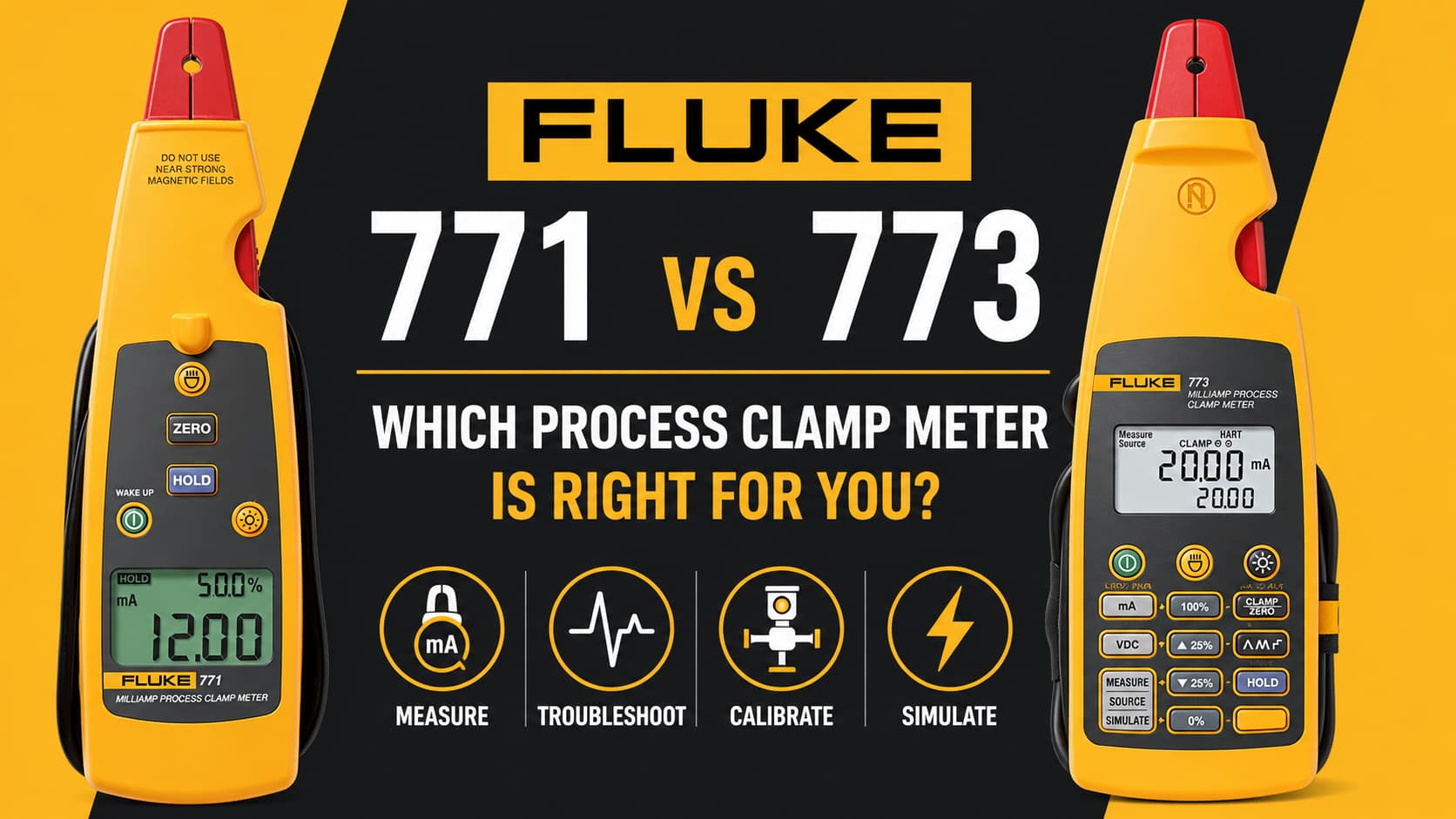
If you troubleshoot 4–20 mA process control loops, both the Fluke 771 and Fluke 773 can save significant time by allowing you to measure loop current without breaking the circuit. Both are purpose-built for instrumentation technicians, maintenance engineers, and process control professionals.
⚡ Quick Pick: Fluke 771 vs Fluke 773
Choose the Fluke 771 if you mainly need to measure live 4-20 mA process loops without breaking the circuit.
Choose the Fluke 773 if you want a more complete process tool that can measure, source, simulate, power loops, and handle voltage signals.
💰 Best for Simple Loop Measurement: Fluke 771
The Fluke 771 is the better choice for routine maintenance checks. It is focused, easy to use, and ideal for technicians who simply need fast non-intrusive 4-20 mA measurements in live control loops.
🏆 Best Full Process Tool: Fluke 773
The Fluke 773 adds major calibration and troubleshooting capabilities, including current sourcing, transmitter simulation, 24 V loop power, DC voltage measurement, and 0-10 V sourcing. It is the better long-term pick for instrumentation, PLC, HVAC, and commissioning work.
Bottom line: Buy the Fluke 771 if you only need quick live-loop current measurements. Buy the Fluke 773 if you want a full-featured process clamp meter that can measure, source, simulate, and troubleshoot both current and voltage control signals.
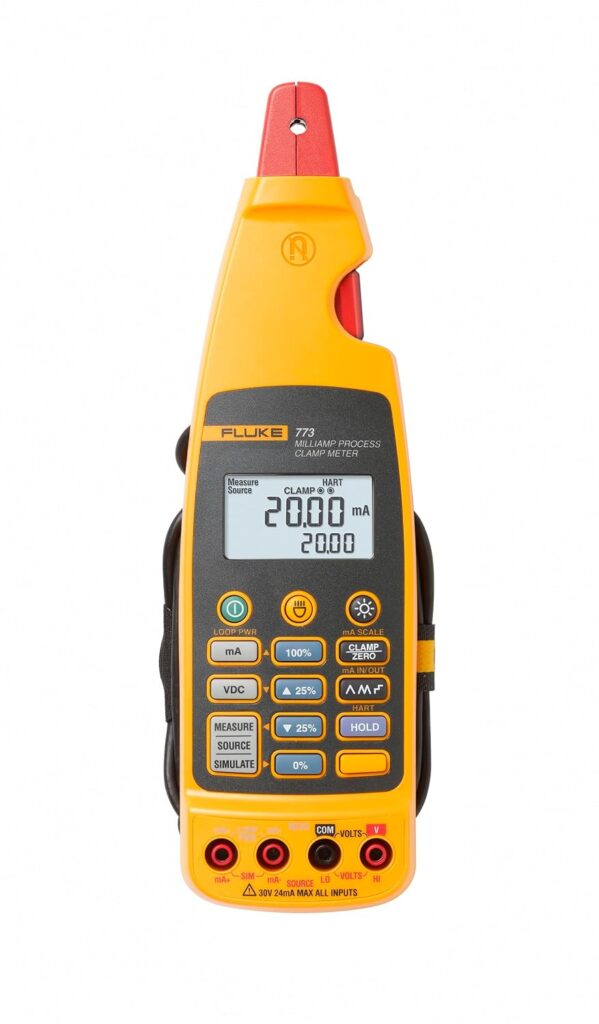
Fluke 771 vs 773 Comparison
| Feature | Fluke 771 | Fluke 773 |
|---|---|---|
| Measure 4–20 mA without breaking loop | ✅ | ✅ |
| Detachable clamp jaw | ✅ | ✅ |
| Loop current measurement | ✅ | ✅ |
| Loop percentage display | ✅ | ✅ |
| Source 4–20 mA | ❌ | ✅ |
| Simulate transmitter output | ❌ | ✅ |
| 24 V Loop Power | ❌ | ✅ |
| Automatic mA Ramp | ❌ | ✅ |
| 25% Step Output | ❌ | ✅ |
| Measure DC Voltage | ❌ | ✅ |
| Source 0–10 V | ❌ | ✅ |
| Dual Display | ✅ | ✅ |
| Best For | Fast diagnostics | Calibration & troubleshooting |
What Both Meters Have in Common
Both models were designed for industrial process technicians and share several important features.
They both offer:
- Non-contact 4–20 mA measurement
- High measurement accuracy
- Clamp around live conductors without opening the loop
- Detachable remote clamp
- Compact handheld design
- Backlit display
- Rugged industrial construction
If your only goal is measuring loop current quickly, either meter performs extremely well.
Fluke 771 Overview
🔍 Fluke 771: The Right Tool for Fast Process Diagnostics
If your primary job is verifying transmitter output and diagnosing live 4-20 mA loops, the Fluke 771 is difficult to beat. It quickly measures loop current without disconnecting wiring, making routine maintenance faster while reducing process downtime.
- ✓ Non-contact 4-20 mA measurements
- ✓ Detachable clamp for tight control panels
- ✓ Accurate loop diagnostics
- ✓ Compact and lightweight
- ✓ Excellent value for maintenance technicians
The Fluke 771 is essentially a specialized process clamp meter.
Its job is straightforward:
- Measure live 4–20 mA signals
- Verify transmitter output
- Diagnose loop problems
- Eliminate the need to disconnect wiring
Because it focuses exclusively on measurement, it’s smaller, simpler, and generally less expensive than the 773.
Pros
- Lower purchase price
- Extremely easy to use
- Measures current without breaking the loop
- Compact and lightweight
- Excellent for routine maintenance
Cons
- Cannot source current
- Cannot simulate transmitters
- No voltage measurements
- Cannot provide loop power
- Limited calibration capability
Fluke 773 Overview
🏆 Fluke 773: One Tool for Measurement and Calibration
The Fluke 773 goes well beyond current measurement. It combines non-contact loop diagnostics with current sourcing, transmitter simulation, loop power, and DC voltage testing, making it an outstanding all-in-one tool for instrumentation engineers and commissioning technicians.
- ✓ Measures, sources, and simulates 4-20 mA signals
- ✓ Built-in 24 V loop power
- ✓ Measures DC voltage and sources 0-10 V
- ✓ Ideal for PLC, HVAC, and industrial automation
- ✓ Replaces multiple field instruments
The Fluke 773 is much more than a clamp meter.
In addition to measuring loop current, it functions as a process calibrator, allowing technicians to:
- Source 4–20 mA signals
- Simulate transmitter outputs
- Supply 24 V loop power
- Measure DC voltage
- Source 0–10 V signals
- Perform automatic ramps and step outputs
This makes it suitable for commissioning new systems, calibrating transmitters, and troubleshooting PLC analog inputs.
Pros
- Everything the 771 can do
- Source and simulate 4–20 mA
- Built-in 24 V loop power
- Measures DC voltage
- Sources voltage signals
- Automatic ramp and step functions
- Can replace multiple field instruments
Cons
- Higher purchase price
- Larger and slightly heavier
- Extra features may be unnecessary for technicians who only measure loops
Performance Comparison
Routine Process Loop Checks
Both meters perform equally well when simply measuring loop current.
Winner: Tie
Calibration Work
The Fluke 773 is vastly more capable because it can generate test signals.
Winner: Fluke 773
Commissioning New Installations
The 773’s ability to power loops and source current makes startup much easier.
Winner: Fluke 773
Troubleshooting PLC Analog Inputs
Because it can both source current and measure voltage, the 773 allows technicians to isolate faults much faster.
Winner: Fluke 773
Ease of Use
The 771 is extremely straightforward because it focuses on measurement only.
Winner: Fluke 771
Pros and Cons at a Glance
Fluke 771
Advantages
- Affordable
- Fast non-contact loop measurements
- Lightweight
- Excellent battery life
- Ideal for maintenance rounds
Disadvantages
- Measurement only
- No calibration functions
- Cannot source current
- Cannot power loops
Fluke 773
Advantages
- Full process calibrator
- Measures, sources, and simulates
- Supplies loop power
- Voltage measurement capability
- One tool replaces several instruments
Disadvantages
- Higher price
- More features than some users require
What Customers Think
Users consistently praise the Fluke 771 for its ability to measure 4–20 mA signals without interrupting the process loop, making routine maintenance significantly faster. Maintenance technicians appreciate its simplicity, compact size, and reliability for everyday diagnostics.
Owners of the Fluke 773 frequently describe it as a major productivity upgrade because it combines a clamp meter and process calibrator in one instrument. Technicians who commission transmitters or troubleshoot PLC analog inputs value its ability to source current, power loops, and measure voltage, reducing the need to carry multiple tools. Discussions among instrumentation professionals often recommend the 773 for technicians who regularly perform calibration work, while suggesting the 771 is sufficient for users whose primary task is measuring loop current.
🏁 Final Recommendation
The Fluke 771 and Fluke 773 are designed for different types of technicians. If your work is limited to measuring live 4–20 mA loops during routine maintenance, the 771 delivers excellent performance at a lower cost. If you regularly calibrate transmitters, commission new systems, or troubleshoot both current and voltage control signals, the 773’s additional capabilities easily justify the investment.
💰 Best Value: Fluke 771
Perfect for maintenance technicians who need fast, accurate 4–20 mA measurements without breaking the loop. If you already own a process calibrator, the 771 provides everything required for everyday diagnostics.
🏆 Best Overall: Fluke 773
If you want one instrument that can measure, source, simulate, and power process loops while also handling voltage measurements, the Fluke 773 is the clear winner. It is the better long-term investment for instrumentation engineers, PLC technicians, and commissioning professionals.
Bottom line: Buy the Fluke 771 if you need an affordable tool for measuring live process loops. Buy the Fluke 773 if you want a complete process troubleshooting and calibration solution that can grow with your needs.