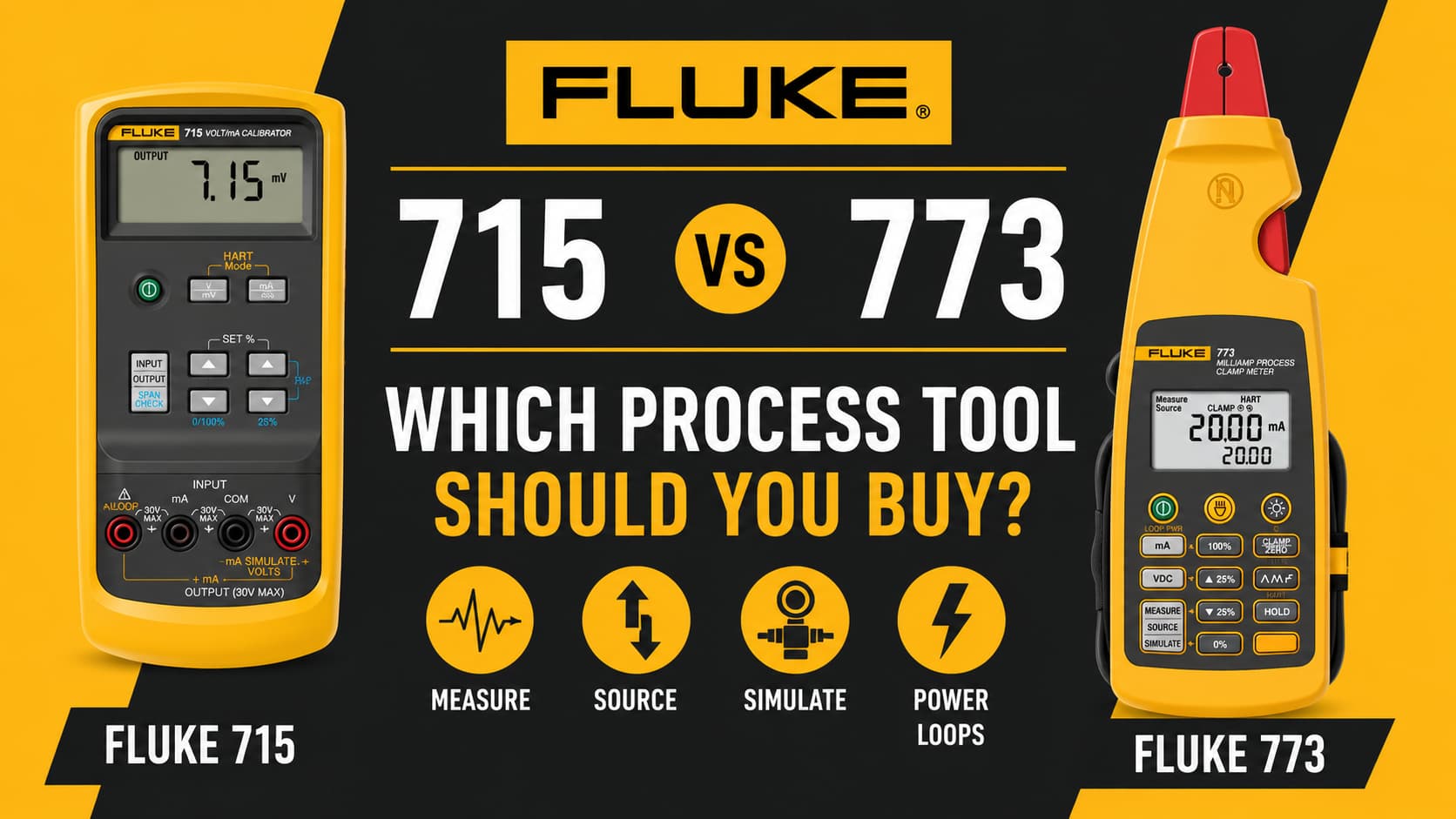
If you work with industrial control systems, transmitters, PLC analog inputs, or 4-20 mA process loops, both the Fluke 715 and Fluke 773 can be extremely useful tools. However, they are designed for different types of work.
The Fluke 715 is a dedicated volt/mA loop calibrator. It is built for technicians who need to source, simulate, and measure current and voltage signals during calibration work.
The Fluke 773 is a milliamp process clamp meter. Its biggest advantage is that it can measure 4-20 mA loop current without breaking the circuit. It also adds sourcing, simulation, loop power, and voltage functions, making it a more complete field troubleshooting tool.
⚡ Quick Pick: Fluke 715 vs Fluke 773
Choose the Fluke 715 if you mainly need a compact loop calibrator for sourcing, simulating, and measuring mA and voltage signals.
Choose the Fluke 773 if you want a more advanced process clamp meter that can measure live 4-20 mA loops without disconnecting wires.
💰 Best Dedicated Calibrator: Fluke 715
The Fluke 715 is ideal for technicians who need a reliable tool for loop calibration, bench testing, transmitter setup, and signal simulation. It is simple, focused, and easier to justify if you do not need clamp-based loop measurement.
🏆 Best Overall Process Tool: Fluke 773
The Fluke 773 is the better all-around choice for field troubleshooting. It can measure 4-20 mA loops without breaking the circuit, source and simulate process signals, provide loop power, and handle voltage work.
Bottom line: Buy the Fluke 715 if you need a dedicated loop calibrator. Buy the Fluke 773 if you want the more versatile field tool for live-loop diagnostics, calibration, and process troubleshooting.
Quick Verdict
Buy the Fluke 715 if:
- You mainly perform loop calibration.
- You need to source and simulate mA signals.
- You want a compact dedicated process calibrator.
- You do not need clamp-based non-intrusive loop measurement.
- You want a simpler and generally lower-cost tool.
Buy the Fluke 773 if:
- You troubleshoot live 4-20 mA loops in the field.
- You want to measure current without breaking the loop.
- You work in crowded control cabinets.
- You need current sourcing, simulation, and loop power.
- You want one instrument for both troubleshooting and calibration.
Fluke 715 vs Fluke 773 Comparison Table
| Feature | Fluke 715 | Fluke 773 |
|---|---|---|
| Tool Type | Volt/mA loop calibrator | Milliamp process clamp meter |
| Measure 4-20 mA | Yes, using test leads | Yes, with clamp or test leads |
| Measure mA Without Breaking Loop | No | Yes |
| Source 4-20 mA | Yes | Yes |
| Simulate Transmitter Output | Yes | Yes |
| 24 V Loop Power | No | Yes |
| Measure DC Voltage | Yes | Yes |
| Source DC Voltage | Yes | Yes, 0-10 V |
| Best For | Calibration and signal simulation | Field troubleshooting and live-loop diagnostics |
Fluke 715 Overview
The Fluke 715 is a practical choice for technicians who need a dedicated loop calibrator. It is designed to measure, source, and simulate process current and voltage signals. This makes it useful for calibrating transmitters, checking analog inputs, and verifying control system response.
The key thing to understand is that the 715 is not a clamp meter. To measure loop current, you typically need to connect into the circuit with test leads. That is perfectly acceptable for calibration work, but it is less convenient when you simply want to check a live loop quickly without interrupting the process.
🔧 Fluke 715: Best for Dedicated Loop Calibration
The Fluke 715 is a focused calibrator for technicians who need to source, simulate, and measure mA and voltage signals. It is a strong choice for transmitter calibration, bench testing, and analog signal verification.
- ✓ Source and simulate 4-20 mA signals
- ✓ Measure current and voltage signals
- ✓ Useful for transmitter calibration
- ✓ Compact and straightforward to use
- ✓ Good choice if you already have a clamp meter
Fluke 715 Pros and Cons
Pros
- Excellent for loop calibration
- Sources and simulates mA signals
- Measures voltage and current
- Compact and easy to carry
- Simpler interface than more advanced process tools
- Good option for bench and calibration work
Cons
- Cannot measure loop current with a clamp
- Requires test-lead connection for current measurement
- No non-intrusive live-loop measurement
- No built-in clamp jaw for crowded control panels
- Less convenient for quick field diagnostics
Fluke 773 Overview
The Fluke 773 is a more advanced process tool. Its biggest advantage is non-intrusive current measurement. Instead of opening the circuit, you can clamp around the loop conductor and measure the 4-20 mA signal directly.
This is a major advantage in industrial environments where breaking the loop could interrupt a process, create downtime, or require additional permits and coordination. The 773 also includes sourcing, simulation, loop power, and voltage capabilities, making it much more versatile than a basic process clamp meter.
🏆 Fluke 773: Best for Live-Loop Troubleshooting
The Fluke 773 is the better choice for technicians who regularly troubleshoot active process loops in the field. It can measure 4-20 mA current without breaking the loop, then source, simulate, and power loops when deeper diagnostics are needed.
- ✓ Measure 4-20 mA without opening the loop
- ✓ Source and simulate process signals
- ✓ Built-in 24 V loop power
- ✓ Measures DC voltage and sources 0-10 V
- ✓ Excellent for PLC, HVAC, and instrumentation work
Fluke 773 Pros and Cons
Pros
- Measures 4-20 mA without breaking the loop
- Excellent for live-loop troubleshooting
- Sources and simulates mA signals
- Provides 24 V loop power
- Measures DC voltage
- Sources 0-10 V signals
- Can replace several field instruments
Cons
- More expensive than the Fluke 715
- More tool than some calibration-only users need
- Larger than a simple handheld calibrator
- May be unnecessary if you rarely work on live process loops
Key Difference: Calibrator vs Clamp Meter
The most important distinction is that the Fluke 715 is primarily a calibrator, while the Fluke 773 is a process clamp meter with calibration features.
The 715 is excellent when you are intentionally connecting into a loop to source, simulate, or verify signals. The 773 is better when you need to diagnose a live system quickly without disturbing the wiring.
In simple terms: the Fluke 715 is best when you are intentionally connecting to a loop for calibration. The Fluke 773 is best when you want to check what is happening in a live loop before disconnecting anything.
Which Is Better for Routine Maintenance?
For routine process loop checks, the Fluke 773 has the advantage. Being able to clamp around a wire and read loop current without opening the circuit is faster and safer in many plant environments.
The Fluke 715 can still perform accurate measurements, but it is less convenient because it requires direct connection.
Which Is Better for Calibration?
For pure calibration tasks, the Fluke 715 remains a strong choice. It is simple, direct, and designed for sourcing and simulating current and voltage signals.
However, the Fluke 773 can also handle many calibration tasks while adding clamp-based diagnostics. If you want one tool for both calibration and troubleshooting, the 773 is the stronger option.
Which Is Better for PLC and Control System Troubleshooting?
The Fluke 773 is better for PLC and control system troubleshooting because it gives you more ways to isolate problems. You can measure a live loop, source a test signal, simulate a transmitter, power a loop, and check voltage signals with one instrument.
The Fluke 715 is still useful for checking analog inputs and generating signals, but it does not provide the same non-intrusive measurement capability.
What Customers Think
Users who choose the Fluke 715 generally like it because it is straightforward, accurate, and focused on calibration work. It is often seen as a dependable tool for technicians who already know exactly what they need: a compact source and simulation instrument for mA and voltage signals.
Users who choose the Fluke 773 tend to value its field flexibility. The ability to measure loop current without breaking the circuit is the feature that makes it stand out. For instrumentation technicians working in live plants, crowded panels, or critical processes, that capability can save a significant amount of time.
Which Should You Buy?
Buy the Fluke 715 if:
- You mainly need a loop calibrator.
- You source and simulate process signals.
- You do most of your work at the bench or during planned calibration.
- You do not need clamp-based live-loop measurement.
- You want a simpler tool for calibration tasks.
Buy the Fluke 773 if:
- You troubleshoot live 4-20 mA loops.
- You want to measure current without breaking the circuit.
- You work in industrial plants or crowded control cabinets.
- You need loop power, sourcing, and simulation.
- You want one tool for both diagnostics and calibration.
🏁 Final Recommendation
The Fluke 715 is the right choice if your main priority is dedicated loop calibration. It is compact, focused, and well suited to sourcing, simulating, and measuring process signals.
The Fluke 773 is the better choice if you want the more complete process troubleshooting tool. Its ability to measure 4-20 mA without breaking the loop makes it more useful for live industrial systems.
💰 Choose the Fluke 715 If You Want a Dedicated Calibrator
Best for technicians who mainly calibrate transmitters, verify analog signals, and work with planned loop testing rather than live-loop troubleshooting.
🏆 Choose the Fluke 773 If You Want the More Complete Field Tool
Best for instrumentation technicians who need to diagnose live loops, source and simulate process signals, power loops, and troubleshoot current and voltage control systems.
Bottom line: Buy the Fluke 715 if you need a compact calibration-focused tool. Buy the Fluke 773 if you want a premium process clamp meter that can troubleshoot live loops without interrupting the circuit.
Final Verdict
The Fluke 715 is a strong value for users who mainly need a traditional loop calibrator. It does the essential calibration work well and keeps the tool simple.
The Fluke 773 is the more powerful and versatile instrument. For field technicians who regularly work on live process loops, its clamp-based measurement capability is the deciding factor. It costs more, but it can save time, reduce downtime, and eliminate the need to carry multiple instruments.
For most industrial instrumentation technicians, the Fluke 773 is the better long-term investment. For users who only need sourcing and simulation, the Fluke 715 remains a practical and capable choice.