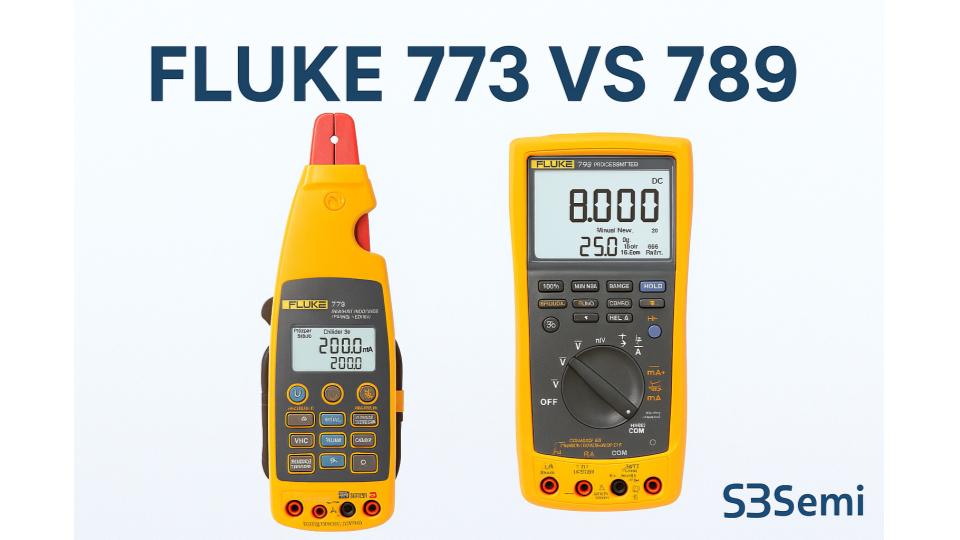
Choosing the right process meter can make a big difference in how efficiently you work with current loops and instrumentation. The Fluke 773 and Fluke 789 are two popular options, each designed for slightly different needs.

⚡ Quick Pick: Fluke 773 vs Fluke 789
Choose the Fluke 773 if you want a dedicated process clamp meter that can measure 4-20 mA signals without breaking the loop, source/simulate current, and handle voltage signals in a compact field tool.
Choose the Fluke 789 if you want a full-featured process multimeter that combines a digital multimeter with loop calibration functions for broader electrical and instrumentation troubleshooting.
🏆 Best for Non-Intrusive Loop Testing: Fluke 773
The Fluke 773 is ideal for technicians who frequently troubleshoot live 4-20 mA loops and want to measure loop current with the clamp instead of disconnecting wires. It is the faster choice for process loop checks in crowded panels.
🔧 Best All-in-One Process Meter: Fluke 789
The Fluke 789 is the better pick if you want one instrument for both electrical measurements and loop calibration. It adds broader multimeter functionality, making it a strong choice for technicians who troubleshoot more than just process loops.
Bottom line: Buy the Fluke 773 if quick, non-intrusive 4-20 mA clamp measurements are your priority. Buy the Fluke 789 if you want a more complete process multimeter for calibration, electrical testing, and general instrumentation work.
🏷️ Fluke Process Meter Deals ⭐⭐⭐⭐
While the 773 excels at non-intrusive loop testing with its clamp design, the 789 stands out as an all-in-one powerhouse with built-in loop power and HART support.
In this comparison, we’ll break down their key features, strengths, and ideal use cases to help you decide which one is the better fit for your workflow.
Fluke 773: The Loop Clamp Specialist

- Non-disruptive loop testing with the ability to measure 4–20 mA signals without breaking the loop, thanks to its clamp design.
- Adds DC voltage source and measure capability, enabling verification of power supplies and analog I/O devices.
- Portable and flexible, with a detachable clamp and extension cable for tight spaces, a dual backlit display, and a built-in spotlight.
- High accuracy and sensitivity, offering 0.2% accuracy with 0.01 mA resolution, and non-contact measurement up to 99.9 mA.
Bottom line: A go-to tool for live-loop diagnostics, especially where non-intrusive measurements are vital.

Fluke 789: The All-in-One Process Powerhouse

- Includes a built-in 24 V loop power supply to drive loops without external power.
- HART ready, with a built-in 250 Ω resistor for working with smart transmitters.
- SpanCheck buttons for fast and intuitive 0% and 100% calibration of 4–20 mA loops.
- Large dual display with enhanced backlighting for visibility in dim environments.
Bottom line: A comprehensive tool for calibration and power-loop maintenance, especially in HART and standalone loop scenarios.
Feature Comparison
| Feature | Fluke 773 (Process Clamp Meter) | Fluke 789 (Process Meter) |
|---|---|---|
| Non-disruptive measurement | Yes | No |
| Built-in loop power | No | Yes (24 V) |
| HART communication support | No | Yes (250 Ω resistor) |
| SpanCheck buttons | No | Yes |
| Clamp design for tight spaces | Yes | No |
| 💳 Pricing | 💲Check Price | 💲Check Price |
Which Tool Suits Your Workflow?
Choose the Fluke 773 if you need:
- Fast, non-intrusive measurement in live loops.
- Portability and flexibility with clamp testing.
- Simple voltage or loop source testing without built-in loop power.
Choose the Fluke 789 if you need:
- All-in-one loop sourcing, calibration, and power delivery.
- HART-compatible diagnostics for smart instrumentation.
- Quick, reliable span checks and better visibility.
Final Verdict
If your work emphasizes loop diagnostics in tight or live environments, the Fluke 773 shines. But if you seek full-feature versatility, HART compatibility, and streamlined calibration in one rugged tool, the Fluke 789 stands out.
