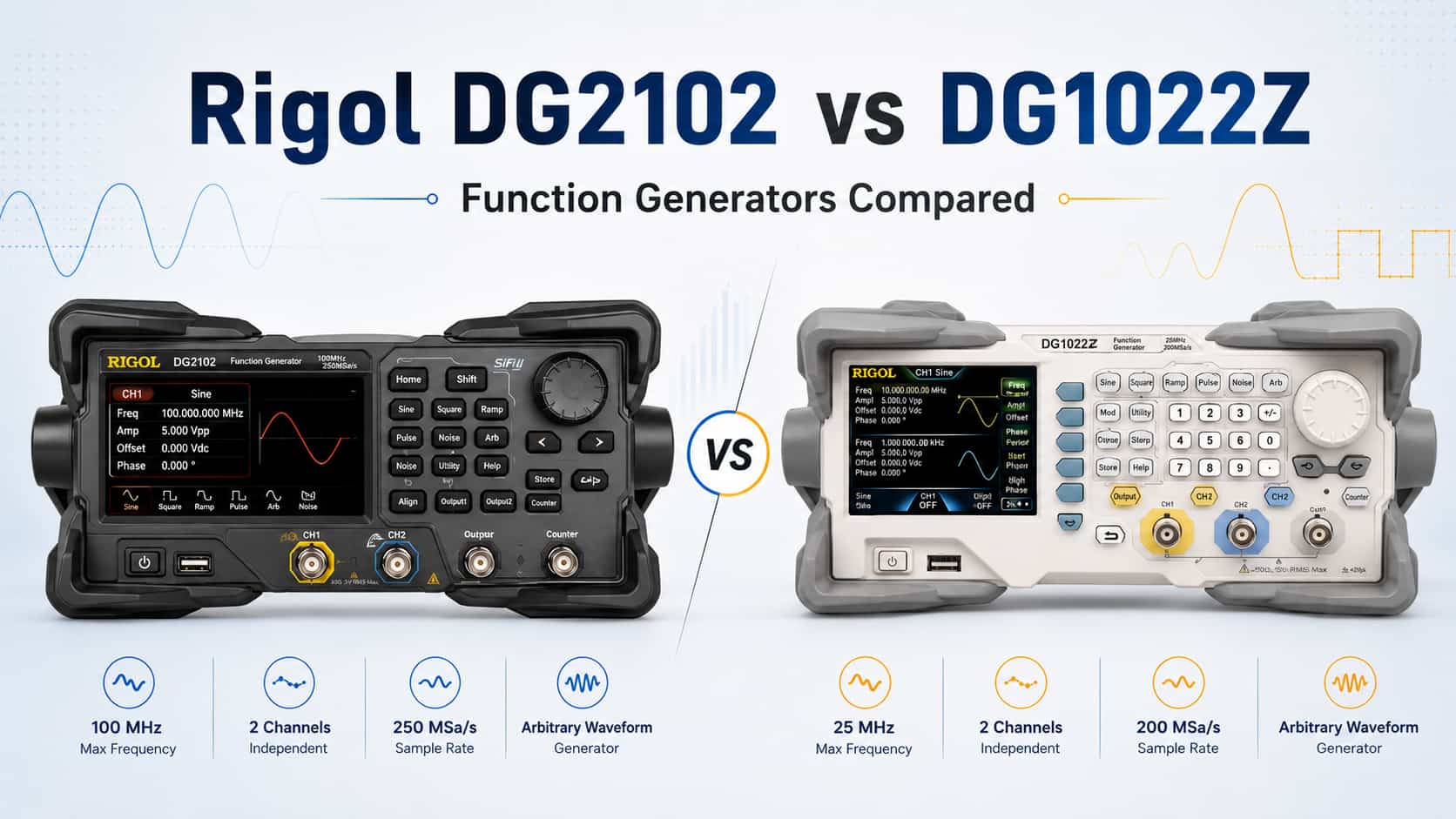
The Rigol DG2102 and DG1022Z both generate function and arbitrary waveforms across two channels, but they come from different generations and different tiers of Rigol’s signal generator lineup. The DG1022Z is the entry point into the older DG1000Z platform, built around Rigol’s original SiFi technology. The DG2102 is a newer DG2000-series instrument with SiFi II, a touchscreen interface, and specs that outpace the DG1022Z across nearly every measure — bandwidth, sample rate, resolution, and memory depth. This is less a close call between similar products and more a decision about how much signal generation capability your bench actually needs.
Below, we walk through what that capability gap means in practice, and when the DG1022Z’s lower cost makes more sense than paying for the DG2102’s added headroom.
Short answer: if your work involves higher frequencies, longer or more detailed arbitrary waveforms, or you want a touchscreen workflow with finer resolution, the DG2102 is the stronger long-term instrument. If you need a straightforward, capable function generator for standard bench and educational tasks, the DG1022Z covers that ground well at a meaningfully lower price.
Quick Pick
Rigol DG1022Z — 25 MHz bandwidth, SiFi technology, and 2 Mpts arbitrary memory for general-purpose bench and educational signal generation.
Rigol DG2102 — 100 MHz bandwidth, SiFi II technology, 16-bit resolution, and 16 Mpts per-channel memory for more demanding applications.
Quick Verdict
The DG2102 is a genuinely higher-tier instrument than the DG1022Z, not a marginal upgrade. It quadruples the bandwidth, improves vertical resolution, adds a touchscreen interface, and offers eight times the per-channel arbitrary memory as standard. The DG1022Z remains a capable, well-regarded generator for its price point, but it’s aimed at a different level of demand. If your bench work doesn’t require the DG2102’s added headroom, the DG1022Z is the more proportionate purchase; if it does, the DG2102 is worth the step up.
Comparison Table
| Spec | Rigol DG2102 | Rigol DG1022Z |
|---|---|---|
| Channels | 2 | 2 |
| Max Sine Output Frequency | 100 MHz | 25 MHz |
| Sample Rate | 250 MSa/s | 200 MSa/s |
| Vertical Resolution | 16-bit | 14-bit |
| Arbitrary Memory (per channel) | 16 Mpts standard | 2 Mpts standard (16 Mpts optional) |
| Signal Fidelity Technology | SiFi II | SiFi |
| Built-In Waveforms | Up to 160 | Up to 160 |
| Modulation Types | AM, FM, PM, ASK, FSK, PSK, PWM | AM, FM, PM, ASK, FSK, PSK, PWM |
| Frequency Counter | 7-digit, 240 MHz bandwidth | 7-digit, 200 MHz bandwidth |
| Display | 4.3″ touchscreen | 3.5″ TFT, non-touch |
| Connectivity | USB Host/Device, LAN (LXI) | USB Host/Device, LAN (LXI) |
| Platform | DG2000 series | DG1000Z series |
Rigol DG2102 Overview
The DG2102 represents a meaningful step up from Rigol’s entry-level generators, built around SiFi II technology, which adds dynamic edge-time filtering on top of the point-by-point waveform reconstruction found in the original SiFi engine. The result is cleaner signal fidelity across a much wider operating range: 100 MHz of sine bandwidth, a 250 MSa/s sample rate, and 16-bit vertical resolution, which gives finer amplitude precision than the DG1022Z’s 14-bit resolution, particularly useful when generating signals with subtle amplitude detail.
The DG2102’s 16 Mpts of arbitrary memory per channel, included as standard rather than an optional add-on, is a substantial jump from the DG1022Z’s 2 Mpts. That headroom matters most when building long or intricate arbitrary sequences, simulating real-world captured data, or working with pattern generation across extended durations. The 4.3-inch touchscreen also speeds up day-to-day navigation compared to the DG1022Z’s smaller non-touch display.
Rigol DG2102
Best overall for higher-frequency and detailed arbitrary waveform work
The DG2102 makes sense if your work regularly requires frequencies above 25 MHz, finer amplitude resolution, or the ability to generate long, detailed arbitrary waveforms without immediately running into memory limits. It’s built for engineers and technicians who need real headroom rather than just a basic function generator.
It’s worth saying plainly: the DG2102 sits at a noticeably higher price tier than the DG1022Z, and that premium only pays off if you’re actually using the extra bandwidth, resolution, or memory. Buying it purely because it has better numbers on the spec sheet, without a concrete need, is an easy way to overspend on capability that will sit unused.
Rigol DG2102 Pros
Pros
- 100 MHz bandwidth, 4x the DG1022Z’s frequency ceiling
- 16-bit vertical resolution for finer amplitude precision
- 16 Mpts arbitrary memory per channel included as standard
- Touchscreen interface speeds up navigation and setup
- SiFi II technology adds dynamic edge-time filtering
Cons
- Priced at a meaningfully higher tier than the DG1022Z
- More capability than many general bench tasks will use
Rigol DG1022Z Overview
The DG1022Z is the entry-level model in Rigol’s DG1000Z series, offering 25 MHz of sine output, a 200 MSa/s sample rate, and 14-bit vertical resolution, all built around Rigol’s original SiFi signal fidelity technology. For general bench testing, educational use, and standard modulation tasks, this is a capable and widely used instrument that covers the majority of everyday function generator needs without asking you to pay for capability you won’t use.
Where the DG1022Z shows its position in the lineup is in memory depth and resolution — its standard 2 Mpts of arbitrary memory per channel is a fraction of the DG2102’s 16 Mpts, and its 14-bit resolution is a step below the DG2102’s 16-bit precision. For most standard function generator tasks, neither of these differences will be noticeable, but for detailed arbitrary waveform work or fine amplitude control, the gap becomes more relevant.
Rigol DG1022Z
Best value for standard bench and educational signal generation
The DG1022Z is the right call if your work centers on standard function generator tasks — basic waveforms, common modulation types, and moderate arbitrary sequences — without needing frequencies above 25 MHz or extensive arbitrary memory. It delivers solid, dependable performance at a fraction of the DG2102’s price.
Don’t feel like the DG1022Z is a compromise for general bench work. For the vast majority of standard signal generation tasks in R&D, education, and everyday troubleshooting, it performs the job just as reliably as the pricier DG2102, and the money saved is better allocated elsewhere in your test setup if you don’t have a specific need for the DG2102’s extra capability.
Rigol DG1022Z Pros
Pros
- Reliable performance for general bench and educational use
- Significantly lower price point than the DG2102
- Same core modulation types and waveform library as higher-tier models
- 2 Mpts standard memory is sufficient for most everyday tasks
Cons
- Lower 25 MHz bandwidth ceiling compared to the DG2102’s 100 MHz
- 14-bit resolution versus the DG2102’s finer 16-bit precision
- Standard memory is a fraction of what the DG2102 offers
- Smaller, non-touch display
Key Differences
Unlike a same-tier comparison, the gap between the DG2102 and DG1022Z spans nearly every core spec. Bandwidth quadruples from 25 MHz to 100 MHz. Vertical resolution improves from 14-bit to 16-bit, meaningfully increasing the number of distinguishable amplitude levels. Standard arbitrary memory jumps from 2 Mpts to 16 Mpts per channel, an eight-fold increase. The DG2102 also introduces SiFi II technology and a touchscreen interface, both genuine usability and signal-quality improvements over the DG1022Z’s older SiFi engine and physical-button navigation.
These aren’t marginal refinements — they reflect the DG2102 being built for a higher tier of demand. The practical question isn’t which generator is “better” in the abstract, but whether your work actually calls for that tier of capability.
Real-World Performance Comparisons
For standard function generator tasks — producing sine, square, ramp, and pulse waveforms, or applying common modulation for sensor and communications testing — both generators handle the job well, since none of that work pushes into the DG1022Z’s bandwidth or memory limits. The difference becomes apparent specifically when working with higher-frequency signals or longer arbitrary waveforms, where the DG2102’s 100 MHz ceiling, 250 MSa/s sample rate, and 16 Mpts of memory give you room the DG1022Z simply doesn’t have as standard equipment.
The DG2102’s 16-bit resolution also shows its advantage in precision-sensitive applications, where finer amplitude steps reduce quantization artifacts in the generated signal. For general troubleshooting and standard test signal generation, though, the DG1022Z’s 14-bit resolution is rarely a limiting factor.
If you’re deciding between these two purely on arbitrary memory needs, it’s worth remembering the DG1022Z does offer an optional 16 Mpts upgrade — but even with that option, it doesn’t close the gap in bandwidth, resolution, or interface that the DG2102 provides as standard.
Customer Opinions: Amazon and Reddit Summary
Feedback on the DG1022Z consistently describes it as a dependable, easy-to-use generator well suited to general bench and classroom use, with reviewers frequently highlighting its straightforward interface and solid build quality for the price. Some buyers who later took on more demanding projects mention outgrowing its memory depth or bandwidth over time, which tracks with its positioning as an entry-level instrument.
DG2102 reviewers and forum commenters tend to emphasize the touchscreen interface and the jump in bandwidth and memory as clear justifications for the higher price, particularly among engineers who previously worked around a lower-tier generator’s limitations. Sentiment across both products is generally positive for their respective tiers, with the overall theme being that buyers who chose the DG2102 typically did so with a specific need for the extra capability in mind, rather than as a default upgrade.
Which Should You Buy?
Because the DG2102 and DG1022Z sit at genuinely different capability tiers, this decision comes down to matching the instrument to your actual bandwidth, resolution, and memory requirements rather than assuming the higher-spec option is automatically the right call.
Buy the Rigol DG2102 if…
- You need output frequencies above 25 MHz
- You build long or detailed arbitrary waveforms regularly
- You want finer amplitude resolution for precision-sensitive work
- You’d benefit from a touchscreen interface and faster day-to-day navigation
Buy the Rigol DG1022Z if…
- Your work centers on standard function generator waveforms and basic modulation
- Your frequency needs stay comfortably within 25 MHz
- You want a dependable, well-priced generator for general bench or educational use
- You don’t need extensive arbitrary memory or 16-bit precision
Final Verdict
The Rigol DG2102 and DG1022Z aren’t really competing for the same buyer — the DG2102 is a genuinely higher-tier instrument, with substantially more bandwidth, resolution, and standard arbitrary memory, built for engineers who need real headroom. The DG1022Z remains an excellent, dependable choice for standard bench and educational signal generation at a noticeably lower price. If your work doesn’t call for the DG2102’s added capability, the DG1022Z is the smarter, more proportionate purchase; if it does, the DG2102 earns its higher price tier.
Ready to Decide?
Compare final pricing and availability below