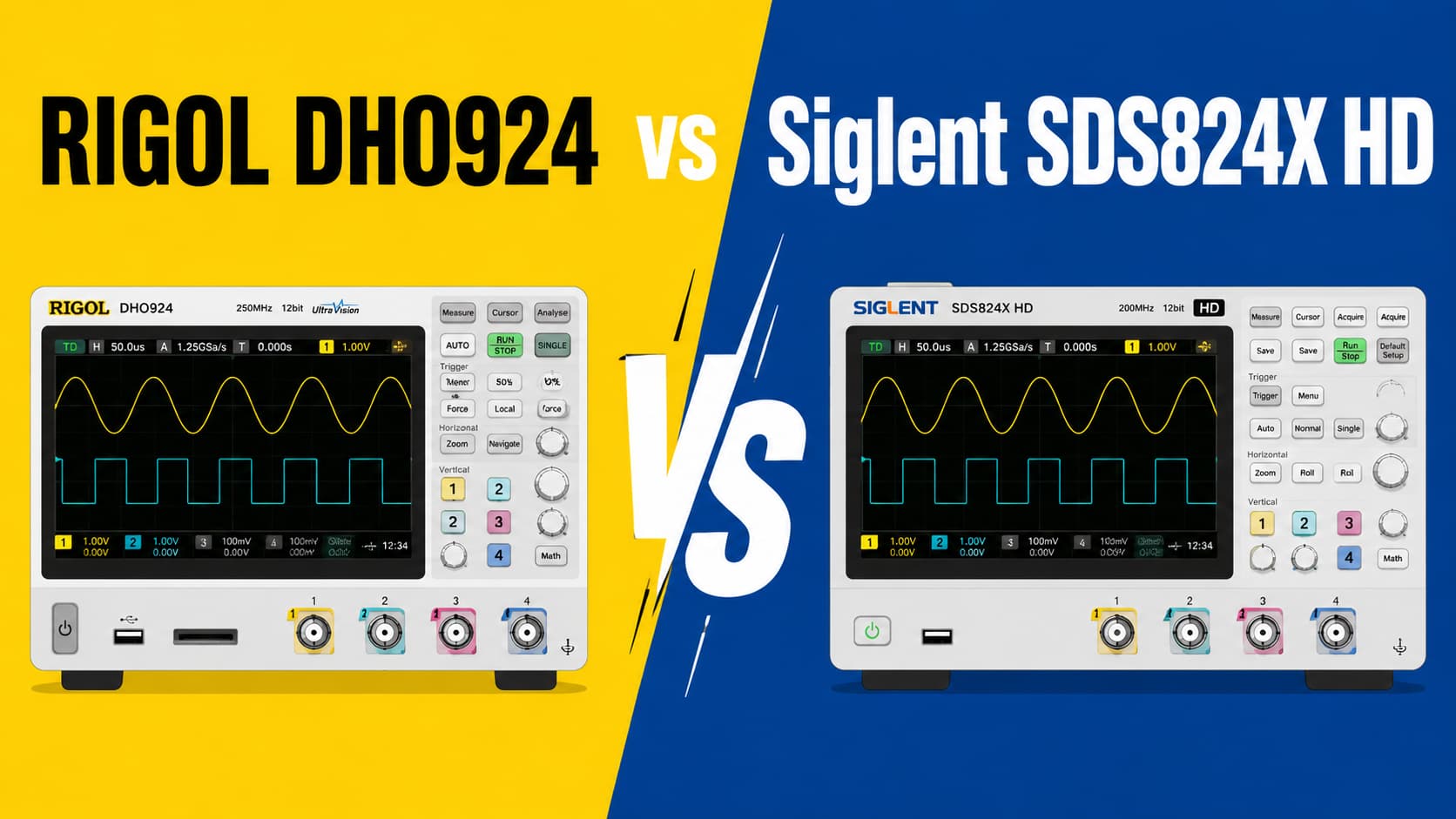
The RIGOL DHO924 and Siglent SDS824X HD are two of the most interesting affordable 12-bit, four-channel oscilloscopes for engineers, technicians, educators, repair benches, embedded developers, and serious electronics hobbyists. Both give you high-resolution acquisition, modern touch interfaces, deep memory, mixed-signal capability with optional logic inputs, and far better low-level signal visibility than older 8-bit scopes.
The buying decision comes down to a practical tradeoff: the RIGOL DHO924 gives you more analog bandwidth on paper, while the Siglent SDS824X HD gives you a higher maximum sample rate and deeper memory. For many users, either scope is a major upgrade from entry-level 8-bit instruments, but they are not identical tools.
For most buyers, the Siglent SDS824X HD is the stronger all-around choice if memory depth, sample rate, and bench workflow matter most, while the RIGOL DHO924 is the better value if you specifically want 250 MHz bandwidth in a compact 12-bit scope.
Choose the DHO924 if you want a compact four-channel 12-bit oscilloscope with 250 MHz bandwidth and strong value for general electronics, RF-adjacent troubleshooting, power measurements, and digital debugging.
Choose the SDS824X HD if you want deeper captures, a higher maximum sample rate, and a more flexible all-around bench scope for serial buses, embedded systems, power work, and longer time-window debugging.
Quick Verdict
Buy the RIGOL DHO924 if you want the most bandwidth for the money in this class and value a small, modern, 12-bit scope that fits easily on a crowded bench.
Buy the Siglent SDS824X HD if you want the better overall instrument for deeper acquisition, longer captures, protocol work, and everyday engineering use where sample rate and memory depth matter as much as headline bandwidth.
The DHO924 is attractive because it gives you 250 MHz bandwidth, four channels, 12-bit vertical resolution, a compact form factor, and modern triggering/acquisition features. The SDS824X HD counters with 200 MHz bandwidth, four channels, 12-bit resolution, up to 2 GSa/s sample rate, and up to 100 Mpts memory depth, making it especially compelling when you need to inspect longer events without sacrificing timing detail.
In plain terms: RIGOL wins on bandwidth-per-dollar positioning. Siglent wins on acquisition depth and all-around bench confidence.
Comparison table
| Feature | RIGOL DHO924 | Siglent SDS824X HD | Why it matters |
|---|---|---|---|
| Analog channels | 4 | 4 | Four channels are useful for power rails, clock/data relationships, multi-stage analog circuits, and embedded systems. |
| Bandwidth | 250 MHz | 200 MHz | Bandwidth affects how accurately the scope captures fast edges, harmonics, ringing, and high-frequency components. |
| Vertical resolution | 12-bit | 12-bit | 12-bit acquisition gives more vertical detail than older 8-bit scopes, especially for small signals riding on larger waveforms. |
| Maximum sample rate | 1.25 GSa/s | 2 GSa/s | Higher sample rate gives more timing points across fast edges and helps preserve detail at shorter timebases. |
| Maximum memory depth | 50 Mpts | 100 Mpts | Deeper memory lets you capture longer events while maintaining useful sample density. |
| Display | 7-inch touchscreen class display | 7-inch touchscreen class display | Touch control improves day-to-day navigation, cursor placement, zooming, and waveform inspection. |
| Mixed-signal capability | Supports 16 digital channels with optional logic probe | Supports mixed-signal analysis with digital channels depending on configuration/options | Useful when you need analog plus digital timing correlation on microcontroller, FPGA, or bus-level work. |
| Bench footprint | Very compact | Compact, but more traditional bench-scope feel | Footprint matters if your bench already has a power supply, function generator, spectrum analyzer, soldering station, and PC. |
| Best fit | Value-focused 250 MHz 12-bit bench scope | Higher-memory, higher-sample-rate all-rounder | The best choice depends on whether your work is more bandwidth-limited or acquisition-depth-limited. |
RIGOL DHO924 overview
The RIGOL DHO924 is part of RIGOL’s DHO900 series, a compact family of high-resolution digital oscilloscopes built around 12-bit acquisition. The DHO924 model is especially interesting because it combines four analog channels with 250 MHz bandwidth, making it attractive for technicians and engineers who want more analog headroom than a 100 MHz or 200 MHz entry-level scope.
The main reason to consider the DHO924 is simple: it gives you a lot of scope capability in a small package. With 12-bit resolution, it is better suited than older 8-bit scopes for viewing low-amplitude ripple, sensor signals, power-supply behavior, and analog detail. With 250 MHz bandwidth, it also gives you more margin when measuring faster digital edges or signal content beyond the basic audio, low-speed embedded, and power-electronics range.
The DHO924 is not just about headline bandwidth. Its compact design is useful for crowded benches, field-adjacent engineering setups, lab carts, and educational environments where space matters. If you are coming from a classic entry-level scope, the combination of four channels, high-resolution acquisition, modern display, and deep memory will feel like a major upgrade.
The RIGOL DHO924 is the better choice if your main goal is to get a modern four-channel 12-bit oscilloscope with 250 MHz bandwidth without stepping into a much more expensive class of instrument.
Best for: embedded development, power-supply debugging, general electronics repair, education labs, RF-adjacent troubleshooting, audio and sensor work, and users upgrading from older 8-bit bench scopes.
Skip it if: you regularly need the deepest possible acquisition memory, you want the highest sample-rate margin in this comparison, or your work depends heavily on long-duration serial-bus captures.
Value note: This is the scope to consider if you want to avoid overbuying while still getting a serious high-resolution instrument. For many benches, the DHO924 is already more than enough scope.
RIGOL DHO924 pros
- 250 MHz bandwidth gives it more analog headroom than the Siglent SDS824X HD on paper.
- 12-bit vertical resolution improves visibility of small waveform details compared with traditional 8-bit scopes.
- Four analog channels make it practical for multi-rail, multi-signal, and timing-correlation measurements.
- Compact form factor is excellent for small benches, repair stations, classrooms, and shared lab spaces.
- Good value positioning for buyers who want higher bandwidth without moving into a much more expensive oscilloscope tier.
- Useful modern interface with touchscreen-style workflow and contemporary acquisition features.
RIGOL DHO924 cons
- Lower maximum sample rate than the Siglent, which can matter when viewing fast edges or preserving timing detail at high bandwidth.
- Less maximum memory depth, so the Siglent has the advantage for long captures at high sample density.
- Digital-channel and accessory configuration may add cost depending on the package you buy.
- Not automatically the better real-world choice just because it has 250 MHz bandwidth, sample rate and memory also matter.
- Users focused on protocol debugging may prefer Siglent’s deeper-memory workflow.
Siglent SDS824X HD overview
The Siglent SDS824X HD is a four-channel, 12-bit high-resolution oscilloscope from Siglent’s SDS800X HD family. It is positioned as a modern bench scope for users who want better signal fidelity, deep acquisition memory, mixed-signal capability, and a practical interface for everyday engineering work.
On paper, the SDS824X HD has less bandwidth than the RIGOL DHO924, 200 MHz instead of 250 MHz. But it counters with a higher maximum sample rate and deeper memory. That combination matters because many real-world debugging sessions are not limited by bandwidth alone. Engineers often need to capture a long event, zoom into a detail, and still have enough samples to make sense of timing relationships.
For embedded systems, digital control boards, serial buses, switching supplies, and mixed analog/digital debugging, the SDS824X HD is especially compelling. Its deeper memory can be more useful than an extra 50 MHz of bandwidth if your measurements involve intermittent faults, startup behavior, protocol events, or longer acquisition windows.
The Siglent SDS824X HD is the scope I would choose for most engineering benches if the price difference is acceptable. It gives up some headline bandwidth to the RIGOL, but its acquisition depth and sample-rate advantage make it a more flexible all-around tool.
Best for: embedded systems, serial-bus debugging, power electronics, firmware/hardware bring-up, longer captures, mixed analog/digital analysis, and engineers who want a scope they will not quickly outgrow.
Skip it if: your work is mostly simple signal checking, audio, low-speed digital, basic repair, or you specifically want the lowest-cost path to a 250 MHz 12-bit scope.
Value note: Do not overbuy just for the Siglent name or the deeper memory if you will only use the scope for basic waveform checks. But if you debug complex boards, the extra acquisition headroom can save time.
Siglent SDS824X HD pros
- 2 GSa/s maximum sample rate gives more timing resolution than the RIGOL DHO924 in this comparison.
- 100 Mpts maximum memory depth is a major advantage for long acquisitions and zooming into captured events.
- 12-bit resolution helps reveal small analog details, ripple, noise, and waveform distortion.
- Four-channel design is well suited to real engineering debug, not just simple two-signal comparisons.
- Strong mixed-signal bench positioning for embedded systems and digital timing correlation.
- Better overall choice for long-window debugging where memory depth and sample density matter.
Siglent SDS824X HD cons
- Lower analog bandwidth than the RIGOL DHO924, 200 MHz versus 250 MHz.
- May cost more depending on bundle and availability, so value depends on current pricing.
- May be more scope than necessary for users doing only basic repair or low-speed hobby electronics.
- Optional features and accessories can affect total cost, especially for mixed-signal or advanced analysis needs.
- Bandwidth-focused buyers may prefer the RIGOL if they do not need deeper memory.
Key differences
Bandwidth: RIGOL has the headline advantage
The RIGOL DHO924 offers 250 MHz bandwidth, while the Siglent SDS824X HD is a 200 MHz scope. If you routinely work near the upper end of this range, the RIGOL gives you more analog bandwidth margin.
That said, bandwidth should not be evaluated in isolation. A scope also needs enough sample rate and memory depth to capture useful waveform detail. A higher bandwidth number does not automatically mean better results in every real-world measurement.
Sample rate: Siglent has the timing advantage
The Siglent SDS824X HD has a higher maximum sample rate than the RIGOL DHO924. This is important when looking at fast edges, short glitches, narrow pulses, and timing relationships between channels.
For digital debugging, sample rate often matters as much as analog bandwidth because you are trying to understand when something happened, not merely whether it happened.
Memory depth: Siglent is stronger for long captures
The Siglent SDS824X HD has a clear advantage in maximum memory depth. This matters when capturing startup behavior, bus activity, intermittent faults, power sequencing, motor control events, or long protocol transactions.
With deeper memory, you can capture a longer time window while retaining more samples for zoomed-in analysis. This is one of the biggest practical reasons to choose the Siglent.
Resolution: both are 12-bit instruments
Both scopes offer 12-bit vertical resolution, which is one of the main reasons they are attractive. Compared with older 8-bit oscilloscopes, 12-bit acquisition can make small changes in voltage easier to see.
This is especially useful for power-supply ripple, sensor outputs, amplifier behavior, low-level analog signals, and measurements where quantization noise can obscure detail.
Physical workflow: RIGOL is especially compact
The RIGOL DHO924 is appealing if you care about bench space. Its small footprint makes it easier to fit into a crowded work area or shared lab.
The Siglent still fits well on a modern bench, but it feels more like the better all-around engineering instrument when acquisition depth and analysis flexibility are the priority.
Real-world performance comparisons
Embedded systems and microcontroller debugging
For embedded work, the Siglent SDS824X HD has the edge. The higher sample rate and deeper memory are useful when debugging clocks, resets, SPI, I2C, UART, PWM, power sequencing, and intermittent firmware-related hardware behavior.
The RIGOL DHO924 is still very capable for embedded work, especially if you value bandwidth and compact size. But if your workflow involves long captures and zooming into specific events, the Siglent is more comfortable.
Power electronics and switch-mode power supplies
Both scopes are strong choices for power-supply work because both have 12-bit resolution. That helps when looking at ripple, transient response, startup behavior, and control-loop effects.
The Siglent is better for long startup captures and event analysis. The RIGOL is attractive if you want extra bandwidth margin for ringing, switching edges, and high-frequency artifacts.
RF-adjacent troubleshooting
Neither scope replaces a spectrum analyzer, but both are useful for RF-adjacent bench work such as envelope behavior, baseband signals, control lines, IF-related debugging, oscillator outputs, modulation-related timing, and digital/RF system support circuits.
If your priority is analog bandwidth, the RIGOL DHO924 has the advantage. If your priority is capturing longer timing relationships around RF control events, the Siglent SDS824X HD is more flexible.
Repair bench use
For repair work, the RIGOL DHO924 is likely the better value. Many repair measurements do not require 100 Mpts memory depth or the highest sample-rate capability. You need a clear display, enough bandwidth, stable triggering, and good usability.
The Siglent is still excellent for repair, but it makes the most sense if your repair work involves complex digital boards, intermittent failures, power sequencing, or mixed analog/digital diagnosis.
Education and training labs
The RIGOL DHO924 is a strong candidate for classrooms because of its compact size, modern interface, and value positioning. It gives students a high-resolution four-channel instrument without consuming excessive bench space.
The Siglent SDS824X HD is better for advanced labs where students need to analyze longer captures, serial buses, embedded systems, and more complex timing events.
Don’t overbuy: If your work is mostly checking whether a signal is present, measuring basic waveforms, troubleshooting audio circuits, or doing low-speed electronics repair, the RIGOL DHO924 is already a very capable instrument. The Siglent SDS824X HD becomes easier to justify when you will actually use the deeper memory, higher sample rate, and more analysis-oriented workflow.
Customer opinions, Amazon and Reddit summary
Customer sentiment for this class of scope tends to focus on value, display quality, modern 12-bit acquisition, included accessories, shipping condition, and whether optional features are included in the specific bundle. Buyers moving up from older entry-level oscilloscopes usually notice the improved waveform detail immediately, especially on low-amplitude signals.
On engineering forums and Reddit-style discussions, the debate often comes down to the same tradeoff: the RIGOL DHO924 has the more attractive bandwidth number, while the Siglent SDS824X HD is frequently considered stronger for memory depth, sample rate, and day-to-day debugging workflow. Users also tend to discuss firmware maturity, interface preference, fan noise, accessory packages, and whether optional mixed-signal or decoding features are worth paying for.
It is important not to treat forum comments as lab-grade measurements. They are useful for understanding owner priorities, but your decision should still be based on the signals you actually measure, the time windows you need to capture, and the complexity of your debug work.
Which should you buy?
Buy the RIGOL DHO924 if…
You want the stronger value play and care most about getting 250 MHz bandwidth, four analog channels, 12-bit resolution, and a compact footprint.
It is the better fit if your bench work is mostly general electronics, repair, power-supply checks, embedded development, RF-adjacent support circuitry, and everyday waveform analysis.
Buy the Siglent SDS824X HD if…
You want the better overall engineering scope and care most about deeper memory, higher maximum sample rate, and long-capture debugging.
It is the better fit if you work on embedded systems, serial buses, complex digital boards, power sequencing, intermittent faults, or long-duration captures where you need to zoom into details later.
If you are buying for a professional engineering bench, the Siglent SDS824X HD is the safer long-term choice. If you are buying for a value-conscious lab, repair station, or personal bench and you specifically want 250 MHz bandwidth, the RIGOL DHO924 is very compelling.
Final recommendation affiliate box
Buy the RIGOL if you want a compact 250 MHz, four-channel, 12-bit oscilloscope and do not need the deepest capture memory in this comparison.
Skip it if: your debugging often depends on long captures, high sample density, and extensive post-capture zooming.
Buy the Siglent if you want the more flexible daily-use instrument for embedded debug, protocol work, deeper captures, and complex bench analysis.
Skip it if: you are mostly doing simple measurements and would rather put the price difference toward probes, a bench supply, or a signal generator.
Final verdict with final Amazon CTA buttons
The RIGOL DHO924 is the better pick if you want the most bandwidth-oriented value. It gives you 250 MHz bandwidth, four channels, 12-bit acquisition, and a compact modern design. For many technicians, educators, repair users, and general electronics engineers, that is the smarter buy.
The Siglent SDS824X HD is the better overall pick if you want a scope that feels more capable across a wider range of real engineering tasks. Its deeper memory and higher maximum sample rate make it more attractive for embedded systems, serial buses, long captures, and complex debug sessions.
Bottom line: choose the RIGOL DHO924 for value and bandwidth. Choose the Siglent SDS824X HD for acquisition depth and overall bench versatility.