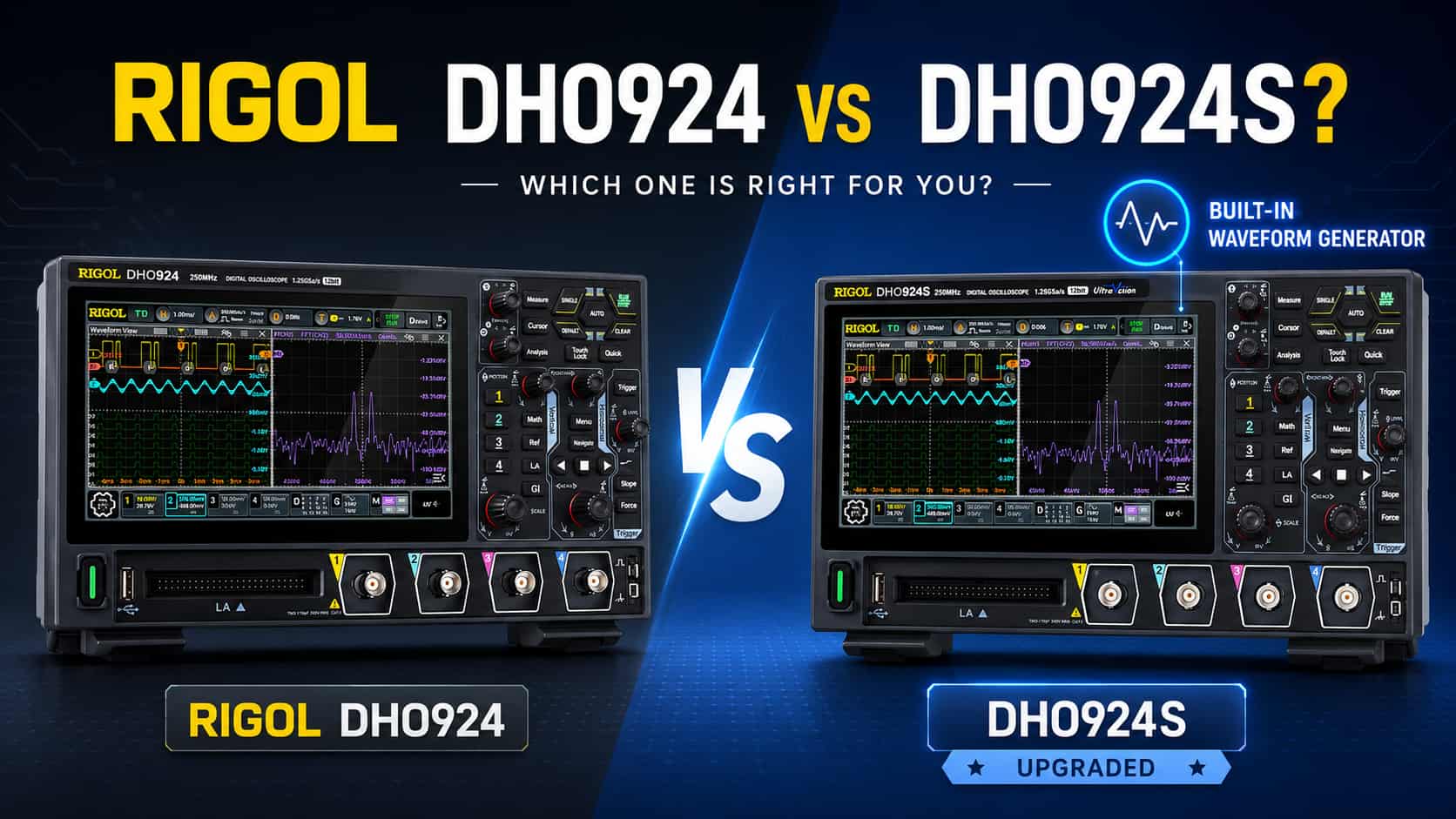
The RIGOL DHO924 and RIGOL DHO924S are very closely related 12-bit, four-channel oscilloscopes from RIGOL’s DHO900 series. Both models offer 250 MHz bandwidth, 1.25 GSa/s real-time sample rate, up to 50 Mpts memory depth, a 7-inch capacitive touchscreen, 16-channel mixed-signal support with the optional logic probe, and a compact bench-friendly design.
The difference is not basic oscilloscope performance. The difference is functionality. The DHO924S adds a built-in 25 MHz single-channel arbitrary/function generator and Bode plot analysis, while the standard DHO924 gives you the same core oscilloscope platform without those integrated signal-generation features.
That makes this a practical buying decision: do you just need a high-resolution 250 MHz oscilloscope, or do you also want an integrated signal source for stimulus-response testing, filter checks, control-loop work, amplifier testing, and quick bench experiments?
For most buyers, the RIGOL DHO924 is the better value because it gives you the same core 250 MHz, 12-bit oscilloscope performance; choose the RIGOL DHO924S if you will actually use the built-in function generator and Bode plot tools.
Choose the DHO924 if you want the same 250 MHz, four-channel, 12-bit oscilloscope performance without paying extra for the built-in waveform generator.
Choose the DHO924S if you want the oscilloscope plus an integrated 25 MHz arbitrary/function generator and Bode plot capability in one compact instrument.
Quick Verdict
Buy the RIGOL DHO924 if you already own a function generator, do not need automated Bode plot testing, or simply want the best value in the 250 MHz DHO900 family.
Buy the RIGOL DHO924S if you want a more self-contained bench instrument that can generate signals, stimulate circuits, and perform frequency-response work without needing a separate generator.
For pure oscilloscope use, the two models are effectively the same class of instrument. Both are four-channel, 250 MHz, 12-bit scopes with the same headline sample rate and memory depth. That means you should not pay more for the DHO924S expecting better waveform capture, higher bandwidth, deeper memory, or more vertical resolution.
The DHO924S upgrade is about bench integration. The built-in signal generator and Bode plot feature can be genuinely useful, especially in education labs, power-supply work, amplifier testing, filter response checks, and quick design validation. But if those features will sit unused, the DHO924 is the smarter buy.
Comparison table
| Feature | RIGOL DHO924 | RIGOL DHO924S | Why it matters |
|---|---|---|---|
| Analog channels | 4 | 4 | Both scopes can monitor multiple rails, clocks, logic signals, analog nodes, and timing relationships at the same time. |
| Analog bandwidth | 250 MHz | 250 MHz | There is no bandwidth advantage to the S model. Both offer the same 250 MHz oscilloscope bandwidth. |
| Vertical resolution | 12-bit | 12-bit | 12-bit resolution improves visibility of small voltage changes compared with traditional 8-bit oscilloscopes. |
| Real-time sample rate | Up to 1.25 GSa/s | Up to 1.25 GSa/s | Both models have the same sample-rate capability for capturing fast waveform detail. |
| Memory depth | Up to 50 Mpts | Up to 50 Mpts | Both can capture relatively long events while preserving useful sample density. |
| Display | 7-inch capacitive touchscreen | 7-inch capacitive touchscreen | Touch control improves navigation, cursor placement, waveform zooming, and menu interaction. |
| Digital channels | 16-channel support with optional PLA2216 logic probe | 16-channel support with optional PLA2216 logic probe | Both can support mixed-signal debugging when paired with the required logic probe. |
| Built-in arbitrary/function generator | No | Yes, single-channel 25 MHz AFG | This is the main hardware difference. The DHO924S can generate test waveforms without a separate function generator. |
| Bode plot analysis | No | Yes | Useful for loop response, filter response, amplifier frequency response, and control-system testing. |
| Best fit | Value-focused 250 MHz scope buyer | Integrated scope-plus-generator buyer | The right choice depends on whether you need a built-in stimulus source. |
RIGOL DHO924 overview
The RIGOL DHO924 is the standard 250 MHz model in the DHO900 family. It gives you four analog channels, 12-bit vertical resolution, up to 1.25 GSa/s sample rate, up to 50 Mpts memory depth, and a compact touchscreen design. For most users, this is the model that delivers the best value because it includes the core oscilloscope capability without the extra integrated signal generator.
The main attraction is that the DHO924 is not a stripped-down instrument in the areas that matter most for waveform capture. You still get the same 250 MHz bandwidth as the DHO924S. You still get the same 12-bit acquisition platform. You still get the same four channels. You still get the same DHO900-style form factor and interface.
For technicians and engineers who already own a separate function generator, the DHO924 makes a lot of sense. A standalone generator may have better controls, more outputs, higher output capability, or a workflow you already know. In that case, paying extra for an integrated generator may not add much practical value.
The RIGOL DHO924 is the better buy if your priority is oscilloscope performance rather than integration. It gives you the same core measurement platform as the DHO924S, which makes it the value pick for most electronics benches.
Best for: general electronics troubleshooting, embedded development, power-supply debugging, education labs, repair work, sensor measurements, digital timing checks, and users who already own a function generator.
Skip it if: you want one compact instrument that can both generate and measure waveforms, or you specifically need built-in Bode plot analysis for frequency-response work.
Value note: This is the model to buy if you do not want to overpay for features you may rarely use. For many technicians, the standard DHO924 is already the complete oscilloscope they need.
RIGOL DHO924 pros
- Same 250 MHz bandwidth as the DHO924S, so there is no oscilloscope bandwidth penalty for choosing the lower-cost model.
- 12-bit vertical resolution helps with low-level waveform detail, ripple, noise, and analog signal inspection.
- Four analog channels are useful for power sequencing, multi-rail debugging, clock/data analysis, and control-system measurements.
- Up to 50 Mpts memory depth gives useful capture length for many engineering and repair tasks.
- Compact design works well on crowded benches, carts, classrooms, and field-adjacent workspaces.
- Best value in this comparison if you do not need an integrated arbitrary/function generator.
RIGOL DHO924 cons
- No built-in 25 MHz arbitrary/function generator, so you need a separate signal source for stimulus-response testing.
- No built-in Bode plot feature, which limits convenience for frequency-response and loop-response analysis.
- Optional logic probe still adds cost if you want to use the 16 digital channels.
- Less integrated for teaching labs where one box that both generates and measures signals can simplify setups.
- Not the best choice for users without other bench instruments who want to build a compact, all-in-one test setup.
RIGOL DHO924S overview
The RIGOL DHO924S is the upgraded version of the DHO924. It keeps the same core oscilloscope platform, including four analog channels, 250 MHz bandwidth, 12-bit resolution, 1.25 GSa/s sample rate, and 50 Mpts memory depth, but adds a built-in single-channel 25 MHz arbitrary/function generator and Bode plot analysis.
That extra functionality can be more valuable than it sounds. A scope is often used to measure how a circuit responds to a stimulus. With the DHO924S, the stimulus source is built into the instrument. You can generate sine, square, ramp, noise, DC, and user-defined waveforms, then immediately observe the circuit response on the analog channels.
The DHO924S is especially attractive for users who test filters, amplifiers, switching power supplies, sensor interfaces, op-amp stages, audio circuits, control loops, and educational lab circuits. Instead of using a separate generator, extra cabling, and a separate control interface, the DHO924S puts the source and measurement system in one compact package.
The RIGOL DHO924S is the better choice if you want a more complete bench instrument rather than just a scope. It is not a higher-bandwidth DHO924. It is a DHO924 with added signal-generation and frequency-response functionality.
Best for: circuit design, education labs, power-supply loop testing, filter response checks, amplifier testing, op-amp circuits, audio work, sensor simulation, and users without a separate function generator.
Skip it if: you already own a good function generator, rarely perform stimulus-response testing, or simply want the lowest practical cost for a 250 MHz 12-bit four-channel oscilloscope.
Value note: The DHO924S is worth paying more for only if the built-in generator and Bode plot workflow will actually save you time or reduce the need for separate bench gear.
RIGOL DHO924S pros
- Includes a built-in 25 MHz arbitrary/function generator, making it useful for stimulus-response testing without a separate generator.
- Supports Bode plot analysis, which is valuable for filters, amplifiers, control loops, and power-supply stability work.
- Same 250 MHz oscilloscope bandwidth as the DHO924, so you do not give up measurement performance.
- Same 12-bit acquisition platform, useful for low-level signals, ripple, noise, and small analog changes.
- More integrated bench workflow for users who want fewer boxes, fewer cables, and faster setup.
- Better for education and lab environments where students need both signal generation and signal measurement.
RIGOL DHO924S cons
- Costs more than the standard DHO924, while the core oscilloscope specifications remain largely the same.
- The built-in generator is single-channel, so it does not replace every standalone function generator use case.
- Not necessary if you already own a separate generator and prefer using dedicated bench instruments.
- Optional logic probe may still be required if you want to use the digital channels for mixed-signal debugging.
- Can be overkill for basic repair work where you mainly need to view signals, not generate test stimuli.
Key differences
The DHO924S adds a built-in function generator
The biggest difference is that the DHO924S includes a built-in single-channel 25 MHz arbitrary/function generator. The standard DHO924 does not.
This matters because many real measurements require a known input signal. If you are testing an amplifier, checking a filter, injecting a clock-like waveform, sweeping a circuit, or simulating a sensor signal, the DHO924S can do that without a separate signal generator.
The DHO924S adds Bode plot analysis
The second major difference is Bode plot capability. A Bode plot shows gain and phase versus frequency. This is useful for understanding frequency response, stability margins, filter behavior, amplifier performance, and control-loop response.
For power electronics and analog design work, this can be a meaningful upgrade. If you never run frequency-response tests, it may not matter.
Oscilloscope performance is essentially the same
Both models are 250 MHz, four-channel, 12-bit scopes with up to 1.25 GSa/s sample rate and up to 50 Mpts memory depth. That means the DHO924S should not be viewed as a better oscilloscope in the basic waveform-capture sense. It is better because it adds extra test functions.
This is the key value point: if you only need oscilloscope capability, the DHO924 is the logical choice. If you need integrated source-and-measure capability, the DHO924S is the logical choice.
The S model reduces bench clutter
The DHO924S can reduce the need for a separate function generator in many everyday tests. That is useful on small benches, in classrooms, on lab carts, and in shared engineering spaces where setup time and cable clutter matter.
However, a standalone function generator may still be better for advanced waveform generation, multiple outputs, higher output amplitude, specialized modulation, or workflows where the generator is used independently of the oscilloscope.
The standard DHO924 is the better value if you already have bench gear
If your bench already has a capable function generator, the DHO924S may duplicate equipment you already own. In that case, the standard DHO924 is usually the smarter value because it gives you the same scope performance and lets you spend the difference on probes, adapters, a current probe, a differential probe, or a bench power supply.
Real-world performance comparisons
General electronics troubleshooting
For general troubleshooting, the DHO924 is the better value. Most repair and diagnostic tasks involve observing voltages, timing, ripple, pulses, clocks, and control signals. You usually do not need the built-in generator unless you are actively injecting signals into the circuit.
The DHO924S is still excellent for general troubleshooting, but its extra value appears only when you use the generator or Bode plot feature.
Embedded systems and microcontroller work
Both scopes are strong choices for embedded systems. Four analog channels are useful for checking reset, clock, power rails, GPIO, PWM, and analog sensor outputs. The optional digital-channel capability can also help when correlating analog and digital behavior.
The DHO924S becomes more attractive if you need to simulate sensor signals, inject test waveforms, or generate simple stimulus signals during firmware and hardware bring-up. If you mostly observe signals from the board, the DHO924 is enough.
Power-supply and control-loop testing
This is one area where the DHO924S has a clear use-case advantage. Bode plot analysis is valuable when evaluating loop stability, frequency response, and gain/phase behavior in switching power supplies and control systems.
If power electronics are a major part of your work, the DHO924S is easier to justify. If you only check output ripple, startup behavior, transient response, and switching waveforms, the standard DHO924 can still do the core measurement work.
Filter, amplifier, and analog circuit testing
The DHO924S is better for analog design validation because the built-in generator lets you apply a known waveform and observe the response. That is useful for low-pass filters, high-pass filters, op-amp gain stages, audio amplifiers, comparator circuits, and sensor front ends.
The DHO924 can do the same measurement work only if paired with a separate generator. That may be perfectly fine if you already own one.
Education labs and teaching benches
The DHO924S is the better classroom instrument because it combines a scope and signal source in one box. Students can generate a waveform, connect it to a circuit, and measure the response without needing another instrument.
The DHO924 is better when budgets are tight and the lab already has shared signal generators. It gives students the same high-resolution oscilloscope experience at a better value point.
Field-adjacent or portable work
The DHO900 family’s compact design and USB-C power support make both models attractive for portable or space-constrained use. The DHO924S has the edge if you want to carry fewer instruments because it includes the signal source.
The standard DHO924 is better if you want to minimize cost, weight, and complexity and only need the oscilloscope itself.
Don’t overbuy: The DHO924S is not automatically the better purchase just because it has more features. If you already own a function generator or rarely inject test signals, the standard DHO924 gives you the same core oscilloscope performance and better value. Put the saved money toward quality probes, a differential probe, a current probe, or other accessories that may improve your measurements more than an integrated generator would.
Customer opinions, Amazon and Reddit summary
Customer sentiment around the RIGOL DHO900 series is generally focused on the value of getting a compact 12-bit scope with four channels, 250 MHz bandwidth on the higher models, a modern touchscreen, and mixed-signal capability. Buyers upgrading from older 8-bit scopes often appreciate the cleaner vertical detail and smaller footprint.
In Amazon-style reviews, buyers typically care about whether the product arrives as described, whether the included probes and accessories match expectations, how responsive the interface feels, and whether the model includes the features they expected. With this specific comparison, the most important buying detail is making sure you are ordering the correct version: the DHO924 does not include the built-in AFG and Bode plot capability, while the DHO924S does.
On Reddit and engineering forums, discussions around these models tend to focus on value, firmware maturity, fan noise, touchscreen usability, bandwidth, and whether the S model is worth the premium. The common practical advice is simple: buy the S version if you need the generator and Bode plot tools, otherwise buy the standard model and save the money.
As with any forum feedback, treat individual comments as user experience rather than controlled lab testing. The right choice depends less on general popularity and more on whether your bench needs an integrated signal source.
Which should you buy?
Buy the RIGOL DHO924 if…
You want a high-resolution 250 MHz, four-channel oscilloscope and do not need a built-in arbitrary/function generator.
It is the better choice if you already own a separate function generator, mostly perform observation-based troubleshooting, or want the best value in this comparison.
Buy the RIGOL DHO924S if…
You want the same core oscilloscope plus a built-in 25 MHz function generator and Bode plot analysis.
It is the better choice if you test filters, amplifiers, power supplies, control loops, analog circuits, sensors, or educational lab setups where source-and-measure integration saves time.
If you are uncertain, the safer value choice is the standard DHO924. It gives you the same core scope specifications and avoids paying for integrated features that may go unused. The DHO924S becomes the better buy only when you know you will use the generator and Bode plot functions regularly.
Final recommendation affiliate box
Buy the DHO924 if your main requirement is a compact 250 MHz, four-channel, 12-bit oscilloscope. It is the better value because it keeps the same core measurement performance as the S model.
Skip it if: you want one instrument that can generate signals and measure circuit response without a separate function generator.
Buy the DHO924S if you want the more complete bench instrument. The built-in 25 MHz generator and Bode plot analysis make it more useful for design, test, education, and frequency-response work.
Skip it if: you already have a function generator and rarely perform Bode plot or stimulus-response testing.
Final verdict with final Amazon CTA buttons
The RIGOL DHO924 is the best choice for most buyers. It gives you the same core oscilloscope platform as the DHO924S, including 250 MHz bandwidth, four analog channels, 12-bit vertical resolution, 1.25 GSa/s sample rate, and 50 Mpts memory depth. If you just need a capable high-resolution scope, this is the better value.
The RIGOL DHO924S is the better choice if you want a more integrated test instrument. The built-in 25 MHz arbitrary/function generator and Bode plot analysis make it more useful for analog design, filter testing, power-supply loop analysis, education labs, and situations where you want to generate and measure signals with one instrument.
Bottom line: choose the RIGOL DHO924 for best value. Choose the RIGOL DHO924S if the built-in generator and Bode plot tools will save you time or replace another piece of bench equipment.