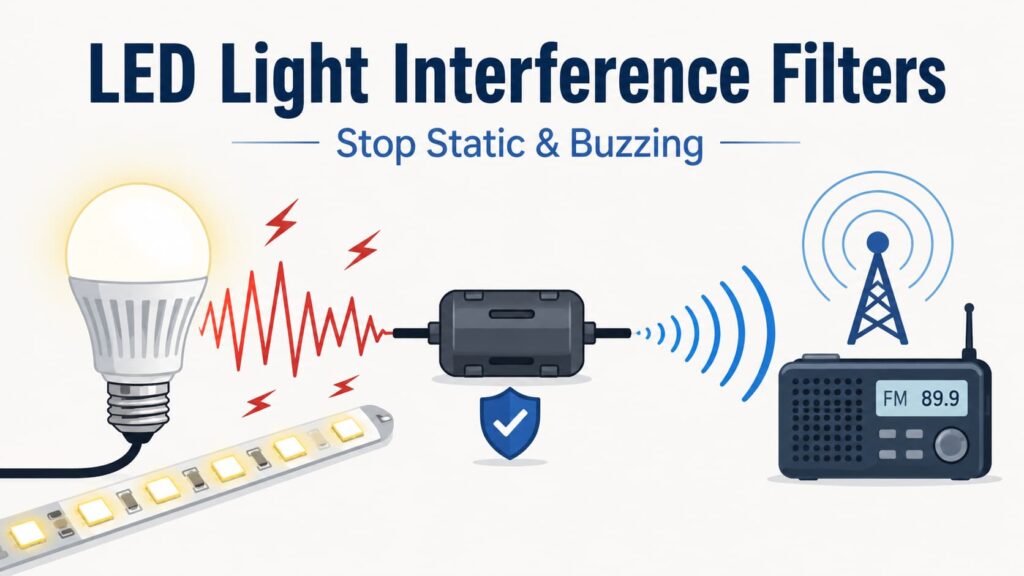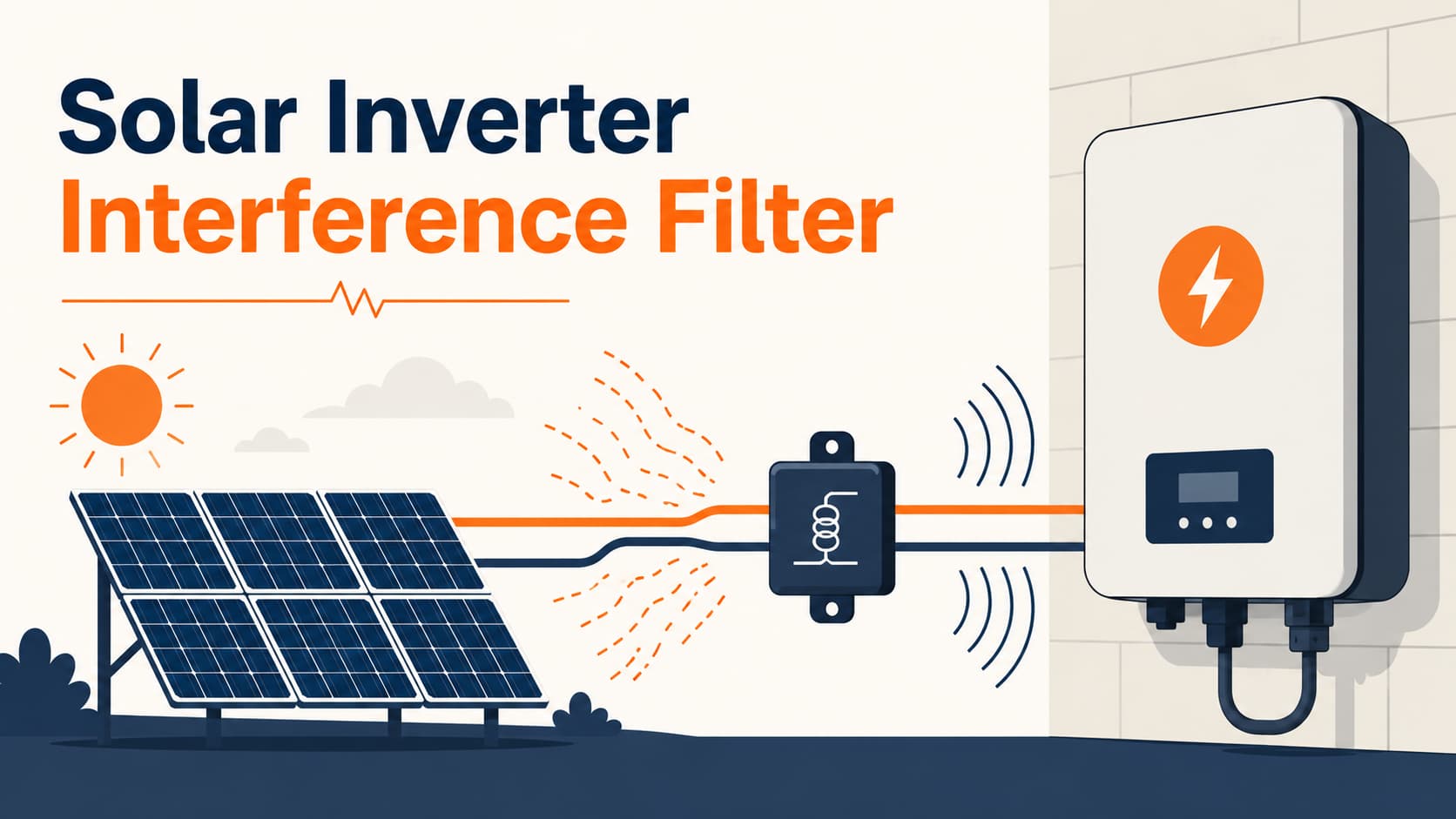
A radio interference filter for solar inverter use is designed to reduce unwanted RF noise from solar power electronics. Solar inverters, microinverters, optimizers, charge controllers, MPPT circuits, and battery inverters can all create radio-frequency interference. The symptoms can include AM radio static, shortwave noise, ham radio interference, CB radio buzzing, scanner noise, weak reception, or a raised noise floor across multiple bands.
Solar inverter interference is different from ordinary household electrical noise because the system often includes long DC cables, AC output wiring, rooftop conductors, metal racking, grounding conductors, battery cables, and monitoring cables. Any of these can act like an antenna if high-frequency switching noise gets onto the wiring.
This guide explains what causes solar inverter RFI, where to install filters, which product types are worth trying, and when you should call a qualified solar or electrical professional instead of attempting a DIY fix.
Safety warning: solar inverter systems can involve lethal AC voltage, high-voltage DC strings, battery fault current, and code-regulated wiring. Do not install inline AC filters, PV-side filters, or hardwired components unless you are qualified to do so. For most DIY users, the safest first step is non-invasive ferrite filtering on accessible cables and consulting a licensed electrician or solar installer for hardwired filters.
For most solar inverter radio interference problems, start with Mix 31 ferrites or clip-on ferrite chokes on accessible inverter, monitoring, and low-voltage cables; consider a properly rated AC EMI line filter only when installed by a qualified professional.
Best first product to try on monitoring cables, communication leads, small AC adapter cords, control wires, and accessible inverter cabling.
Best choice for more serious common-mode suppression where you can route multiple turns of a cable through a large Mix 31-style ferrite core.
Quick Verdict
Buy clip-on ferrite chokes if you want the safest, easiest, non-invasive first step for solar inverter RFI. They are useful on Ethernet cables, monitoring leads, low-voltage control wires, USB cables, small power adapter cords, and accessible inverter cables.
Buy Mix 31 ferrite toroids if you are dealing with HF, shortwave, AM, ham radio, or broad-spectrum common-mode noise. Large toroids are often more effective than small clip-on cores because the cable can be looped through the core multiple times.
Buy an AC EMI line filter only if the inverter’s AC output or branch circuit is confirmed as the noise path and the filter is properly rated and professionally installed.
Do not install random filters on PV string wiring unless the component is specifically rated for the system voltage, current, environment, and code requirements. PV DC wiring can remain energized even when AC power is off.
Why Solar Inverters Cause Radio Interference
Solar inverters convert DC power from panels or batteries into AC power. To do that efficiently, they use high-speed switching electronics. Those switching circuits can create electrical noise. If the inverter’s internal filtering, cable routing, grounding, or installation layout does not adequately suppress that noise, it can appear as radio interference.
Solar RFI often comes from common-mode current. This means unwanted RF current flows on the outside of cables or along wiring paths that were never intended to carry radio-frequency energy. Long solar cables, AC conductors, equipment grounding conductors, and communication cables can then radiate that noise like antennas.
Common symptoms include:
- AM radio static that appears during daylight hours when the inverter is producing power.
- Shortwave or ham radio noise that rises when the solar array wakes up.
- HF band noise that changes with sun intensity or inverter load.
- Buzzing or hash on CB radio near the inverter, battery system, or solar wiring.
- Scanner or VHF/UHF noise from inverter communication modules, optimizers, or nearby electronics.
- Noise that disappears at night or when the inverter is shut down.
Comparison Table
| Product | Best for | Connection type | Use this when… |
|---|---|---|---|
| Clip-On Ferrite Choke Kit | Best first fix | Clips around cable | You want a safe, non-invasive first step for accessible cables. |
| YARADECRO Clip-On Ferrite Chokes | Small monitoring and control cables | Clip-on ferrite | You need a small multipack for Ethernet, USB, sensor, or low-voltage leads. |
| Mecion 31 Mix Ferrite Filter Cores | HF and ham radio noise | Clip-on ferrite / suppression core | You want Mix 31-style material for lower-frequency RFI suppression. |
| FT240-31 Ferrite Toroid Core | Serious common-mode suppression | Cable looped through toroid | You can route multiple turns of an accessible cable through a large ferrite. |
| uxcell AC 115/250V 20A EMI Power Line Filter | AC-side conducted noise | Hardwired AC filter | A qualified installer confirms the AC line is the noise path. |
| CW4L2-20A EMI Power Filter | Higher-current AC line filtering | Hardwired AC filter | You need a properly rated AC filter installed in an enclosure by a qualified person. |
| HLin 20A AC Noise Suppressor | Budget AC filter option | Hardwired AC filter | You want an AC line filter option for professionally installed filtering. |
Best First Fix: Clip-On Ferrite Choke Kit
A clip-on ferrite choke kit is the best first product to try because it is non-invasive, inexpensive, and easy to test. Ferrites clip around a cable and increase the impedance to high-frequency common-mode noise. They do not require cutting into wiring, opening the inverter, or modifying the solar installation.
Ferrite chokes are especially useful on Ethernet monitoring cables, USB cables, communication leads, low-voltage control wires, CT sensor leads, small power adapter cords, and accessible AC adapter cables. They are also useful for experimenting because you can move them from cable to cable while watching the radio noise level.
Buy it if: you want a simple, safe, non-invasive first step for inverter RFI on accessible cables.
Skip it if: you already know the interference is conducted on a hardwired AC circuit that requires a properly rated line filter.
Installation tip: place ferrites close to the inverter, gateway, charge controller, or monitoring device. Multiple ferrites on the same cable may work better than one.
Best for Monitoring and Control Cables: YARADECRO Clip-On Ferrite Chokes
YARADECRO clip-on ferrite chokes are useful for small cables around solar equipment, including monitoring gateway cables, low-voltage control leads, USB adapters, network cables, sensor leads, and small DC wiring.
This is a good option if your noise seems to be coming from the inverter’s data gateway, communication module, Ethernet cable, RS-485 line, Wi-Fi bridge, or monitoring accessory rather than the main power conductors.
Buy it if: you need ferrites for small inverter-related cables and want a practical multipack for troubleshooting.
Skip it if: the cable is too thick for the ferrite size or you need a large toroid for multiple turns.
Best use: clip them near both ends of a noisy monitoring cable, especially near the inverter, gateway, or controller.
Best for HF and Ham Radio Noise: Mecion 31 Mix Ferrite Filter Cores
For solar inverter RFI that affects AM, shortwave, or ham radio, ferrite material matters. Mix 31 ferrite is widely used for lower-HF common-mode suppression. The Mecion 31 Mix ferrite filter cores are the kind of product to consider when ordinary small snap-on chokes are not enough.
These are especially relevant if the noise appears on HF bands, rises during solar production, and sounds like broadband hash or buzzing. They are not a guaranteed cure, but they are usually more relevant for ham-radio-style interference than tiny ferrite beads designed only for USB cables.
Buy it if: your solar inverter is raising the HF noise floor and you want ferrite material better suited to common-mode RFI suppression.
Skip it if: your issue is only on very small low-voltage cables where a simple clip-on ferrite kit may be easier to use.
Technical note: ferrite placement matters. Install cores as close as practical to the noise source or on the cable that is acting as the radiator.
Best for Stronger Common-Mode Suppression: FT240-31 Ferrite Toroid Core
The FT240-31 ferrite toroid core is a popular style of large ferrite used for stronger RFI suppression. The advantage of a toroid is that you can pass a cable through the core multiple times. More turns can increase the common-mode impedance and improve suppression, especially on HF bands.
This is a better option when you have enough cable slack to wrap several turns through the core. It can be useful on accessible low-voltage wiring, monitoring cables, antenna feedline-related noise paths, and other cables where multiple turns are practical.
Important: do not disassemble high-voltage PV string wiring or hardwired AC inverter wiring just to pass conductors through a toroid unless you are qualified and the installation remains code-compliant. For main inverter conductors, use a licensed installer.
Buy it if: clip-on ferrites are not enough and you can safely route an accessible cable through a large toroid multiple times.
Skip it if: the cable cannot be safely looped, is part of high-voltage PV wiring, or is inside a code-regulated enclosure.
Best use: multiple turns through the toroid on the noisy cable, placed close to the inverter, controller, or device creating the interference.
Best AC-Side Filter: uxcell AC 115/250V 20A EMI Power Line Filter
The uxcell AC 115/250V 20A EMI power line filter is the type of product to consider when the interference is conducted through the AC side of a small inverter, subpanel feed, or connected power circuit. This style of filter is designed to reduce conducted noise traveling on AC lines.
This is not the first product most homeowners should install because it requires proper wiring, enclosure, grounding, current rating, voltage rating, and code compliance. However, for qualified installers, an AC EMI filter can be useful when testing confirms that the inverter’s AC output path is carrying noise.
Buy it if: you have confirmed conducted noise on an AC line and a qualified person will install a properly rated filter.
Skip it if: you are looking for a simple DIY fix. Start with ferrites first unless you are qualified to work on AC wiring.
Installation note: this type of filter must be mounted, grounded, fused/breakered, and enclosed correctly. Do not leave line-voltage terminals exposed.
Best Higher-Current AC Filter Option: CW4L2-20A EMI Power Filter
The CW4L2-20A EMI power filter is another 20A-class AC line filter option. It is relevant for users looking at conducted EMI filtering on an AC circuit, especially where a compact metal-housed filter is appropriate for a controlled installation.
As with any AC line filter, the key issue is not just buying the part. It must be correctly rated for the electrical system, installed in an appropriate enclosure, grounded properly, and used within its current and voltage limits.
Buy it if: you need a 20A-class AC EMI filter and have a qualified installer handling the wiring and enclosure.
Skip it if: your inverter is on a larger circuit, the current rating is insufficient, or you have not confirmed the AC line is the actual noise path.
Value note: do not overbuy AC filters before trying ferrites. Many solar RFI problems are common-mode cable radiation issues rather than simple AC line noise.
Best Budget AC Filter Option: HLin 20A AC Noise Suppressor
The HLin AC 115/250V 20A noise suppressor is a budget-oriented AC EMI filter option. It can be considered when a qualified installer wants an economical line-filter component for testing or installation on an appropriately rated circuit.
This is not a universal solar inverter filter. It is one possible AC line filter component. Solar inverters, battery inverters, and grid-tie systems vary widely, so the filter must match the application.
Buy it if: you want a budget AC EMI filter option for a properly rated and professionally installed application.
Skip it if: you need a certified solar-specific solution, outdoor-rated enclosure, higher current rating, or PV-side filtering.
Best use: controlled AC-side filtering where the filter rating, enclosure, and wiring method are appropriate.
How to Diagnose Solar Inverter Radio Interference
Check whether the noise follows sunlight
Solar inverter RFI often follows production. If the radio noise appears after sunrise, increases with sun intensity, changes with cloud cover, and disappears at night, the solar power system is a likely source.
Turn off the inverter safely
If you know how to shut down the inverter according to the manufacturer’s procedure, compare the radio noise with the inverter operating and with it off. Do not open electrical panels or PV disconnects unless you are qualified. Use the normal shutdown procedure provided by the system manufacturer or installer.
Use a portable AM or shortwave radio
A portable battery-powered AM or shortwave receiver can help locate radiating cables. Walk near the inverter, AC wiring, DC conduit, battery cables, monitoring gateway, and communication cables. If the noise peaks near a specific cable, that cable may need ferrite suppression.
Check monitoring and communication cables
Many users focus only on the big power wires, but communication cables can also radiate or conduct RFI. Ethernet, RS-485, gateway, CT sensor, USB, and low-voltage adapter cables are easy places to start with clip-on ferrites.
Separate antenna systems from solar wiring
If you are a ham radio operator, avoid routing antenna feedlines near inverter wiring, PV conductors, battery cables, or inverter enclosures. Physical separation can be as important as filtering.
Where to Install Solar Inverter RFI Filters
On monitoring and data cables
Start with Ethernet, RS-485, USB, CT sensor, and gateway cables. These are usually safer and easier to treat than power conductors. Clip-on ferrites near both ends can reduce common-mode noise.
On accessible low-voltage DC cables
Battery monitoring leads, auxiliary supply cables, and low-voltage control wires may benefit from ferrites. Do not confuse these with high-current battery cables or high-voltage PV strings.
On antenna feedlines affected by common-mode noise
If the solar system raises your station noise floor, common-mode chokes on antenna feedlines may also help. This does not fix the inverter source, but it may reduce noise entering the receiver through the outside of the coax shield.
On the AC output, only with qualified installation
AC EMI line filters can help when conducted noise is confirmed on the AC side. However, installation must be code-compliant and properly rated. For grid-tie solar systems, this should be handled by a licensed electrician or solar installer.
On PV DC wiring, only with solar-rated parts and professional guidance
PV DC wiring is not a place for random Amazon filters. High-voltage DC arcs are dangerous, and solar circuits have specific code and equipment requirements. Use manufacturer-approved or professionally specified solutions.
Do Not Overbuy: Ferrites First, Hardwired Filters Later
Start with non-invasive ferrites before buying hardwired filters. Many solar inverter RFI problems are caused by common-mode noise on cables. Ferrites are safe to test, reversible, and useful for locating the noise path. AC line filters and PV-side filters should come later, after diagnosis and with proper installation.
Do not assume the largest or most expensive filter will solve the problem. The most important factors are ferrite material, placement, number of turns, cable selection, grounding, and whether you are treating the correct noise path.
Which Should You Buy?
Buy ferrite chokes if…
You want a safe first step for solar inverter RFI on communication cables, monitoring leads, Ethernet cables, low-voltage wiring, and accessible cords.
Best picks: clip-on ferrite choke kit, YARADECRO ferrite chokes, Mecion 31 Mix ferrite cores, FT240-31 ferrite toroids.
Buy an AC EMI line filter if…
You have confirmed the inverter noise is conducted on the AC line and a qualified installer will handle wiring, grounding, enclosure, and rating requirements.
Best picks: uxcell 20A EMI filter, CW4L2-20A EMI power filter, HLin 20A AC noise suppressor.
Final Recommendation
Start here if you want the safest and easiest way to reduce RFI on accessible inverter, gateway, sensor, and monitoring cables.
Skip it if: you need a professionally installed AC line filter or solar-rated PV-side solution.
Choose this if you need stronger common-mode suppression and can safely route multiple turns of an accessible cable through the core.
Skip it if: the cable is high-voltage PV wiring, a hardwired AC conductor, or anything you are not qualified to modify.
Final Verdict
The best radio interference filter for solar inverter use depends on the noise path. If the interference is radiating from communication, monitoring, or accessible low-voltage cables, ferrite chokes are the best first purchase. If the issue is strong HF common-mode noise, Mix 31 ferrite cores or FT240-31 toroids are usually more relevant than tiny cable beads. If testing confirms conducted noise on the AC side, a properly rated AC EMI line filter may help, but it should be installed by a qualified professional.
Bottom line: do not start by modifying solar power wiring. Start with diagnosis, add ferrites to accessible cables, separate antennas and feedlines from inverter wiring, and escalate to professionally installed AC or solar-rated filtering only when the noise path is confirmed.