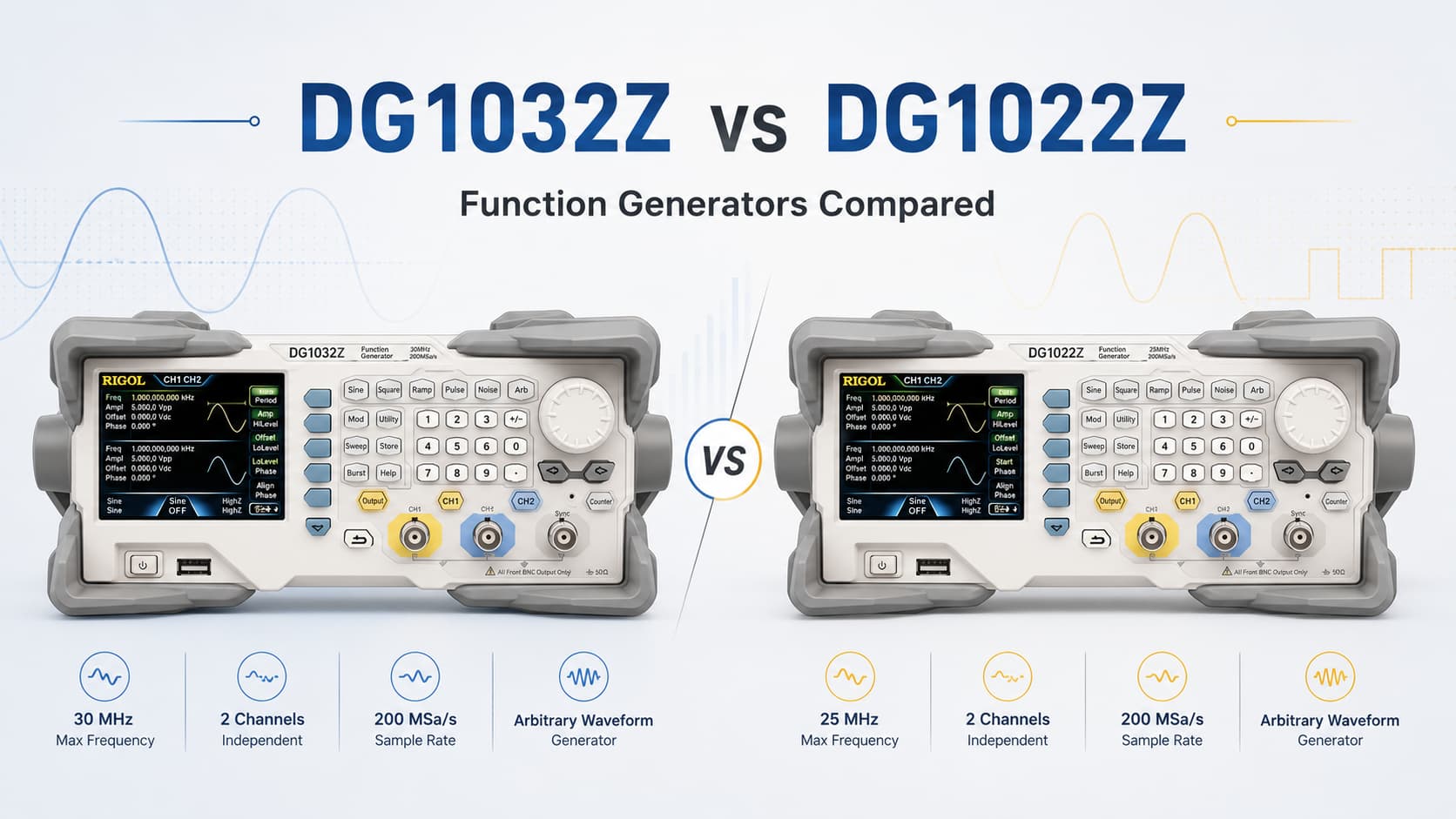
The Rigol DG1032Z and DG1022Z are both 2-channel function/arbitrary waveform generators built on the same DG1000Z platform, sharing the same SiFi signal fidelity technology, 200 MSa/s sample rate, and 14-bit vertical resolution. On paper they look nearly identical, and in many respects they are. But the two specs that actually differ between them — output bandwidth and standard arbitrary waveform memory depth — matter more than the small numbers suggest, especially if your bench work leans on complex or high-frequency arbitrary waveforms.
This comparison walks through exactly where the DG1032Z pulls ahead, when that gap is worth paying for, and when the DG1022Z is the more sensible choice for your bench.
Short answer: if you regularly work with longer or more detailed arbitrary waveforms, or need output frequencies closer to 30 MHz, the DG1032Z is worth the step up. If your signal generation needs are simpler — standard function generator waveforms, basic modulation, and shorter arbitrary sequences — the DG1022Z covers that ground at a lower price with no real compromise.
Quick Pick
Rigol DG1022Z — same SiFi platform, 25 MHz bandwidth, and 2 Mpts of arbitrary memory for general bench signal generation.
Rigol DG1032Z — 30 MHz bandwidth and 8 Mpts standard arbitrary memory for more demanding or detailed waveform work.
Quick Verdict
The DG1032Z and DG1022Z share their core architecture, interface, and feature set, but the DG1032Z’s 8 Mpts of standard arbitrary waveform memory versus the DG1022Z’s 2 Mpts is a meaningfully larger gap than the 5 MHz bandwidth difference alone would suggest. If your work involves longer, more intricate arbitrary waveforms, that memory depth difference is the more important spec to weigh. If you mainly need standard function generator output — sine, square, ramp, pulse, and basic modulation — either unit will serve you well, and the DG1022Z is the more cost-effective pick.
Comparison Table
| Spec | Rigol DG1032Z | Rigol DG1022Z |
|---|---|---|
| Channels | 2 | 2 |
| Max Sine Output Frequency | 30 MHz | 25 MHz |
| Sample Rate | 200 MSa/s | 200 MSa/s |
| Vertical Resolution | 14-bit | 14-bit |
| Standard Arbitrary Memory | 8 Mpts | 2 Mpts |
| Optional Memory Upgrade | Up to 16 Mpts | Up to 16 Mpts |
| Built-In Waveforms | Up to 160 | Up to 160 |
| Modulation Types | AM, FM, PM, ASK, FSK, PSK, PWM | AM, FM, PM, ASK, FSK, PSK, PWM |
| SiFi Signal Fidelity Technology | Yes | Yes |
| Display | 3.5″ TFT color, 320×240 | 3.5″ TFT color, 320×240 |
| Connectivity | USB Host/Device, LAN (LXI) | USB Host/Device, LAN (LXI) |
| Platform | DG1000Z series | DG1000Z series |
Rigol DG1032Z Overview
The DG1032Z sits at the middle of Rigol’s DG1000Z lineup, extending sine output up to 30 MHz while doubling down on the platform’s standout feature: SiFi (Signal Fidelity) technology, which generates arbitrary waveforms point-by-point rather than relying on traditional DDS reconstruction. This produces cleaner, lower-jitter arbitrary signals than older-generation function generators, with jitter as low as 200 picoseconds.
The more consequential upgrade over the DG1022Z is standard memory depth — 8 Mpts versus 2 Mpts. That difference matters most when you’re building longer or more intricate arbitrary waveforms, such as multi-segment test signals, extended digital patterns, or waveforms captured from real-world sensor data that need to be reproduced with fine detail over a longer duration. With only 2 Mpts to work with, you either simplify the waveform or accept a shorter usable record; with 8 Mpts standard, you have considerably more room before running into memory constraints.
Rigol DG1032Z
Best overall for demanding or detailed arbitrary waveform work
The DG1032Z makes sense if you regularly build longer or more complex arbitrary waveforms, need output frequencies closer to 30 MHz, or simply want more headroom before running into memory limitations. The extra standard memory depth is the single biggest reason to choose this model over the DG1022Z.
It’s worth being upfront: the 5 MHz bandwidth gap between these two units rarely matters much on its own. The memory depth difference is the real reason to spend more here, so it’s worth confirming your actual waveform requirements before assuming you need this model.
Rigol DG1032Z Pros
Pros
- 8 Mpts standard arbitrary memory, 4x that of the DG1022Z
- Higher 30 MHz sine output frequency
- Same SiFi signal fidelity and low-jitter performance across both channels
- Better suited to longer or more intricate arbitrary waveforms
Cons
- Priced higher than the DG1022Z for a benefit many users won’t need
- Same sample rate and resolution as the DG1022Z, so no gain in signal fineness
Rigol DG1022Z Overview
The DG1022Z is the entry point into the DG1000Z series, offering the same 2-channel architecture, 200 MSa/s sample rate, and 14-bit vertical resolution as its siblings, with a 25 MHz sine output ceiling and 2 Mpts of standard arbitrary waveform memory. For general-purpose bench work — testing analog circuits, generating standard modulated signals, or simulating basic sensor outputs — this is comfortably enough capability for the vast majority of tasks.
Where the DG1022Z asks for a tradeoff is in longer or more complex arbitrary waveform work, where 2 Mpts of standard memory can start to feel tight. It’s worth noting that both the DG1022Z and DG1032Z share the same optional 16 Mpts memory upgrade path, so if you find yourself needing more headroom later, that option exists on either unit — though buying into the DG1032Z’s larger standard allotment from the outset avoids paying for an add-on down the line.
Rigol DG1022Z
Best value for standard bench signal generation
The DG1022Z is the right call if your work centers on standard function generator waveforms, basic modulation, and moderate-length arbitrary signals. You get the same SiFi technology, sample rate, and resolution as the DG1032Z, just with less standard memory and a slightly lower frequency ceiling — neither of which matters for the majority of general electronics testing.
Don’t feel like you’re settling for less by choosing the DG1022Z. For most bench testing, IC verification, and general signal generation tasks, its memory depth is more than sufficient, and the money saved is better spent elsewhere in your test setup if you don’t have a specific need for deeper arbitrary memory.
Rigol DG1022Z Pros
Pros
- Same SiFi technology and low-jitter arbitrary waveform generation
- Lower price point for the same core platform
- 2 Mpts standard memory is sufficient for most general bench tasks
- Identical sample rate and 14-bit resolution to the DG1032Z
Cons
- Standard memory depth can feel limiting for longer arbitrary waveforms
- Lower 25 MHz frequency ceiling versus the DG1032Z’s 30 MHz
Key Differences
Strip away the shared architecture and the difference between these two generators comes down to two specs: sine output frequency (30 MHz on the DG1032Z versus 25 MHz on the DG1022Z) and standard arbitrary waveform memory (8 Mpts versus 2 Mpts). The frequency gap is modest and rarely decisive on its own. The memory gap is the more meaningful of the two, since it directly affects how long or detailed an arbitrary waveform you can generate before running into constraints.
Everything else — sample rate, vertical resolution, modulation types, built-in waveform library, connectivity, and the SiFi signal fidelity engine — is identical across both models. This makes the buying decision largely about how much arbitrary waveform headroom your work actually requires.
Real-World Performance Comparisons
For standard function generator use — producing sine, square, ramp, and pulse waveforms, or applying AM/FM/PM modulation for communications and sensor simulation testing — both generators perform identically, since none of that work approaches either unit’s memory or frequency ceiling. The practical difference shows up specifically when building longer arbitrary sequences: a detailed multi-cycle waveform that fits comfortably in the DG1032Z’s 8 Mpts might need to be simplified or truncated to fit within the DG1022Z’s 2 Mpts, unless you opt for the 16 Mpts memory upgrade on either unit.
For frequency-sensitive applications approaching either unit’s ceiling, the DG1032Z’s extra 5 MHz of headroom gives a bit more margin, though most bench applications using function generators in this class operate well below 25 MHz regardless of which model you choose.
If you already know you’ll need more than 2 Mpts of arbitrary memory, it’s worth comparing the DG1032Z’s standard 8 Mpts against the cost of adding the optional 16 Mpts upgrade to a DG1022Z, since the better path depends on how much extra memory you actually need.
Customer Opinions: Amazon and Reddit Summary
Reviewers of the DG1022Z consistently describe it as reliable, easy to use, and well suited to general bench and educational use, with praise centered on the intuitive front panel and clean signal output for standard waveform tasks. Some longtime users mention it as a dependable daily-use instrument that rarely gives them reason to think about its memory ceiling, since their work doesn’t push into complex arbitrary waveform territory.
DG1032Z buyers and forum commenters tend to specifically cite the larger standard memory as their reason for choosing it over the DG1022Z, particularly those working with detailed arbitrary signals or longer test sequences. Sentiment across both models is generally positive regarding build quality and the SiFi signal fidelity feature, with most negative feedback centered on the small 3.5-inch display being a minor inconvenience for detailed waveform editing directly on the instrument, a limitation shared by both models.
Which Should You Buy?
Since both generators share the same core platform, this decision comes down almost entirely to how much arbitrary waveform memory your work actually requires, plus whether the modest frequency difference matters for your application.
Buy the Rigol DG1032Z if…
- You regularly build longer or more detailed arbitrary waveforms
- You want more standard memory headroom without paying for an add-on upgrade
- You need output frequencies closer to 30 MHz
- You’d rather buy the extra capability once than upgrade or add options later
Buy the Rigol DG1022Z if…
- Your work centers on standard function generator waveforms and basic modulation
- Your arbitrary waveforms are typically short or moderate in complexity
- You want the same SiFi platform at a lower price point
- 25 MHz of bandwidth comfortably covers your signal requirements
Final Verdict
The Rigol DG1032Z and DG1022Z share nearly everything that makes the DG1000Z platform worth buying — SiFi signal fidelity, 200 MSa/s sampling, 14-bit resolution, and the same modulation and connectivity feature set. The real decision point is arbitrary waveform memory: 8 Mpts standard on the DG1032Z versus 2 Mpts on the DG1022Z, with a modest frequency bump as a secondary consideration. If your bench work regularly pushes into longer or more detailed arbitrary signals, the DG1032Z is worth the step up. If your needs are more standard, the DG1022Z delivers the same core platform for less.
Ready to Decide?
Compare final pricing and availability below