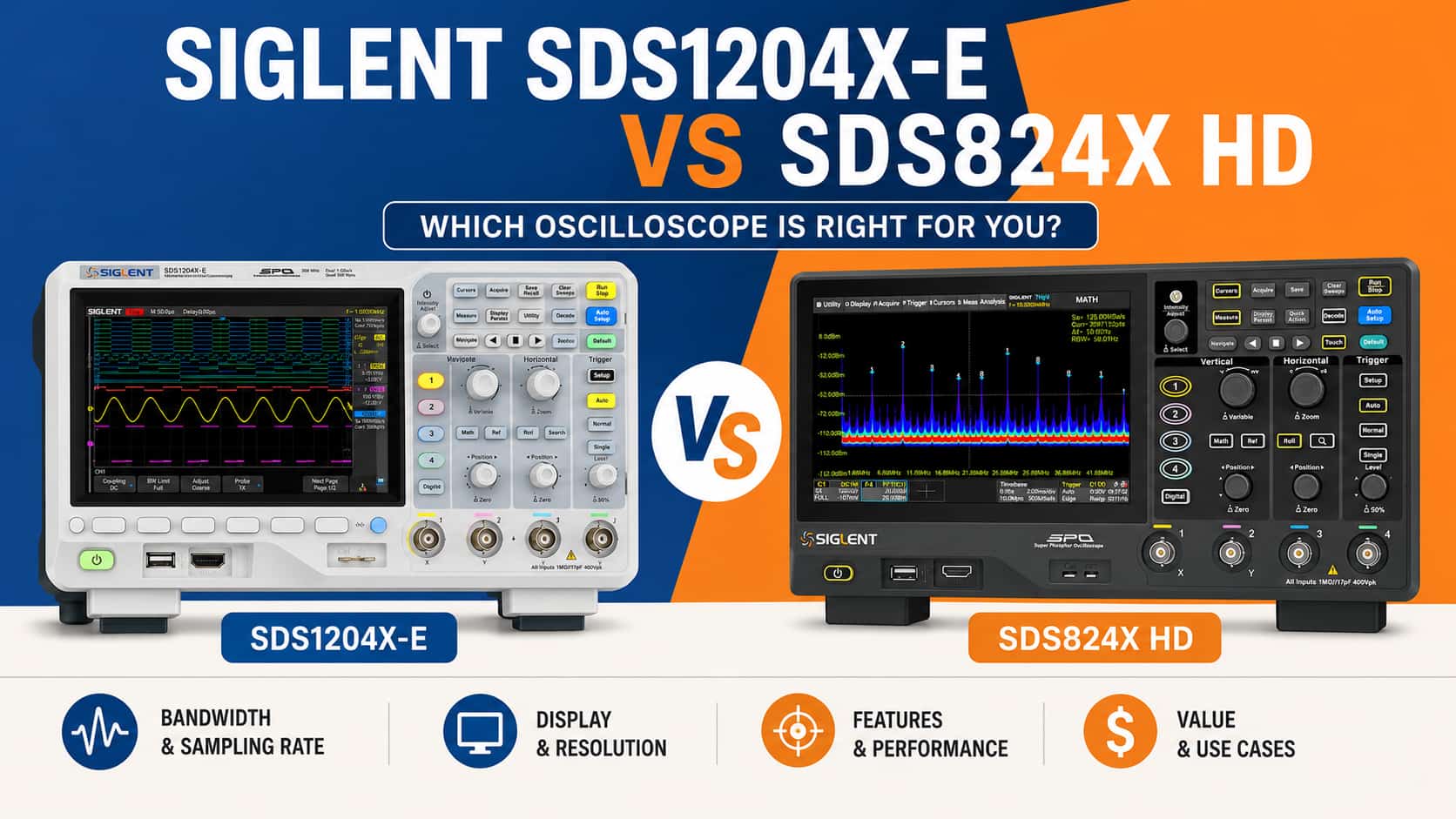
Two of Siglent’s most popular 200 MHz, 4-channel oscilloscopes occupy a similar price bracket — yet they are not the same class of instrument. The SDS1204X-E belongs to Siglent’s older Super Phosphor Oscilloscope (SPO) line, while the SDS824X HD is part of the newer high-definition HD series built around a 12-bit ADC.
📊 Quick Recommendation: SDS1204X-E vs SDS824X HD
| 🏆 Siglent SDS1204X-E | 🚀 Siglent SDS824X HD |
|---|---|
|
Best Overall for Most Engineers ✅ 200 MHz bandwidth ✅ Four analog channels ✅ Proven X-E series platform ✅ Better for RF and high-speed signals ✅ Excellent long-term value Check Price |
Best Resolution and Waveform Detail ✅ 12-bit HD architecture ✅ Significantly lower noise floor ✅ Better for power analysis ✅ Superior low-level signal visibility ✅ Modern HD oscilloscope platform Check Price |
Bottom Line: Choose the SDS1204X-E if you need the extra bandwidth for RF work, faster digital signals, and general-purpose engineering tasks. Choose the SDS824X HD if your priority is cleaner waveforms, better measurement accuracy, power electronics work, or viewing small signals buried in noise.
Read on to see whether bandwidth or 12-bit resolution matters more for your applications.
If you are shopping around $750–$800 and trying to decide between them, this guide breaks down exactly where they differ and who each one is for.
Overview
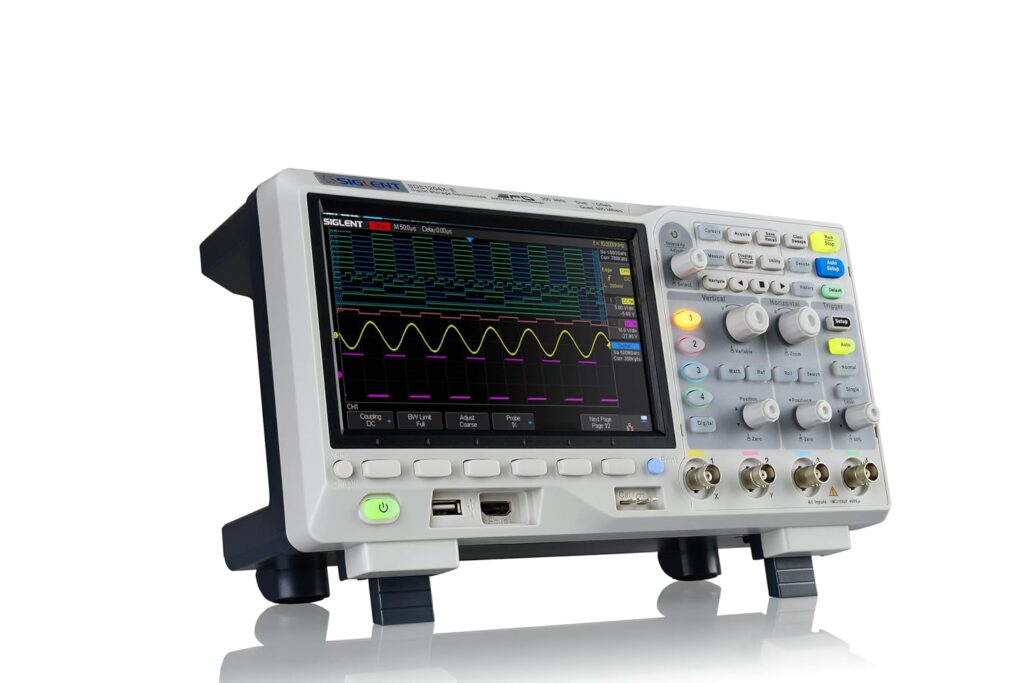
The SDS1204X-E has been on the market for several years and earned a strong reputation as a capable, reliable mid-range scope with a generous feature set for its original price point.
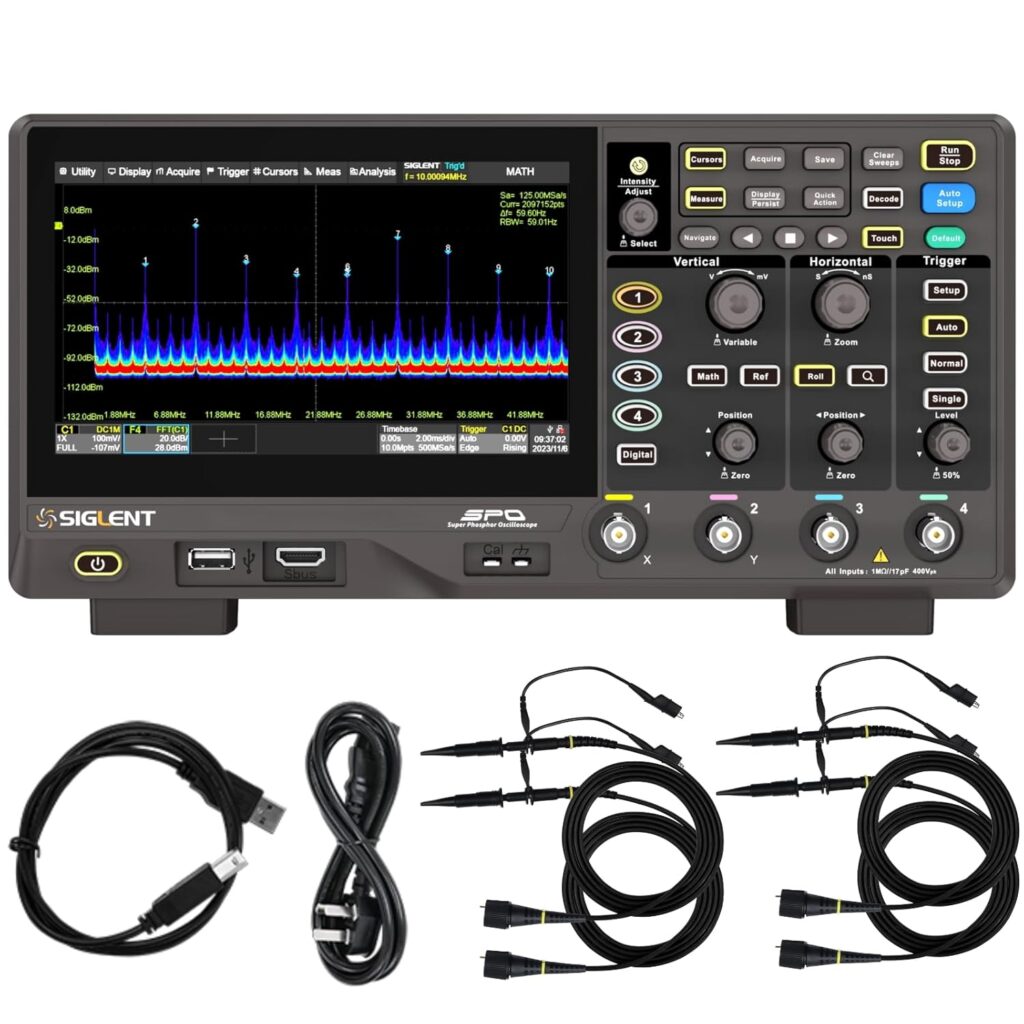
The SDS824X HD is a more recent entry in Siglent’s portfolio, designed to bring high-resolution 12-bit acquisition to the sub-$800 segment. As of mid-2026 both are available at roughly the same price — which makes the comparison unusually direct.
Specs at a Glance
| Feature | SDS1204X-E | SDS824X HD |
|---|---|---|
| Bandwidth | 200 MHz | 200 MHz |
| Channels | 4 analog | 4 analog |
| ADC Resolution | 8-bit | 12-bit |
| Max Sample Rate | 1 GSa/s | 2 GSa/s |
| Sample Rate (4-ch) | 500 MSa/s/ch | 500 MSa/s/ch |
| Memory Depth (1-ch) | 14 Mpts | 100 Mpts |
| Memory Depth (4-ch) | 7 Mpts/ch | 25 Mpts/ch |
| Waveform Capture Rate | 100K wfm/s (normal) / 400K (seq) | 120K wfm/s (normal) / 500K (seq) |
| Display | 7″ TFT LCD, 800×480 | 7″ capacitive touch, 1024×600 |
| FFT | 1 Mpt | 2 Mpts |
| Min Vertical Scale | 500 µV/div | 1 mV/div |
| Bode Plot | Yes (4-ch only) | Yes |
| Mask Test | No | Yes |
| Power Analysis | No | Yes |
| Serial Decode | I²C, SPI, UART, CAN, LIN | I²C, SPI, UART, CAN, LIN |
| CAN-FD / FlexRay | No | No |
| AWG Option | 25 MHz (optional) | 25 MHz (optional) |
| Web/LAN Remote Control | Yes | Yes |
| Touchscreen | No | Yes |
| Price (approx. USD) | Check Price | Check Price |
ADC Resolution: The Core Difference
This is where the comparison begins and ends for many users. The SDS1204X-E uses an 8-bit ADC — the industry-standard depth that has been in budget and mid-range scopes for decades. The SDS824X HD uses a 12-bit ADC, which provides 16 times more vertical quantisation steps than an 8-bit device. In practice that means lower noise floor, cleaner waveform display on small-amplitude signals, and more accurate amplitude measurements.
The difference is most visible when measuring low-level signals — power supply ripple, audio noise floors, RF envelope detection — where an 8-bit scope’s quantisation noise can mask what you are trying to see. For routine digital signal debugging at TTL or CMOS levels, both scopes are perfectly adequate and you may not notice a difference at all.
Memory Depth
The SDS824X HD has a significant advantage here. With four channels active, it gives you 25 Mpts per channel versus 7 Mpts per channel on the SDS1204X-E. In single-channel mode the gap widens further: 100 Mpts versus 14 Mpts. More memory means longer captures at a given sample rate, which matters most for catching intermittent faults and analysing long serial bus transactions.
Display
Both units have 7-inch screens, but the SDS824X HD’s display is a capacitive touchscreen with a higher resolution panel. The SDS1204X-E uses a traditional knob-and-button interface with a non-touch LCD. One independent technical evaluation noted that while the 7-inch panel feels slightly compact compared to the 10.1-inch screens found on Siglent’s higher-end SDS2000 series, the overall build quality and display clarity are solid.
The touchscreen on the SDS824X HD does meaningfully improve daily usability — zooming, panning waveforms, and navigating menus are faster with touch than with the rotary encoder approach of the X-E series.
Where the SDS1204X-E Still Holds Its Own
The SDS824X HD wins on most technical dimensions, but the SDS1204X-E has a few genuine advantages worth noting.
Vertical sensitivity. The SDS1204X-E goes down to 500 µV/div, finer than the SDS824X HD’s 1 mV/div minimum. For very small signal measurements — sub-millivolt sensor outputs, for example — this matters.
Community and documentation. The SDS1204X-E has been widely deployed in universities, hobbyist labs, and small engineering firms for years. There are extensive forum threads, YouTube teardowns, firmware tips, and community tutorials available for it. The SDS800X HD series is newer and the community knowledge base is still growing.
Proven firmware. The X-E firmware has gone through many revision cycles and most edge cases have been identified and patched. The HD series firmware is more recent and, while stable, has had less community-driven testing at scale.
What the SDS824X HD Is Missing
No scope at this price is without trade-offs. The SDS824X HD does not include an external trigger input, 50 Ω termination inputs, or probe factor auto-detection — features you will find on Siglent’s higher-end models. CAN-FD and FlexRay serial protocol decoding are absent (though standard CAN and LIN are included). It also lacks a real-time clock, relying on NTP over a network connection instead.
None of these are dealbreakers for most benchtop use, but engineers coming from higher-end instruments may notice the omissions.
Real Customer Feedback
On the SDS1204X-E, the most consistent feedback theme across forums and review platforms is reliability and value — qualified by the acknowledgement that its price-to-performance ratio has weakened as newer options entered the market. Users on EEVblog and Reddit electronics communities frequently praise the scope’s quiet noise floor for an 8-bit instrument, the free inclusion of serial decoders (some competitors charge extra), and Siglent’s ongoing firmware support. The most common criticisms are the non-touch interface feeling dated and the 7-Mpts-per-channel memory ceiling in four-channel mode being a limitation on long-capture work. One review from a specialised oscilloscope site summarised it well: the SDS1204X-E “was an excellent value two years ago and has since been lapped by the competition” — a fair assessment given what the HD series delivers at the same price.
On the SDS824X HD, a detailed independent evaluation published on Siglent’s Finnish distributor site found the first impression “very positive,” describing the instrument as feeling solid and well-built. The same evaluation measured the actual -3 dB bandwidth at 244 MHz — slightly exceeding the advertised 200 MHz specification. Boot time was recorded at under 40 seconds. The most noted limitation was the 7-inch display feeling compact for users accustomed to the larger screens of higher-tier scopes. On electronics forums, early adopters of the SDS800X HD series highlight the dramatically cleaner waveform presentation compared to 8-bit instruments as the standout benefit, particularly for power integrity and analogue audio work. A recurring comment is that the scope “changes how you look at signals” once you have seen the same waveform on a 12-bit display versus an 8-bit one.
🏆 Editor’s Choice: Siglent SDS824X HD
Our Recommendation: Buy the Siglent SDS824X HD.
At nearly the same price as the SDS1204X-E, the SDS824X HD delivers meaningful hardware improvements including a 12-bit ADC, 2 GSa/s sample rate, deeper memory, higher waveform capture rates, and a modern capacitive touchscreen interface. These are genuine engineering upgrades that improve everyday measurements and make it easier to see low-level signal details.
- ✅ 12-bit ADC for cleaner, more detailed waveforms
- ✅ Higher sample rate for improved signal capture
- ✅ Deeper memory for longer acquisitions
- ✅ Faster waveform update rate
- ✅ Modern touchscreen user interface
Consider the SDS1204X-E only if:
- ✓ You specifically need the 500 µV/div vertical sensitivity
- ✓ You value its larger ecosystem of tutorials and community resources
For most engineers, makers, embedded developers, and power electronics users, the SDS824X HD is the better long-term investment and the oscilloscope you’re less likely to outgrow.
Check SDS824X HD Price