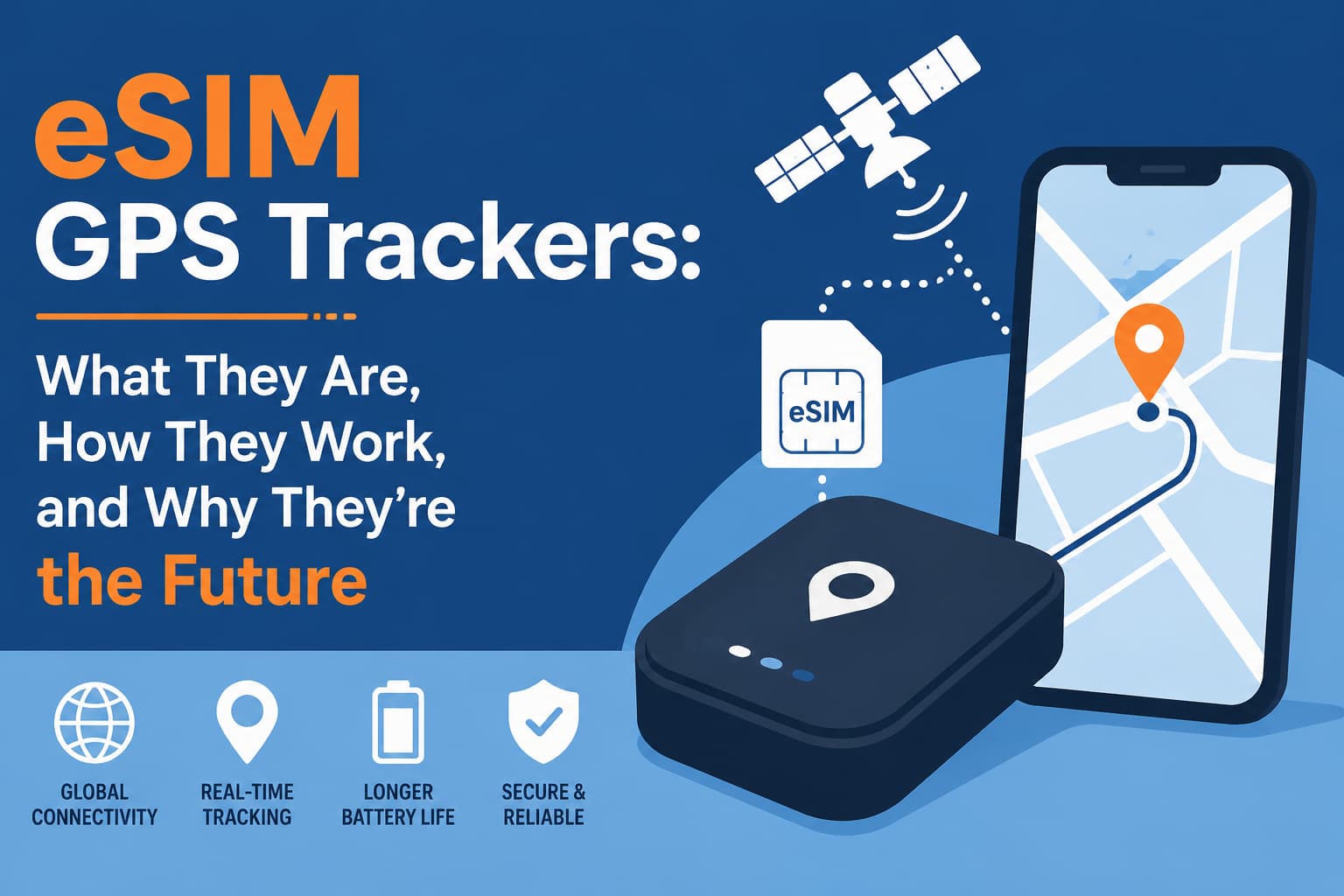
📡 For years, GPS trackers relied on physical SIM cards to send real-time location data over cellular networks. But that’s starting to change. A new generation of GPS trackers now uses eSIM technology, offering better reliability, global coverage, smaller device size, and improved durability. If you’re considering a tracker for your vehicle, luggage, fleet, or personal safety, eSIM-based trackers are quickly becoming the superior option.
This guide breaks down everything you need to know about eSIM GPS trackers – how they work, their advantages, limitations, costs, and which models are worth buying.
📡 TL;DR – eSIM GPS Trackers Explained
eSIM GPS trackers are the next generation of real-time tracking. They use an embedded SIM (no physical card) to send your GPS location over cellular networks.
Why they’re better:
• Smaller, more durable, waterproof designs
• No SIM tray = fewer hardware failures
• Global roaming + automatic carrier switching
• Easy activation and remote provisioning
Best for:
• Vehicles, fleets, shipping, travel, bikes, and high-value assets
• International or cross-border tracking
• Long-term deployments that need reliability
Limitations:
• Requires a monthly subscription
• Slightly higher hardware cost
• Still dependent on cellular coverage (not satellite)
Bottom line: eSIM GPS trackers offer superior reliability and global connectivity. Choose one if you need real-time tracking that “just works” anywhere with cellular service.
🚀 What Is an eSIM GPS Tracker?
An eSIM GPS tracker uses an embedded SIM (eSIM) instead of a removable SIM card. Unlike traditional SIMs, an eSIM is:
- Soldered directly onto the device’s circuit board
- Not removable
- Activated digitally through software
- Able to switch carriers remotely
This makes the tracker smaller, more rugged, and easier to deploy internationally.
Remember the core rule:
- GPS determines the location
- Cellular (via eSIM) sends that location to your app
The eSIM simply replaces the physical SIM card that enables cellular connectivity.
🌍 Why eSIM Is Better for GPS Tracking
eSIM brings multiple advantages over traditional SIM-based trackers.
Smaller size = more placement options
Without a SIM tray, pins, or SIM slot, manufacturers can build:
- Thinner devices
- Waterproof designs
- Trackers that fit into tighter spaces
This is especially useful for asset tracking, bikes, drones, and compact vehicle installs.
Better reliability
Since the eSIM is permanently mounted:
- No loose SIM contacts
- No corrosion over time
- No SIM reseating issues
- Fewer hardware failures
It also handles vibration and temperature swings better than physical SIMs.
Global carrier switching
Many eSIM trackers support multi-carrier roaming, meaning they can automatically switch networks to maintain a connection. This dramatically improves coverage, especially for:
- International travelers
- Shipping and logistics
- Cross-border trucking
- High-value asset transport
Some models include 300+ country coverage out of the box.
Improved waterproofing and durability
Without an SIM tray opening, tracking units can achieve:
- IP67/IP68 waterproofing
- Dust resistance
- Shock resistance
Great for outdoor gear, construction equipment, boats, and long-term vehicle installs.
Easier provisioning
Activation is done digitally—no SIM card to insert or configure.
- Activate through the app
- Add plans or carriers instantly
- Switch networks without touching the device
This saves huge time for fleet deployments.
🔧 How eSIM GPS Trackers Work
Even with eSIM, the tracker still has three core components:
- GPS/GNSS module – Receives satellite positioning data
- Cellular modem – Uses eSIM to transmit that data
- Software/app – Displays real-time location, alerts, and history
Most modern eSIM trackers support multi-constellation GNSS:
- GPS
- GLONASS
- Galileo
- BeiDou
This provides better accuracy and more reliable performance in dense urban areas and challenging environments.
📦 Types of eSIM GPS Trackers
1. Vehicle Trackers (OBD or hardwired)
Great for cars, delivery vans, trucks, and fleets.
Benefits:
- Real-time tracking
- Driving behavior monitoring
- Engine data (OBD-II models)
- Theft recovery
2. Asset Trackers
Designed for tools, equipment, packages, bikes, containers, and luggage.
Benefits:
- Small and rugged
- Long battery life
- Global roaming
- Movement alerts
3. Personal Safety Trackers
Used for kids, seniors, solo travelers, and outdoor adventurers.
Benefits:
- SOS button
- Real-time tracking
- Geofence alerts
4. IoT/Industrial Trackers
Built for logistics, agriculture, and remote monitoring.
Benefits:
- Multi-year batteries
- Extreme durability
- Wide coverage
🛰️ eSIM vs Physical SIM in GPS Trackers
| Feature | eSIM Tracker | SIM Card Tracker |
|---|---|---|
| Device size | Smaller | Larger |
| Reliability | Higher | Can fail due to SIM issues |
| Waterproofing | Better | Limited by SIM slot |
| Carrier switching | Easy and remote | Manual replacement |
| International use | Excellent | Often requires new SIM |
| Cost | Slightly higher | Lower upfront |
| Activation | Software-based | Insert SIM manually |
If you need global coverage, durability, or fleet-level scalability, eSIM is the better choice.
⚡ Limitations of eSIM GPS Trackers
eSIM is excellent, but not perfect. Here’s what to consider:
1. Subscription required
Real-time tracking still requires a monthly or annual cellular plan.
Typical cost:
- $5–$25 per month
- More for global roaming
2. Not compatible with user-supplied SIMs
Most eSIM trackers require you to use their built-in data plan.
You usually cannot insert your own SIM or downgrade to a cheaper plan.
3. Slightly higher upfront cost
The hardware is more advanced, so you may pay $10–$40 more than a SIM-based tracker.
4. Still relies on cellular coverage
No SIM = no data transmission
Even eSIM devices operate on LTE/4G/5G networks and will have dead zones.
🌐 Best Uses for eSIM GPS Trackers
You should choose an eSIM-enabled model if you need:
- International or cross-border tracking
- Rugged, waterproof hardware
- Ultra-compact trackers
- Maintenance-free fleet deployment
- Tamper-proof design
- Reliable long-term performance
They’re especially ideal for:
- Long-distance trucking
- Shipping containers
- High-value equipment
- Luggage and travel
- Bike tracking
- Construction assets
- Motorcycles
- Boats and ATVs
🔋 Battery Life on eSIM Trackers
Because eSIM reduces internal space and mechanical components, manufacturers can design:
- Larger internal batteries
- More efficient power management
- Multi-year battery options for industrial units
Typical battery life:
- Real-time trackers: 2–14 days
- Periodic update trackers: 1–12 months
- Industrial trackers: up to 10 years
💰 Cost Breakdown
Hardware cost
$40–$200 depending on model.
Subscription cost
Ranges from:
- $5–$10/month (domestic coverage)
- $10–$20/month (international roaming)
Some companies offer:
- Annual discounts
- Multi-year plans
- Pay-as-you-go usage
🌍 eSIM GPS Trackers vs Satellite Trackers
Satellite solutions (Garmin inReach, SPOT) work anywhere, but cost more.
| Feature | eSIM GPS Tracker | Satellite Tracker |
|---|---|---|
| Coverage | Areas with LTE service | Global (even oceans) |
| Cost | Low monthly fees | High fees |
| Real-time tracking | Yes | Yes |
| Best for | Cities, highways, shipping, fleets | Remote wilderness, aviation, marine |
Choose satellite only if you operate in areas without cellular coverage.
🧭 Recommended eSIM GPS Trackers
Here are reliable models popular in fleet and consumer markets:
1. Tracki Universal LTE + eSIM
- Global roaming included
- Extremely compact
- Strong app support
2. Invoxia GPS Tracker (eSIM IoT)
- Excellent battery life
- Long-term asset tracking
- Good for bikes and equipment
3. Apple AirTag (Not true eSIM but embedded technology)
Uses Apple’s Find My network instead of cellular, but conceptually similar for short-range tracking.
4. Fleet-based eSIM trackers (CalAmp, Samsara, Geotab)
- Automatic carrier switching
- Enterprise-level reliability
- Best-in-class fleet software
🏁 Final Recommendations
eSIM GPS trackers are quickly becoming the gold standard for real-time tracking. They offer:
- Better global coverage
- Smaller, more durable designs
- Improved reliability
- Easy activation and remote management
Choose an eSIM tracker if you need dependable performance for vehicles, fleets, travel, or high-value assets. For casual tracking of personal items or offline route recording, non-SIM trackers like AirTags or GPS loggers may be more affordable.
If you want, I can also add:
📌 A comparison table
📌 A TL;DR callout box
📌 A title image (widescreen, branded)
📌 Affiliate-ready product table for Tracki, LandAirSea, or others
Just tell me what you need!