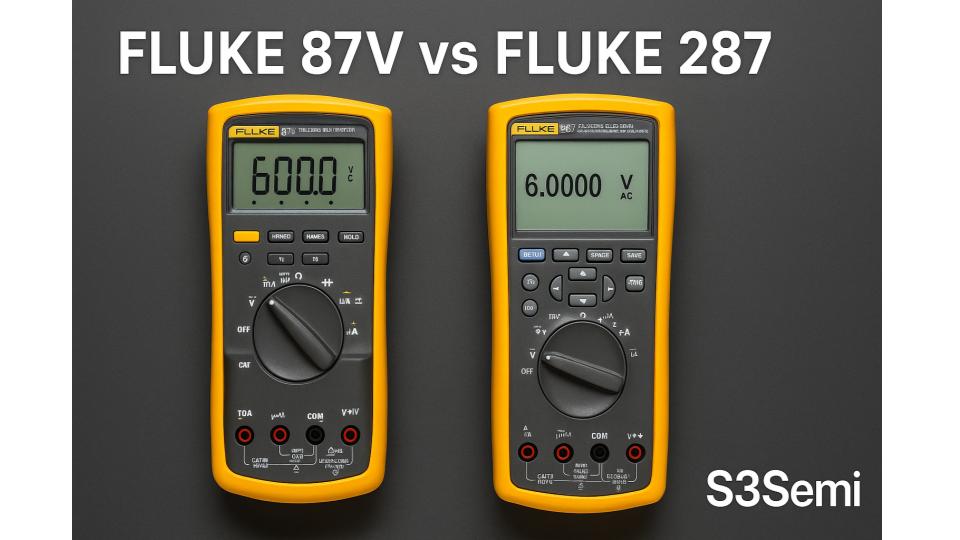
When it comes to professional multimeters, the Fluke 87V and the Fluke 287 are two of the most advanced models in Fluke’s lineup.

⚡ Quick Pick: Fluke 87V vs Fluke 287
Choose the Fluke 87V if you want a rugged, fast, industrial multimeter built for field troubleshooting, motors, drives, electrical panels, and harsh work environments.
Choose the Fluke 287 if you need advanced data logging, trend capture, larger display, and detailed analysis for electronics, R&D, bench work, and long-duration monitoring.
🏆 Best for Industrial Field Work: Fluke 87V
The Fluke 87V is the better choice for electricians, plant technicians, and maintenance professionals who need a tough, dependable True RMS meter with excellent accuracy, fast response, and strong motor-drive troubleshooting capability.
📊 Best for Logging & Advanced Analysis: Fluke 287
The Fluke 287 is ideal if you need to record measurements over time, spot intermittent problems, view trends, and analyze changing signals. It is better suited to electronics benches, diagnostics, engineering work, and detailed troubleshooting sessions.
Bottom line: Buy the Fluke 87V if you want the tougher, faster, field-proven industrial meter. Buy the Fluke 287 if data logging, trend analysis, and advanced bench diagnostics matter more than rugged simplicity.
🏷️ Fluke Multimeter Deals ⭐⭐⭐⭐
Both are True-RMS, highly accurate, and designed for demanding electrical and electronic work. But while they share similarities, they target different kinds of professionals.
Let’s break them down.
📋 Quick Overview
- Fluke 87V: The workhorse of the Fluke lineup, designed for industrial electricians and field engineers. Known for its rugged build, CAT IV safety rating, and low-pass filter for troubleshooting motor drives.
- Fluke 287: A precision logging multimeter with a high-resolution display, data logging, and graphing capabilities. Built for R&D engineers, electronics troubleshooting, and advanced diagnostics.
📊 Fluke 87V vs Fluke 287 Comparison Table
| Feature | Fluke 87V | Fluke 287 |
|---|---|---|
| Display | 20,000-count dual LCD | 50,000-count dot-matrix LCD with trend graph |
| True-RMS | Yes | Yes |
| AC/DC Voltage | Up to 1000V | Up to 1000V |
| Current Measurement | Up to 20A (30s overload) | Up to 10A |
| Resistance | Up to 50 MΩ | Up to 500 MΩ |
| Capacitance | Up to 9,999 µF | Up to 100 mF (100,000 µF) |
| Frequency | Up to 200 kHz | Up to 1 MHz |
| 💳 Pricing | 💲 Check Price | 💲 Check Price |
| Temperature Measurement | Yes (with probe) | Yes (with probe) |
| Special Features | Low-pass filter, peak min/max (250 µs), rugged build | Data logging, USB connectivity, onboard graphing |
| Safety Rating | CAT III 1000V, CAT IV 600V | CAT III 1000V, CAT IV 600V |
| Battery Type | 9V | 6 × AA |
| Target User | Industrial electricians, field technicians | R&D engineers, electronics troubleshooting |
✅ Pros & Cons of Fluke 87V

Pros
- Extremely rugged and field-ready
- High safety rating (CAT IV 600V)
- Handles up to 20A
- Excellent for industrial applications (motors, drives, power systems)
- Faster response for field diagnostics
Cons
- Limited logging and analysis features
- Lower display resolution than the 287
- Bulkier compared to mid-range Fluke models
✅ Pros & Cons of Fluke 287

Pros
- High-resolution 50,000-count display
- Trend graphing directly on the meter
- Advanced data logging with USB export
- Wider resistance, capacitance, and frequency ranges
- Ideal for lab work and R&D diagnostics
Cons
- Slower boot and response compared to 87V
- More expensive
- Less rugged for field use
- Heavier due to AA battery pack
🛠️ Which One Should You Choose?
- Choose the Fluke 87V if you’re an industrial electrician, field engineer, or maintenance professional who needs a rugged, reliable, and fast meter for motors, drives, and power systems.
- Choose the Fluke 287 if you’re an electronics engineer, R&D professional, or advanced troubleshooter who needs logging, graphing, and lab-grade precision.
In short:
- 87V = Rugged field multimeter for industrial use
- 287 = Precision lab multimeter for advanced analysis
Related Posts
- Fluke 28 II vs Fluke 87V: Which Industrial Multimeter is Better?
- Fluke 87V or 787? Key Differences Explained
- Fluke 117 vs Fluke 87V: Which Multimeter Should You Choose?
