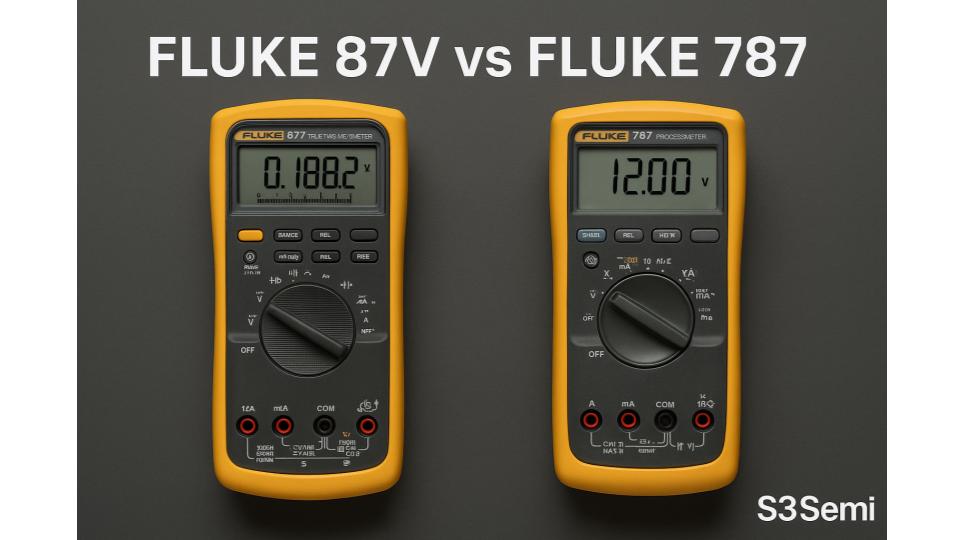
Fluke has long been the gold standard in professional-grade test equipment. Two models that often get compared are the Fluke 87V, an industrial multimeter known for its accuracy and ruggedness, and the Fluke 787, a process meter that combines multimeter functions with loop calibration features.

Bottom line: The Fluke 87V is the better choice for electricians, engineers, and technicians who need a rugged, high-accuracy industrial multimeter. The Fluke 787 is the better choice for process technicians who need a multimeter and loop calibrator in one tool.
| Feature | Fluke 87V | Fluke 787 | Best Choice |
|---|---|---|---|
| Primary use | Industrial electrical troubleshooting | Process control and loop calibration | 87V for general industrial work, 787 for process work |
| True RMS | Yes | Yes | Tie |
| Voltage range | Up to 1000V | Up to 1000V | Tie |
| Current measurement | Up to 10A, 20A for short bursts | Up to 1A | Fluke 87V |
| Current sourcing | No | Yes, up to 20 mA | Fluke 787 |
| DC voltage accuracy | ±0.05% | ±0.1% | Fluke 87V |
| Frequency measurement | 0.5 Hz to 200 kHz | 1 Hz to 20 kHz | Fluke 87V |
| Temperature measurement | Yes, with probe | No | Fluke 87V |
| Special features | VFD filter, high-resolution mode, analog bar graph | 4-20 mA loop sourcing and measurement | Depends on the job |
| Best fit | Electricians, engineers, maintenance technicians | Instrumentation and process-control technicians | 87V for troubleshooting, 787 for calibration |
Buy the Fluke 87V if you want the stronger all-around industrial multimeter. It is the better pick for electrical troubleshooting, VFD work, temperature measurement, higher current measurement, and high-accuracy bench or field diagnostics.
Skip it if: your main job is sourcing and measuring 4-20 mA process loops.
Buy the Fluke 787 if you work with industrial automation, transmitters, control loops, sensors, and 4-20 mA signals. It combines digital multimeter functions with loop calibration features.
Skip it if: you mainly need a high-current, high-accuracy industrial troubleshooting meter.
🏷️ Fluke Multimeter Deals ⭐⭐⭐⭐
Both share Fluke’s legendary reliability. However, they’re built for different types of professionals.
📊 Detailed Comparison Table
| Feature | Fluke 87V | Fluke 787 |
|---|---|---|
| Primary Use | Industrial troubleshooting | Process control & calibration |
| True RMS | Yes | Yes |
| Voltage Range | Up to 1000V | Up to 1000V |
| Current Measurement | Up to 10A (20A for 30s) | Up to 1A |
| Current Sourcing | No | Yes, up to 20 mA |
| Accuracy (DC Voltage) | ±0.05% | ±0.1% |
| Frequency Measurement | 0.5 Hz – 200 kHz | 1 Hz – 20 kHz |
| Temperature Measurement | Yes (with probe) | No |
| Display | Large dual display with analog bar graph | Digital display, backlit |
| Safety Rating | CAT III 1000V / CAT IV 600V | CAT III 1000V / CAT IV 600V |
| Special Features | High-resolution mode, VFD filter, analog bar graph | Loop calibration (source & measure mA), HART compatibility |
| Warranty | Lifetime | 3 years |
| Typical Price | 💲 Check Price | 💲 Check Price |
⚡ Fluke 87V Overview
The Fluke 87V is one of the most popular industrial multimeters in the world. Known for its accuracy, durability, and wide measurement range, it’s built to handle tough industrial environments.

With features like a low-pass filter for VFDs, high-resolution mode, and temperature measurement, it’s a versatile tool for electricians and engineers.
✅ Pros of Fluke 87V
- Extremely accurate (±0.05%)
- Measures up to 1000V and 10A (20A for short bursts)
- Handles variable frequency drives (VFDs) with special filter
- Dual display with analog bar graph for fluctuating signals
- Lifetime warranty
❌ Cons of Fluke 87V
- More expensive than the 787
- Larger and heavier
- Lacks current sourcing (important for process control work)
🔧 Fluke 787 Overview
The Fluke 787 is a process meter, designed specifically for technicians in industrial automation and process control. In addition to its multimeter capabilities, it can source and measure current loops (4–20 mA), making it ideal for calibrating transmitters, testing sensors, and troubleshooting control systems.

✅ Pros of Fluke 787
- Combines a digital multimeter with loop calibration in one tool
- Sources and measures current up to 20 mA
- Compact and lightweight compared to carrying two separate devices
- CAT III 1000V / CAT IV 600V safety rated
- More affordable than the 87V
❌ Cons of Fluke 787
- Lower current measurement capacity (1A max)
- No temperature measurement
- Not as accurate as the 87V for high-precision electronics work
- Shorter warranty (3 years vs lifetime)
🎯 Recommendation
- Choose the Fluke 87V if you are an industrial electrician, engineer, or advanced technician who needs a high-accuracy, rugged multimeter for troubleshooting electrical systems, electronics, or variable frequency drives.
- Choose the Fluke 787 if you work in process control or industrial automation and need a tool that combines multimeter functions with current loop sourcing and measurement. It’s an excellent all-in-one solution for calibration tasks.
👉 In short: The Fluke 87V is the ultimate choice for industrial troubleshooting, while the Fluke 787 is best for process control and loop calibration professionals.
