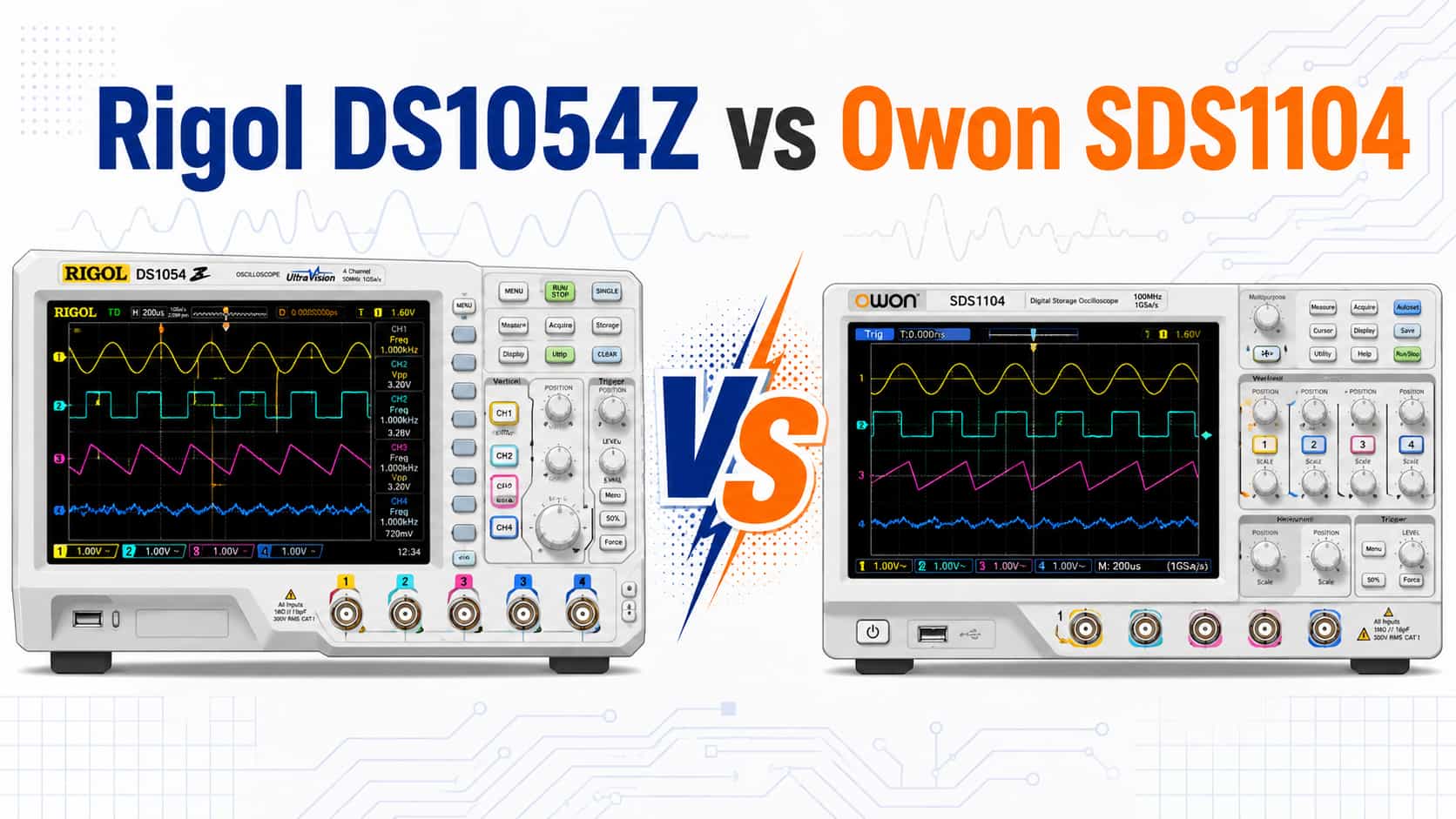
The Rigol DS1054Z and Owon SDS1104 are both four-channel digital oscilloscopes aimed at electronics hobbyists, students, repair technicians, and engineers who want more visibility than a basic two-channel scope can provide.
The Rigol DS1054Z is one of the most widely recommended entry-level bench oscilloscopes. Its biggest strengths are its proven track record, deep memory, strong community support, and excellent documentation. It is a safe choice for users who want a dependable general-purpose scope for embedded systems, power supplies, digital logic, and everyday bench troubleshooting.
The Owon SDS1104 is a value-focused alternative that typically appeals to buyers who want four channels and a higher advertised bandwidth class at a competitive price. It can be attractive if you mainly need basic waveform viewing and want to maximize specifications for the money.
The right choice depends on your priorities. The Rigol is the better-supported and more proven instrument. The Owon is the more budget-oriented higher-bandwidth alternative.
Choose the Rigol DS1054Z if you want the safer, better-documented, more widely supported four-channel oscilloscope for general electronics work.
Choose the Owon SDS1104 if you want a lower-cost four-channel scope with a higher advertised bandwidth class and you are comfortable with a smaller support ecosystem.
The Rigol DS1054Z is the better all-around choice for most users. It offers four channels, deep memory, reliable triggering, and a huge community of users. That makes it easier to learn, easier to troubleshoot, and easier to recommend as a first serious bench oscilloscope.
The Owon SDS1104 is worth considering if you want four channels and a higher nominal bandwidth rating at a competitive price. It is best for general waveform viewing, hobby electronics, and light bench work where community support is less important.
Bottom line: Buy the Rigol DS1054Z if you want the more trusted, better-supported scope. Buy the Owon SDS1104 if advertised bandwidth and price matter more than ecosystem and long-term support.
Quick Verdict
Buy the Rigol DS1054Z if:
- You want a proven four-channel bench oscilloscope.
- You value deep memory and reliable triggering.
- You want extensive tutorials, documentation, and community support.
- You work on microcontrollers, embedded systems, power supplies, digital logic, and general electronics.
- You want the safer long-term purchase.
Buy the Owon SDS1104 if:
- You want four channels at a competitive price.
- You want a higher advertised bandwidth class.
- You mainly need basic waveform viewing and general signal checks.
- You already understand oscilloscopes and need less community support.
- You are comfortable choosing value over ecosystem.
Rigol DS1054Z vs Owon SDS1104 Comparison Table
| Feature | Rigol DS1054Z | Owon SDS1104 |
|---|---|---|
| Oscilloscope Type | Digital storage oscilloscope | Digital storage oscilloscope |
| Analog Channels | 4 channels | 4 channels |
| Bandwidth Class | 50 MHz class | 100 MHz class |
| Sample Rate | Up to 1 GSa/s, depending on active channels | Typically up to 1 GSa/s, depending on configuration |
| Memory Depth | Deep memory, one of its strongest advantages | Generally more limited in practical use |
| Display | Color bench scope display | Color bench scope display |
| Triggering | Strong for the price and well documented | Functional for general use |
| Serial Decode | Available depending on options or bundle | Model and bundle dependent |
| Software and Community Support | Very strong | Smaller ecosystem |
| Best For | General electronics, education, embedded systems, repair, power supply debugging | Budget four-channel use, basic waveform viewing, higher-bandwidth value hunting |
| Main Advantage | Proven usability and ecosystem | Higher advertised bandwidth class for the money |
| Main Limitation | Lower nominal bandwidth rating | Less established documentation and community support |
Rigol DS1054Z Overview
The Rigol DS1054Z became popular because it brought four-channel oscilloscope capability to a price range that students, hobbyists, small labs, and repair benches could justify. It is not the newest oscilloscope on the market, but it remains one of the most familiar and widely supported entry-level bench scopes.
Its most important advantage is not just one specification. It is the overall package. Four channels let you compare multiple signals at once. Deep memory helps capture longer events without immediately losing detail. A large user base means there are many tutorials, configuration examples, and troubleshooting discussions available online.
For embedded systems work, the DS1054Z is especially useful. You can monitor several digital and analog signals at the same time, such as SPI clock, data, chip select, reset, and a power rail. That kind of visibility is often more useful than having only two channels with a higher bandwidth rating.
The Rigol DS1054Z is the best choice for most users who want a dependable four-channel oscilloscope with deep memory, strong documentation, and a massive user community. It is ideal for embedded systems, repair work, education, and general electronics troubleshooting.
- ✓ Four analog channels
- ✓ Deep memory for longer captures
- ✓ Reliable triggering for the price
- ✓ Excellent online documentation and tutorials
- ✓ Strong choice for students, hobbyists, and technicians
Rigol DS1054Z Pros
- Excellent reputation and long-term track record
- Four channels at an accessible price
- Deep memory is useful for capturing longer signal events
- Large user community and strong online support
- Good choice for embedded systems and education
- Plenty of tutorials, videos, and troubleshooting examples
- Reliable general-purpose bench instrument
Rigol DS1054Z Cons
- Lower nominal bandwidth than the Owon SDS1104
- Older interface compared with newer scopes
- Not ideal for higher-frequency RF or very fast edge work
- Some advanced features may depend on options or bundles
- Users who only care about headline bandwidth may prefer another model
Owon SDS1104 Overview
The Owon SDS1104 is aimed at users who want a budget-friendly four-channel oscilloscope with a higher advertised bandwidth class. On paper, the higher bandwidth can look attractive, especially when comparing it against the 50 MHz class Rigol DS1054Z.
The SDS1104 can be useful for general waveform viewing, hobby electronics, audio-frequency work, power supply troubleshooting, and basic digital signal checks. If your main goal is to see whether a signal exists, compare timing, estimate amplitude, or observe multiple channels at once, it can be a practical bench tool.
The main tradeoff is the ecosystem. The Owon does not have the same level of community support, third-party tutorials, long-term user history, and documentation depth as the Rigol DS1054Z. Experienced users may not care, but beginners often benefit greatly from having a larger knowledge base around the instrument.
The Owon SDS1104 is a practical alternative if you want four channels and a higher advertised bandwidth class at a competitive price. It is best suited to users who need basic waveform inspection and already understand how to work around a smaller support ecosystem.
- ✓ Four analog channels
- ✓ Higher advertised bandwidth class than the DS1054Z
- ✓ Useful for general-purpose signal checks
- ✓ Budget-friendly alternative
- ✓ Suitable for hobby and light bench work
Owon SDS1104 Pros
- Four channels for multi-signal debugging
- Higher advertised bandwidth class than the DS1054Z
- Often competitively priced
- Useful for general electronics troubleshooting
- Good option for users who want basic scope functionality without overspending
- Can be attractive for hobbyists and light-duty bench users
Owon SDS1104 Cons
- Smaller user community than Rigol
- Less online documentation and tutorial support
- Software and workflow may feel less polished
- May not be as easy for beginners to troubleshoot
- Long-term resale and support are not as strong as the DS1054Z
Key Differences
The biggest difference between the Rigol DS1054Z and Owon SDS1104 is the tradeoff between ecosystem and proven usability versus headline specifications and budget value.
The Rigol DS1054Z has a lower nominal bandwidth rating, but it is one of the most familiar oscilloscopes in its class. That makes it easier to learn, easier to troubleshoot, and easier to recommend for students, hobbyists, and technicians who want a dependable first serious scope.
The Owon SDS1104 may offer a higher advertised bandwidth class for the money, but it does not have the same level of community knowledge behind it. For experienced users, that may be acceptable. For beginners, the Rigol is usually the safer purchase.
In simple terms: the Rigol DS1054Z is the better-supported and more proven scope. The Owon SDS1104 is the more specification-focused budget alternative.
Real-World Performance Comparisons
Which Is Better for Beginners?
The Rigol DS1054Z is better for beginners because there are far more tutorials, forum posts, setup examples, and troubleshooting guides available. When you are learning triggering, memory depth, probe compensation, coupling, cursors, and measurements, that ecosystem matters.
Which Is Better for Embedded Systems?
The Rigol DS1054Z is also the better choice for embedded systems work. Four channels and deep memory make it useful for watching microcontroller signals, serial buses, GPIO timing, reset lines, and power rails at the same time.
Which Is Better for General Electronics Repair?
For repair work, both scopes can be useful, but the Rigol DS1054Z is the safer pick. Its known behavior, large installed base, and general reliability make it easier to use as a daily troubleshooting instrument.
Which Is Better for Higher-Frequency Signals?
The Owon SDS1104 has the advantage in advertised bandwidth. If your work truly requires signals closer to the 100 MHz range, it may be more attractive. However, bandwidth alone is not the whole story. Triggering, memory depth, noise, probes, and usability all affect real-world results.
Which Is Better for Students and Teaching Labs?
The Rigol DS1054Z is better for students and teaching labs because it is widely documented and commonly used. Instructors, lab partners, and online resources are more likely to be familiar with it.
Which Is Better for Value?
The answer depends on how you define value. If value means the lowest price for four channels and a higher bandwidth rating, the Owon SDS1104 is appealing. If value means long-term usability, documentation, confidence, and support, the Rigol DS1054Z is usually the stronger buy.
Customer Opinions
Amazon buyers and electronics hobbyists generally view the Rigol DS1054Z as a proven entry-level classic. Common praise focuses on its four channels, deep memory, strong feature set for the price, and large community support. Many owners describe it as one of the best first serious oscilloscopes for a home lab, student bench, or small repair workspace.
Common complaints about the DS1054Z usually focus on its age, interface, fan noise in some units, and lower nominal bandwidth compared with newer alternatives. Even so, it remains widely recommended because users know what to expect from it.
Customer opinions on the Owon SDS1104 tend to be more value-focused. Users like the four-channel layout and higher advertised bandwidth for the money. It is often seen as a practical low-cost tool for basic signal viewing and hobby use.
Reddit and forum discussions tend to favor Rigol when beginners ask for a first bench scope, mostly because of its ecosystem and proven reliability. Owon is usually discussed as a budget alternative that can work well, but with less community guidance and fewer long-term user references.
Which Should You Buy?
Buy the Rigol DS1054Z if:
- You want the safest recommendation for a first serious oscilloscope.
- You value community support and documentation.
- You work on embedded systems, digital logic, repair, and general electronics.
- You want deep memory and reliable everyday usability.
- You prefer a proven instrument over a spec-sheet gamble.
Buy the Owon SDS1104 if:
- You want a lower-cost four-channel scope.
- You want a higher advertised bandwidth class.
- You already know how to use oscilloscopes and need less community support.
- You mainly need basic waveform viewing.
- You are comfortable choosing value over ecosystem.
The Rigol DS1054Z is the better choice for most users because it combines four channels, deep memory, strong usability, and an unmatched support ecosystem in the entry-level oscilloscope category.
The Owon SDS1104 is still worth considering if you are shopping primarily on price and advertised bandwidth. It can be a practical tool for basic waveform viewing, but it is not as easy to recommend as the safer all-around choice.
Best for students, hobbyists, repair technicians, and engineers who want a proven four-channel oscilloscope with excellent documentation and long-term community support.
Best for users who want four channels and a higher advertised bandwidth rating at a competitive price, especially for general-purpose hobby and light bench work.
Bottom line: Buy the Rigol DS1054Z if you want the better-supported and more trusted oscilloscope. Buy the Owon SDS1104 if you are comfortable trading ecosystem and polish for a lower-cost higher-bandwidth alternative.
Final Verdict
The Rigol DS1054Z remains one of the easiest oscilloscopes to recommend because it is well understood, widely used, and supported by a large electronics community. It may not have the highest bandwidth on paper, but it delivers the usability and confidence that many users need from a bench instrument.
The Owon SDS1104 is a reasonable alternative for buyers who want a four-channel scope with a higher advertised bandwidth rating and are willing to accept a smaller ecosystem. It is best for users who already understand oscilloscopes and do not need as much hand-holding from tutorials or community support.
For most technicians, students, and engineers buying a general-purpose four-channel oscilloscope, the Rigol DS1054Z is the stronger overall choice. The Owon SDS1104 is best treated as a budget alternative when price and bandwidth are the main deciding factors.