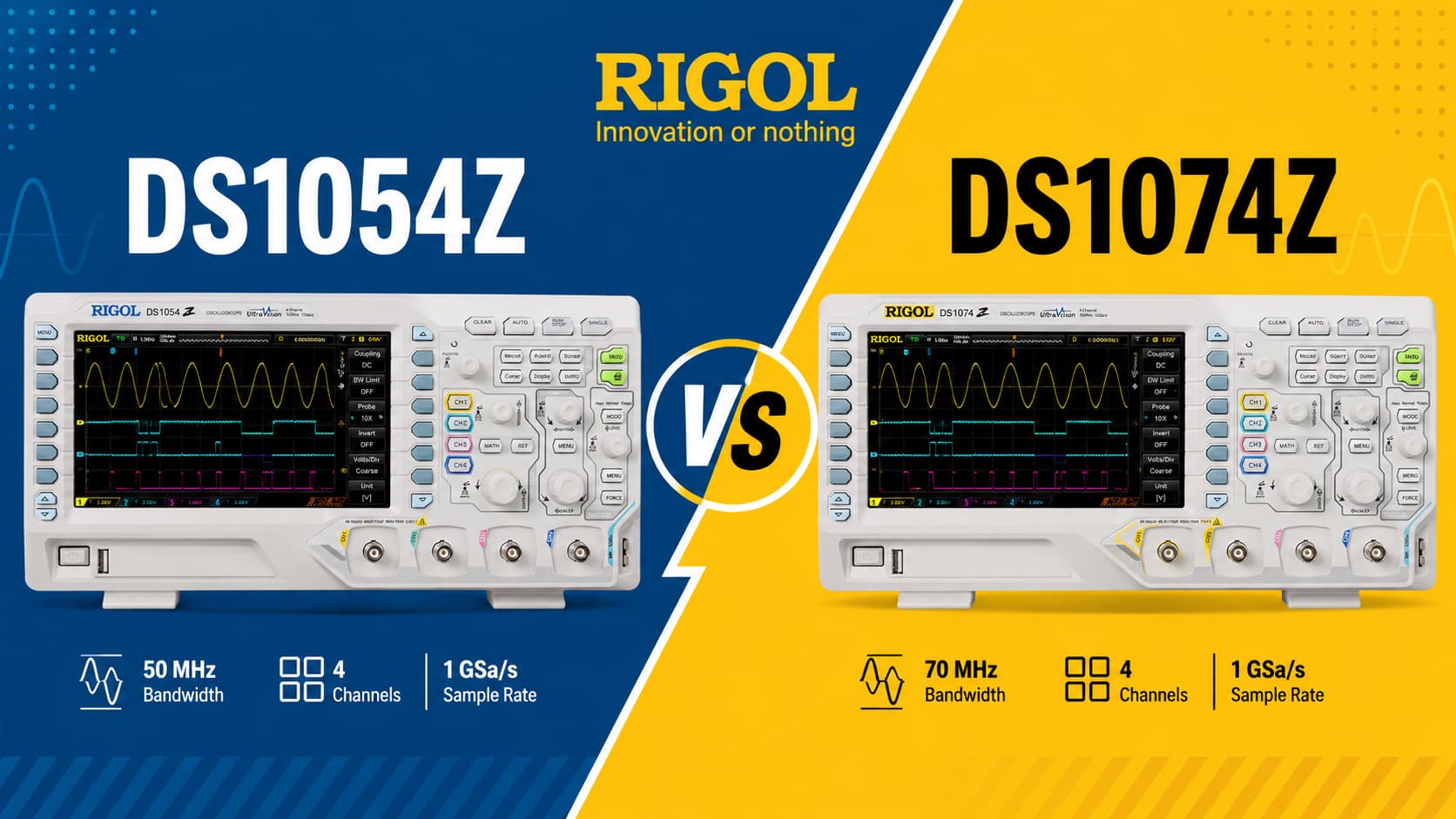
The Rigol DS1054Z and Rigol DS1074Z are closely related four-channel digital oscilloscopes from Rigol’s popular 1000Z series. Both are aimed at electronics hobbyists, students, repair technicians, embedded developers, and engineers who need an affordable bench oscilloscope with more flexibility than a basic two-channel model.
The Rigol DS1054Z is the famous entry-level model. It is widely recommended because it gives users four channels, deep memory, strong documentation, and a huge support community at a relatively accessible price point.
The Rigol DS1074Z sits higher in the same family. Its main advantage is higher bandwidth, making it a better match for users who work with faster signals and want more headroom than the 50 MHz class DS1054Z.
The decision is mostly about whether you need the extra bandwidth. For many users working on microcontrollers, power supplies, audio, sensors, Arduino projects, and general electronics, the DS1054Z is enough. For users who regularly work on faster digital edges, higher-speed embedded systems, or signals where 50 MHz bandwidth feels limiting, the DS1074Z is the better long-term buy.
Best for most buyers: The Rigol DS1054Z is the better value if you mainly need a general-purpose four-channel scope. Choose the Rigol DS1074Z only if you know you need the extra bandwidth headroom.
Choose the Rigol DS1054Z if you want the best-value four-channel oscilloscope for general electronics, education, repair, embedded projects, and everyday bench troubleshooting.
Choose the Rigol DS1074Z if you want a similar Rigol 1000Z-series experience but with more bandwidth for faster signals and more demanding debugging work.
The Rigol DS1054Z is the smarter default pick for most users. It delivers four channels, deep memory, excellent community support, and enough performance for a large amount of practical bench work without paying for bandwidth you may not use.
The Rigol DS1074Z is the better choice if you regularly work with faster signals and want more measurement headroom. It keeps the same general Rigol workflow while giving you more bandwidth for applications where the DS1054Z may feel limiting.
Don’t overbuy: If most of your work is low-speed embedded debugging, power supply testing, audio, sensors, and general electronics, the DS1054Z is likely enough. The DS1074Z makes sense when faster edges and wider bandwidth are genuinely part of your work.
Bottom line: Buy the Rigol DS1054Z for best value. Buy the Rigol DS1074Z if bandwidth headroom matters more than price.
Quick Verdict
Buy the Rigol DS1054Z if:
- You want the best-value four-channel Rigol oscilloscope.
- You mostly work on low-speed and mid-speed electronics.
- You troubleshoot Arduino, Raspberry Pi, sensors, power supplies, audio circuits, and general embedded projects.
- You want the largest community support base and tutorials.
- You do not regularly need more than 50 MHz bandwidth.
Buy the Rigol DS1074Z if:
- You want more bandwidth than the DS1054Z provides.
- You work with faster digital edges or higher-speed embedded signals.
- You want more headroom for rise-time and signal integrity work.
- You prefer to buy a scope with more future-proofing.
- You are comfortable paying more for extra bandwidth.
Rigol DS1054Z vs Rigol DS1074Z Comparison Table
| Feature | Rigol DS1054Z | Rigol DS1074Z |
|---|---|---|
| Oscilloscope Type | Digital storage oscilloscope | Digital storage oscilloscope |
| Series | Rigol 1000Z series | Rigol 1000Z series |
| Analog Channels | 4 channels | 4 channels |
| Bandwidth Class | 50 MHz class | 70 MHz class |
| Maximum Sample Rate | Up to 1 GSa/s, depending on active channels | Up to 1 GSa/s, depending on active channels |
| Memory Depth | Deep memory, one of its key strengths | Deep memory, similar platform advantage |
| Display | Color bench oscilloscope display | Color bench oscilloscope display |
| Triggering | Strong for general bench work | Strong for general bench work with more bandwidth headroom |
| Serial Decode | Available depending on options or bundle | Available depending on options or bundle |
| Best For | Education, hobby electronics, repair, power supplies, low-speed embedded work | Faster embedded work, higher-speed signals, users who want more headroom |
| Main Advantage | Best value and largest community recognition | Higher bandwidth in the same general Rigol family |
| Main Limitation | Lower bandwidth ceiling | Costs more for an incremental bandwidth increase |
Rigol DS1054Z Overview
The Rigol DS1054Z is one of the most popular entry-level bench oscilloscopes because it gives users four channels, deep memory, and a very capable feature set for the money. It is widely used by students, electronics hobbyists, repair technicians, and engineers who need a practical everyday scope.
The reason the DS1054Z remains so popular is that four channels are extremely useful in real troubleshooting. Instead of only looking at one input and one output, you can view multiple related signals at the same time. For embedded work, that can mean clock, data, chip select, and a power rail. For power supply work, it can mean input voltage, output voltage, enable signal, and switching node behavior.
The DS1054Z’s deep memory also matters. Memory depth determines how much waveform data the scope can capture at a useful sample rate. More memory helps when you need to catch longer events, intermittent glitches, startup behavior, or timing relationships over a wider time window.
The Rigol DS1054Z is the best choice for most buyers who want a proven four-channel oscilloscope for general electronics. It offers enough performance for most bench work while keeping cost under control.
- ✓ Four analog channels
- ✓ Deep memory for longer waveform captures
- ✓ Excellent community support and tutorials
- ✓ Great for education, repair, embedded systems, and power supplies
- ✓ Best value if you do not need extra bandwidth
Skip it if: you regularly measure faster signals where a 50 MHz class scope does not provide enough bandwidth or rise-time headroom.
Rigol DS1054Z Pros
- Excellent value for a four-channel bench oscilloscope
- Large user community and extensive online tutorials
- Deep memory helps capture longer events
- Useful for embedded systems, power supplies, audio, sensors, and general electronics
- Good choice for students and first-time scope buyers
- Widely understood and easy to find help for
- Strong enough for many professional low-speed bench applications
Rigol DS1054Z Cons
- Lower bandwidth than the DS1074Z
- Not ideal for faster digital edges or higher-frequency signals
- Older interface compared with newer oscilloscope families
- May be outgrown by users who move into faster embedded or RF-adjacent work
- Advanced options may vary depending on bundle and availability
Rigol DS1074Z Overview
The Rigol DS1074Z is the higher-bandwidth option in this comparison. It keeps the core advantages of the Rigol 1000Z family, including four channels, deep memory, and a familiar bench scope interface, but increases bandwidth compared with the DS1054Z.
Bandwidth matters because an oscilloscope does not display fast edges perfectly. Higher bandwidth gives the scope more ability to capture fast transitions, reduce signal attenuation at higher frequencies, and preserve waveform shape. Even if your signal frequency is not extremely high, fast rise times can require more bandwidth than many beginners expect.
The DS1074Z is therefore a better choice for users who expect to work with faster embedded systems, sharper digital edges, higher-speed communication lines, or circuits where the DS1054Z’s 50 MHz class bandwidth may become the limiting factor.
The Rigol DS1074Z is the better choice if you want more bandwidth while staying in the familiar Rigol 1000Z family. It is better suited to faster signals and users who want a scope with more room to grow.
- ✓ Four analog channels
- ✓ Higher bandwidth than the DS1054Z
- ✓ Better headroom for faster edges
- ✓ Familiar Rigol 1000Z workflow
- ✓ Stronger long-term choice for more demanding signal work
Skip it if: your projects are mostly low-speed microcontrollers, basic repair, power supplies, sensors, and general electronics where the DS1054Z already has enough bandwidth.
Rigol DS1074Z Pros
- Higher bandwidth than the DS1054Z
- Better headroom for faster signals and sharper edges
- Four channels remain very useful for embedded debugging
- Same general Rigol 1000Z platform strengths
- Good option for users who expect their projects to become more demanding
- More future-proof than the DS1054Z for higher-speed work
Rigol DS1074Z Cons
- Costs more than the DS1054Z
- Extra bandwidth may not matter for many common hobby and repair tasks
- Still part of an older oscilloscope family compared with newer models
- May not offer enough improvement to justify the price difference for casual users
- Users needing significantly more bandwidth may want to consider an even higher-end scope
Key Differences
The most important difference is bandwidth. The Rigol DS1054Z is a 50 MHz class scope, while the Rigol DS1074Z is a 70 MHz class scope. Both offer four channels and a similar user experience, but the DS1074Z provides more measurement headroom.
That extra bandwidth matters most when signals have fast transitions. A square wave or digital bus may have a relatively modest clock rate, but its edges can contain much higher-frequency content. If the scope bandwidth is too low, the signal can look slower, softer, or less accurate than it really is.
However, bandwidth is only valuable if you use it. For many users working on Arduino projects, sensors, audio circuits, power supplies, and general repair work, the DS1054Z is still entirely practical. Paying more for the DS1074Z only makes sense if your work genuinely benefits from the extra bandwidth.
In simple terms: the DS1054Z is the better value for most general electronics work. The DS1074Z is the better buy when bandwidth headroom matters.
Real-World Performance Comparisons
Which Is Better for Beginners?
The Rigol DS1054Z is better for most beginners because it costs less and has a huge support community. New users are more likely to find tutorials, videos, and forum discussions covering exactly the problems they encounter.
Which Is Better for Embedded Systems?
For low-speed embedded systems, both scopes are useful. The DS1054Z is enough for many microcontroller projects. The DS1074Z becomes more attractive if you work with faster edges, higher-speed buses, or timing problems where additional bandwidth helps preserve signal shape.
Which Is Better for Power Supply Troubleshooting?
The DS1054Z is usually sufficient for basic power supply troubleshooting, ripple measurements, startup behavior, enable timing, and general switching regulator observation. The DS1074Z can be useful when examining faster switching behavior, sharper transients, or edge detail.
Which Is Better for Audio and Sensor Circuits?
The DS1054Z is the better value for audio and most sensor work. These applications generally do not require the extra bandwidth of the DS1074Z, so the lower-cost scope is usually the smarter choice.
Which Is Better for Faster Digital Signals?
The DS1074Z is better for faster digital signals because bandwidth affects how accurately the scope displays edges and transitions. If edge shape, timing margin, or signal integrity matters, the extra bandwidth can be useful.
Which Is Better for Long-Term Ownership?
The DS1074Z is more future-proof if you expect your work to move into faster signals. The DS1054Z is better if you want the lowest-cost proven four-channel Rigol and do not expect to outgrow 50 MHz bandwidth soon.
Which Is Better for Value?
The DS1054Z wins on value for most users. The DS1074Z wins only when the added bandwidth will actually improve your measurements or prevent you from needing to upgrade later.
Customer Opinions
Amazon reviewers and electronics hobbyists often describe the Rigol DS1054Z as one of the best entry-level four-channel oscilloscopes. Common praise focuses on its value, deep memory, four-channel layout, and large online support community. It is frequently recommended as a first serious oscilloscope for home labs, students, and repair benches.
Common criticisms of the DS1054Z usually involve its lower bandwidth, older interface, fan noise in some units, and the fact that more modern scopes now exist. Even so, many users still consider it a dependable and well-understood tool.
The Rigol DS1074Z is typically viewed as a more capable version of the same general platform. Users who choose it tend to value the additional bandwidth and the comfort of staying within the Rigol ecosystem. It is often seen as a sensible step up for users who already know they need more than the DS1054Z’s 50 MHz class performance.
Reddit and electronics forum discussions usually recommend the DS1054Z for beginners and budget-conscious buyers, mainly because it is widely documented and offers strong value. The DS1074Z tends to be recommended when the buyer has a clear reason to want more bandwidth, rather than simply because it is the higher-numbered model.
Which Should You Buy?
Buy the Rigol DS1054Z if:
- You want the best-value four-channel oscilloscope.
- You are buying your first serious bench scope.
- You mostly work on low-speed digital, analog, audio, sensor, and power supply circuits.
- You want the most tutorials and community support.
- You do not have a clear need for more bandwidth.
Buy the Rigol DS1074Z if:
- You need more bandwidth than the DS1054Z provides.
- You work with faster digital edges or higher-speed embedded systems.
- You want more rise-time headroom.
- You want a more future-proof scope within the same Rigol family.
- You are willing to pay more for additional measurement capability.
The Rigol DS1054Z is the better choice for most users because it delivers four channels, deep memory, broad community support, and excellent general-purpose capability at a lower cost.
The Rigol DS1074Z is the better choice for users who know they need more bandwidth. It is not automatically the better buy for everyone, but it makes sense if faster signals are part of your daily work.
Best for students, hobbyists, repair technicians, and engineers who need a proven four-channel oscilloscope for general electronics work.
Best for users working with faster embedded systems, sharper signal edges, and applications where 50 MHz bandwidth may become limiting.
Bottom line: Buy the Rigol DS1054Z if you want the best value. Buy the Rigol DS1074Z if bandwidth headroom matters enough to justify the upgrade.
Final Verdict
The Rigol DS1054Z remains one of the strongest entry-level oscilloscope choices because it gives most users exactly what they need: four channels, deep memory, a proven workflow, and a huge support community. For general electronics, it is the safer and more economical buy.
The Rigol DS1074Z is the better instrument if your work demands more bandwidth. It is a sensible upgrade for users who work with faster digital signals or want more future-proofing while staying in the familiar Rigol 1000Z family.
For most buyers, the Rigol DS1054Z is the better value. For technicians and engineers who already know they need more bandwidth, the Rigol DS1074Z is the better long-term choice.