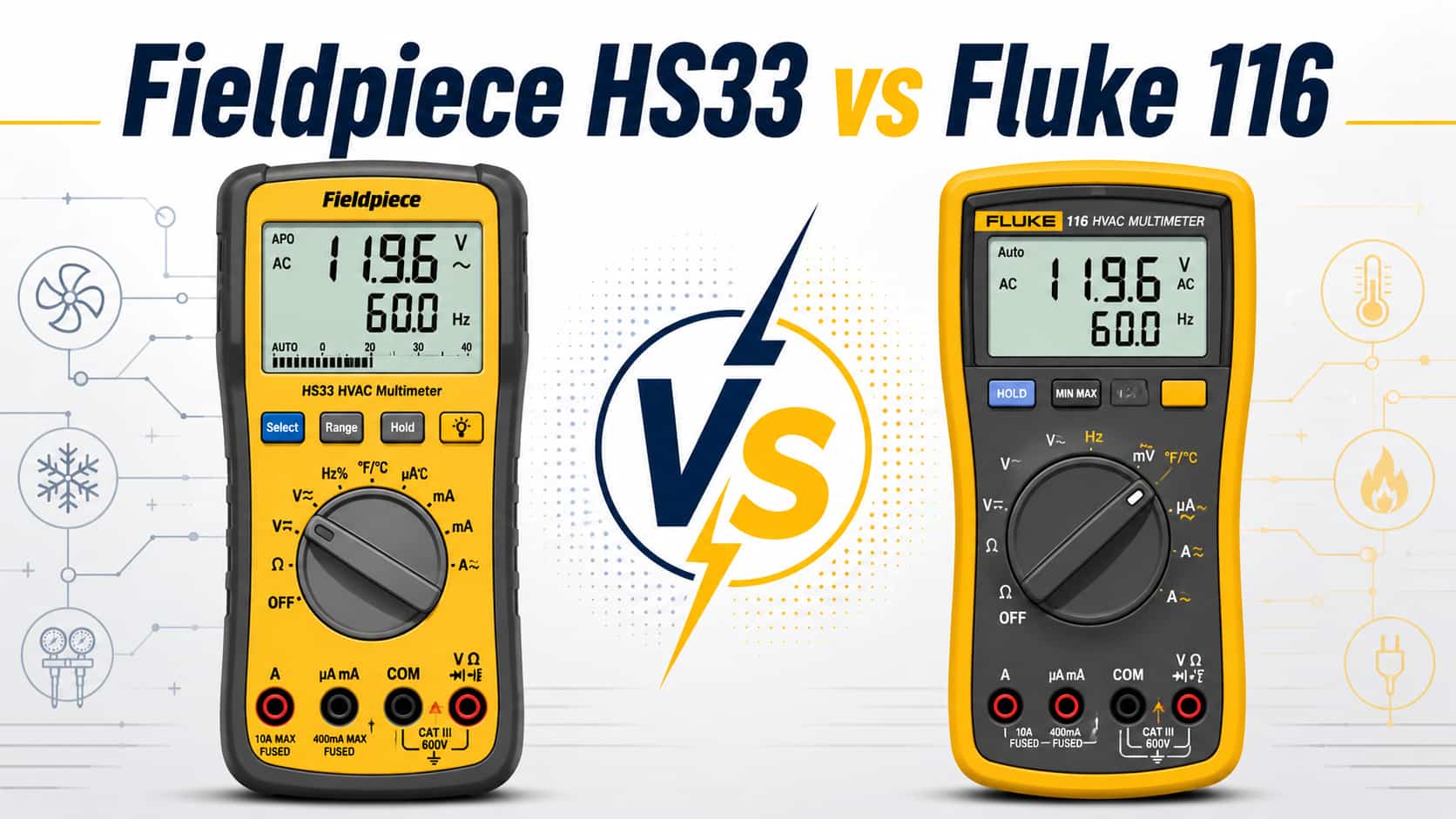
The Fieldpiece HS33 and Fluke 116 are both HVAC-focused digital multimeters, but they are built around different ideas. The Fieldpiece HS33 is a stick-style HVAC meter designed around expandability and field convenience. The Fluke 116 is a compact True RMS HVAC multimeter designed around accuracy, reliability, and professional electrical troubleshooting.
The Fieldpiece HS33 is aimed at HVACR technicians who want a practical everyday meter with voltage, microamps, capacitance, temperature, non-contact voltage detection, and compatibility with Fieldpiece accessory heads. Fieldpiece describes it as an expandable HVACR meter that accepts accessory heads and includes the tests used every day, including voltage, microamps, capacitance, and temperature.
The Fluke 116 is designed specifically for HVAC professionals and includes temperature measurement, microamps for flame sensor testing, and LoZ low-input impedance to reduce false readings from ghost voltage. It is the more traditional compact meter and is often chosen by technicians who prioritize Fluke build quality and electrical confidence.
The best choice depends on how you work. Choose the Fieldpiece HS33 if you want an HVAC-first meter with expandability and a stick-style layout. Choose the Fluke 116 if you want a compact, premium HVAC meter with True RMS accuracy and LoZ for dependable electrical troubleshooting.
Choose the Fieldpiece HS33 if you want an HVAC-focused meter with expandable accessory-head support, non-contact voltage detection, temperature, microamps, capacitance, and a practical stick-style form factor.
Choose the Fluke 116 if you want a compact professional HVAC multimeter with True RMS measurements, built-in temperature, microamps for flame sensors, and LoZ mode for reducing ghost-voltage confusion.
The Fieldpiece HS33 is the better choice for technicians who like the Fieldpiece HVAC ecosystem. Its accessory-head compatibility and field-friendly stick design make it useful for HVACR service calls where flexibility and convenience matter.
The Fluke 116 is the stronger choice if you want a compact professional meter with True RMS accuracy, LoZ mode, temperature, and microamp measurements. It is especially compelling for technicians who value electrical reliability and Fluke’s long-standing reputation.
Bottom line: Buy the Fieldpiece HS33 if you want HVAC expandability and Fieldpiece accessory support. Buy the Fluke 116 if you want the more refined compact HVAC meter with True RMS and LoZ.
Quick Verdict
Buy the Fieldpiece HS33 if:
- You want a meter designed specifically around HVACR field work.
- You use or plan to use Fieldpiece accessory heads.
- You like a stick-style meter with convenient lead storage.
- You want non-contact voltage detection built in.
- You want a practical HVAC meter for voltage, microamps, capacitance, and temperature.
Buy the Fluke 116 if:
- You want a compact professional HVAC multimeter.
- You value True RMS measurement accuracy.
- You need microamps for flame sensor testing.
- You want LoZ mode to reduce false readings from ghost voltage.
- You prefer Fluke build quality and a more traditional meter layout.
Fieldpiece HS33 vs Fluke 116 Comparison Table
| Feature | Fieldpiece HS33 | Fluke 116 |
|---|---|---|
| Tool Type | Expandable HVACR stick multimeter | Compact HVAC digital multimeter |
| Primary Audience | HVACR service technicians | HVAC technicians and electrical troubleshooters |
| True RMS | No, not the main selling point | Yes |
| Voltage Measurement | AC/DC voltage | AC/DC voltage |
| Microamps | Yes, useful for flame sensor testing | Yes, designed for flame sensor testing |
| Capacitance | Yes | Yes |
| Temperature | Yes, K-type thermocouple support | Yes, built-in thermometer with thermocouple support |
| Non-Contact Voltage | Yes | No dedicated NCV feature |
| LoZ Low-Impedance Mode | No | Yes |
| Accessory Expandability | Yes, works with Fieldpiece accessory heads | No, standalone meter design |
| Form Factor | Stick-style meter | Compact handheld meter |
| Best For | HVACR techs who want expandability and field convenience | HVAC techs who want True RMS, LoZ, and Fluke reliability |
| Main Advantage | HVAC accessory ecosystem and practical field layout | Accuracy, LoZ, compact design, and premium build quality |
| Main Limitation | Less refined as a general electrical multimeter | No Fieldpiece-style accessory-head expansion |
Fieldpiece HS33 Overview
The Fieldpiece HS33 is designed for HVACR technicians who want an everyday service meter with the functions they use most often. It covers voltage, microamps, capacitance, temperature, continuity, resistance, and non-contact voltage detection. Fieldpiece also designed it to work with the company’s accessory heads, which is a major advantage if you already use Fieldpiece tools.
The stick-style body is different from a typical compact multimeter. For HVAC field work, that can be a benefit. The shape is easy to hold, the controls are straightforward, and the design is built around common service tasks rather than general electronics bench work.
The HS33’s expandability is the biggest reason to choose it over the Fluke 116. Instead of being limited to the meter’s built-in functions, you can use compatible Fieldpiece accessory heads to extend what the meter can do. That makes it appealing for technicians who want to build around one HVAC-focused tool system.
The Fieldpiece HS33 is a strong choice for HVACR technicians who want a practical everyday meter with accessory-head expandability, non-contact voltage detection, temperature, microamps, and capacitance testing.
- ✓ Designed specifically for HVACR service work
- ✓ Works with Fieldpiece accessory heads
- ✓ Measures voltage, microamps, capacitance, and temperature
- ✓ Includes non-contact voltage detection
- ✓ Stick-style form factor with convenient field handling
Fieldpiece HS33 Pros
- Designed around HVACR service needs
- Expandable with Fieldpiece accessory heads
- Measures microamps for flame sensors
- Measures capacitance for motor start and run capacitors
- Supports temperature measurement with K-type thermocouples
- Includes non-contact voltage detection
- Stick-style layout can be convenient in the field
- Good fit for technicians already invested in Fieldpiece tools
Fieldpiece HS33 Cons
- Not as polished as the Fluke 116 for general electrical troubleshooting
- Does not offer the same LoZ ghost-voltage protection as the Fluke 116
- Not the best choice if you prefer a compact traditional meter shape
- Accessory-head ecosystem is most useful only if you plan to use it
- Less appealing for users who want a premium standalone multimeter
Fluke 116 Overview
The Fluke 116 is one of Fluke’s most popular HVAC-focused multimeters. It is compact, rugged, and designed around the measurements HVAC technicians use every day. It includes temperature measurement, microamps for flame sensor testing, capacitance, resistance, continuity, diode testing, and AC/DC voltage.
Its standout feature is LoZ mode. Low-input impedance helps prevent false readings caused by ghost voltage. That matters in real HVAC and electrical work because induced voltage can make a wire appear energized when it is not actually capable of delivering useful current. LoZ helps reduce that confusion and makes troubleshooting more reliable.
The Fluke 116 also has True RMS measurement capability, which improves accuracy when measuring non-sinusoidal waveforms. In modern HVAC systems with variable-speed drives, electronic controls, and non-linear loads, True RMS can be more dependable than average-responding measurement.
The Fluke 116 is the better pick if you want a compact premium HVAC multimeter with True RMS accuracy, LoZ mode, temperature, capacitance, and microamp measurements for flame sensor testing.
- ✓ True RMS measurements
- ✓ LoZ mode helps reduce ghost-voltage confusion
- ✓ Microamps for flame sensor testing
- ✓ Temperature measurement for HVAC diagnostics
- ✓ Compact, rugged, professional-grade design
Fluke 116 Pros
- True RMS accuracy for modern electrical systems
- LoZ mode helps avoid false ghost-voltage readings
- Designed specifically for HVAC professionals
- Microamp range for flame sensor troubleshooting
- Built-in temperature measurement
- Compact and easy to carry
- Excellent build quality and professional reputation
- Strong choice for electrical confidence and safety-focused troubleshooting
Fluke 116 Cons
- No Fieldpiece-style accessory-head expandability
- No dedicated non-contact voltage detector
- May cost more than some HVAC-specific alternatives
- Does not include a clamp meter function by itself
- Less flexible if you want to build around an HVAC accessory ecosystem
Key Differences
The biggest difference between the Fieldpiece HS33 and Fluke 116 is the design philosophy. The Fieldpiece HS33 is an HVACR field tool built around expandability, while the Fluke 116 is a compact professional HVAC multimeter built around measurement confidence.
The HS33 makes the most sense if you want the Fieldpiece ecosystem. Its accessory-head compatibility can make it more flexible for HVACR work over time. If you already use Fieldpiece tools, that ecosystem can be a meaningful advantage.
The Fluke 116 makes the most sense if you want a premium standalone meter. True RMS and LoZ are not just marketing features. True RMS helps with accuracy on non-ideal waveforms, while LoZ helps prevent ghost-voltage readings from wasting time or causing confusion during troubleshooting.
In simple terms: the Fieldpiece HS33 is the better HVAC ecosystem meter. The Fluke 116 is the better compact professional multimeter.
Real-World Performance Comparisons
Which Is Better for HVAC Service Calls?
For HVACR service calls, the Fieldpiece HS33 is very convenient because it was built around HVAC workflow and accessory-head expandability. It is a natural fit for technicians who want one Fieldpiece-compatible meter platform for multiple field measurements.
The Fluke 116 is also excellent for HVAC service, especially if the work involves more electrical troubleshooting. Its LoZ mode and True RMS accuracy make it more reassuring when diagnosing control circuits, power issues, and confusing voltage readings.
Which Is Better for Flame Sensor Testing?
Both meters can measure microamps, which is important for flame sensor testing. This is one of the key HVAC-specific measurements that separates these tools from generic multimeters.
The Fluke 116 gets the edge if you want the more refined meter for microamp and electrical measurements. The Fieldpiece HS33 remains a good choice if you want those functions inside a more HVAC-accessory-friendly tool.
Which Is Better for Capacitor Testing?
Both meters can test capacitance, which is useful when checking motor start and run capacitors. The Fieldpiece HS33 is very practical for this type of HVAC field work, while the Fluke 116 provides the more premium standalone measurement experience.
Which Is Better for Electrical Troubleshooting?
The Fluke 116 is the better electrical troubleshooting meter. LoZ mode is especially useful when ghost voltage could mislead the technician. True RMS also helps when measuring non-ideal waveforms from modern equipment.
Which Is Better for Expandability?
The Fieldpiece HS33 wins for expandability because it works with Fieldpiece accessory heads. If you want a tool platform that can grow with your HVAC workflow, that is the HS33’s strongest advantage.
Which Is Better for Long-Term Ownership?
The answer depends on your priorities. Choose the Fluke 116 if long-term ownership means premium build quality, electrical confidence, and a compact meter you can trust. Choose the Fieldpiece HS33 if long-term ownership means compatibility with an HVAC-specific ecosystem.
Customer Opinions
Amazon reviewers and HVAC technicians often like the Fieldpiece HS33 because it feels designed for real HVACR service work. Common praise focuses on its practical test functions, stick-style body, non-contact voltage detection, temperature capability, and compatibility with Fieldpiece accessory heads. Users who already own Fieldpiece tools tend to see the HS33 as part of a broader HVAC workflow rather than just a standalone meter.
Common criticisms of the Fieldpiece HS33 usually come from users who prefer a more traditional multimeter layout or want a more premium-feeling general electrical meter. The accessory-head system is useful, but only if you actually plan to use that ecosystem.
The Fluke 116 is frequently praised for its reliability, compact size, True RMS accuracy, and HVAC-specific functions like microamps and temperature. Many buyers choose it because they trust Fluke for electrical measurements and want a meter that feels dependable in real service environments.
Reddit and HVAC forum discussions tend to split along familiar lines. Many HVAC techs recommend Fieldpiece because the brand is strongly associated with HVAC-specific tools and value. Others strongly prefer Fluke when accuracy, durability, and long-term confidence matter most. In practical terms, Fieldpiece often gets recommended for HVAC-first workflows, while Fluke gets recommended when the user wants a more premium electrical meter.
Which Should You Buy?
Buy the Fieldpiece HS33 if:
- You want a meter designed around HVACR field work.
- You already use Fieldpiece accessories or plan to buy them.
- You value non-contact voltage detection.
- You like the stick-style meter format.
- You want practical HVAC measurements in a field-friendly tool.
Buy the Fluke 116 if:
- You want a compact professional HVAC multimeter.
- You value True RMS accuracy.
- You want LoZ mode for reducing ghost-voltage confusion.
- You frequently troubleshoot electrical issues in HVAC systems.
- You prefer Fluke build quality and a more traditional meter design.
The Fieldpiece HS33 is the better choice if you want an HVACR-focused meter that fits into the Fieldpiece accessory ecosystem. It is practical, expandable, and built around the daily needs of service technicians.
The Fluke 116 is the better choice if you want a compact premium HVAC multimeter with True RMS, LoZ, microamps, temperature, and the confidence that comes with Fluke’s professional meter reputation.
Best for HVACR technicians who want a field-friendly meter with non-contact voltage detection, temperature, microamps, capacitance, and compatibility with Fieldpiece accessory heads.
Best for technicians who want True RMS accuracy, LoZ mode, compact design, and strong electrical troubleshooting performance in a professional HVAC multimeter.
Bottom line: Buy the Fieldpiece HS33 if you want an expandable HVACR tool. Buy the Fluke 116 if you want the more accurate and confidence-inspiring compact HVAC multimeter.
Final Verdict
The Fieldpiece HS33 is a strong choice for HVACR technicians who want a practical, expandable meter. Its support for Fieldpiece accessory heads, non-contact voltage detection, and HVAC-specific measurements make it a useful everyday field tool.
The Fluke 116 is the better choice for technicians who prioritize electrical confidence. True RMS measurements, LoZ mode, microamps, temperature, and Fluke’s compact rugged design make it one of the safest recommendations for professional HVAC troubleshooting.
For most technicians who want a premium standalone HVAC multimeter, the Fluke 116 is the stronger overall pick. For users already invested in Fieldpiece or who value accessory-head expandability, the Fieldpiece HS33 remains a practical and capable alternative.