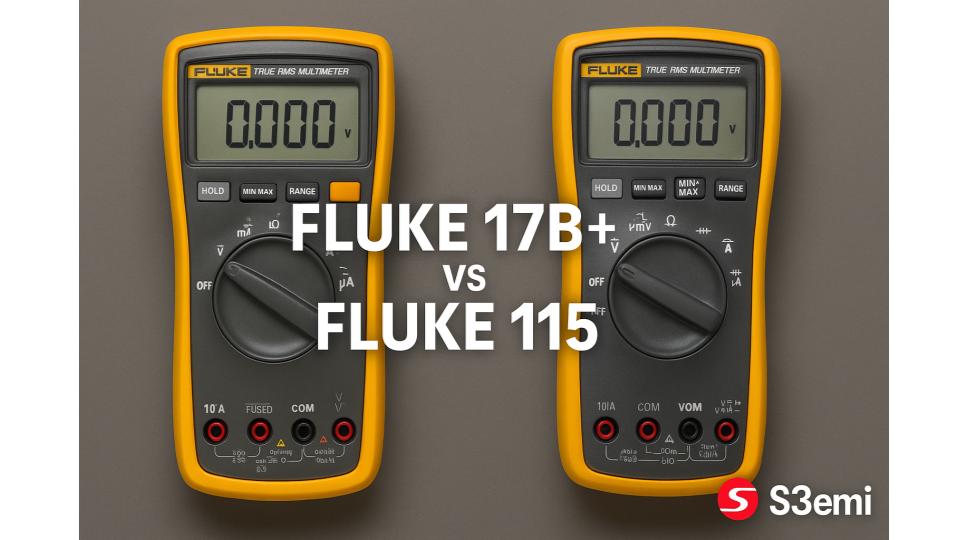
Fluke’s multimeter lineup includes both compact models for general use and professional-grade meters for electricians. The Fluke 17B+ and Fluke 115 are two models often compared because they share similar size and features, but they are targeted at different users.

🏆 Fluke 115 vs Fluke 17B+ – Quick Recommendation
Don’t want to read the entire comparison? Here’s the short version:
- Choose the Fluke 115 if you’re an electrician, field technician, or HVAC professional who needs a meter designed for North American users.
- Choose the Fluke 17B+ if you want a dependable Fluke meter at a lower price and don’t need the extra features of the 115.
Let’s break down the key differences.
📋 Quick Overview
- Fluke 17B+: Designed for technicians and engineers, offering True-RMS, temperature measurement, and a wide voltage range. Popular in Asia as a reliable mid-tier multimeter.
- Fluke 115: A professional multimeter for electricians, with True-RMS, LoZ mode, and compact design, ideal for field service and troubleshooting.
📊 Fluke 17B+ vs Fluke 115 Comparison Table
| Feature | Fluke 17B+ | Fluke 115 |
|---|---|---|
| Display | 6000-count LCD with backlight | 6000-count LCD with backlight |
| True-RMS | Yes | Yes |
| AC/DC Voltage | Up to 1000V | Up to 600V |
| Current Measurement | Up to 10A | Up to 10A |
| Resistance | Up to 40 MΩ | Up to 40 MΩ |
| Capacitance | Up to 10,000 µF | Up to 9,999 µF |
| Frequency | Yes | Yes |
| Temperature Measurement | Yes (with probe) | No |
| Continuity & Diode Test | Yes | Yes |
| Special Features | Min/Max recording, Temp probe | LoZ (Low Impedance), Fast AutoVolt |
| Battery Type | 2 × AA | 9V battery |
| Size & Weight | ~455 g | ~550 g |
| CAT Rating | CAT III 600V | CAT III 600V, CAT IV 600V |
| Target User | Technicians, engineers, hobbyists | Electricians, field service professionals |
✅ Pros & Cons of Fluke 17B+

Pros
- True-RMS for accurate AC readings
- Measures up to 1000V
- Temperature measurement included
- Wider capacitance range (up to 10,000 µF)
- Affordable compared to the 115
Cons
- No LoZ (can pick up ghost voltages)
- No non-contact voltage detection
- Not rated CAT IV like the 115
💰 Buy the Fluke 17B+ If…
The Fluke 17B+ delivers the accuracy and durability Fluke is known for at a lower price point.
- ✔ DIY electronics projects
- ✔ Hobbyists and makers
- ✔ Automotive troubleshooting
- ✔ Occasional professional use
- ✔ Best value among Fluke meters
✅ Pros & Cons of Fluke 115

Pros
- True-RMS accuracy
- LoZ (Low Impedance) prevents ghost voltage errors
- Compact and ergonomic design
- CAT IV safety rating (more robust protection)
- Faster auto-ranging for field use
Cons
- Limited to 600V (vs 1000V for 17B+)
- No temperature measurement
- Slightly more expensive than the 17B+
⚡ Buy the Fluke 115 If…
The Fluke 115 is the better choice for professionals who use a multimeter daily and need a versatile troubleshooting tool.
- ✔ Electricians and maintenance technicians
- ✔ HVAC troubleshooting
- ✔ Commercial and industrial work
- ✔ Users who want a long-term professional meter
- ✔ Excellent reputation for reliability
🛠️ Which One Should You Choose?
- Choose the Fluke 17B+ if you’re an engineer, technician, or electronics enthusiast who needs higher voltage measurement, temperature testing, and advanced diagnostics.
- Choose the Fluke 115 if you’re an electrician or field professional who values LoZ safety features and CAT IV protection in commercial or residential wiring environments.
In short:
- 17B+ = Broader measurement capabilities
- 115 = Safer and faster for electricians

🎯 Want More Features?
If you’re already considering the Fluke 115, it may be worth looking at the Fluke 117. It adds non-contact voltage detection and is one of the most popular professional multimeters in North America.
- ✔ Non-contact voltage detection
- ✔ Low input impedance mode
- ✔ Excellent for electricians
- ✔ One of Fluke’s best-selling models