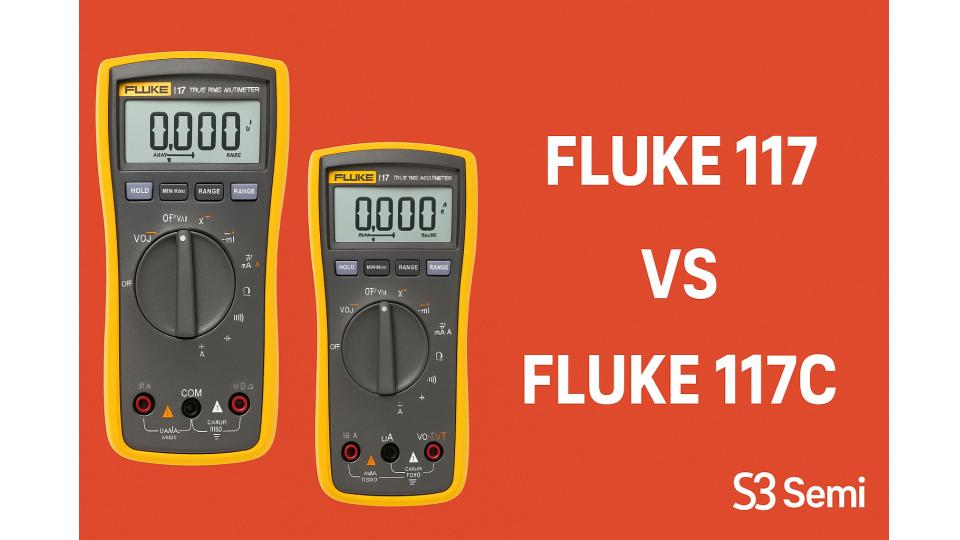
Among Fluke’s compact models, the Fluke 117 and Fluke 117C often create confusion. At first glance, they look almost identical, but there are subtle differences that matter depending on where you buy and use them.

Bottom line: The Fluke 117 is the safer choice for buyers in North America, Europe, and other global markets because it is the standard version with familiar certification, warranty, and support channels. The Fluke 117C is mainly a China / Asia-market version and can be a better-value option if you are buying in a region where it is officially supported.
| Feature | Fluke 117 | Fluke 117C | Best Choice |
|---|---|---|---|
| Core functionality | True RMS electrician’s multimeter | Same core functionality as the 117 | Tie |
| Primary market | Global market, including North America and Europe | China and select Asian markets | Fluke 117 for global buyers |
| Model labeling | Marked as Fluke 117 | Marked as Fluke 117C | Depends on region |
| Certifications | Typically aligned with global-market certifications such as CE, UL, and CSA, depending on package and region | Typically aligned with China-market certification requirements such as CCC | Fluke 117 for North America / Europe |
| True RMS | Yes | Yes | Tie |
| VoltAlert non-contact voltage detection | Yes | Yes | Tie |
| AutoVolt AC/DC detection | Yes | Yes | Tie |
| LoZ low-impedance mode | Yes | Yes | Tie |
| Accessories and manuals | Standard global-market package, varies by retailer | May include region-specific leads, manuals, or labeling | Fluke 117 for familiar documentation |
| Warranty and support | Usually easier to support in North America and Europe | Best if bought in a supported China / Asia channel | Fluke 117 for most global buyers |
| Best fit | Electricians, HVAC techs, maintenance workers, and buyers outside China / Asia | Buyers in China / Asia who want the same meter at a potentially lower price | Depends on where you live and buy |
Buy the Fluke 117 if you are in North America, Europe, or any market where the standard Fluke 117 is the supported model. It gives you the same electrician-focused feature set with clearer certification, warranty, and support expectations.
Skip it if: you are buying in China / Asia and the 117C is officially available at a better price.
Buy the Fluke 117C if you are in China or another supported Asian market and want the same core Fluke 117 performance with region-specific labeling, packaging, and certification.
Skip it if: you need North American or European certification, documentation, warranty support, or workplace compliance.
🏷️ Fluke Multimeter Deals ⭐⭐⭐⭐
Let’s break it down.
🔍 Key Differences
| Feature | Fluke 117 | Fluke 117C |
|---|---|---|
| Region/Market | Global (U.S., Europe, etc.) | China and select Asian markets |
| Labeling | Marked “Fluke 117” | Marked “Fluke 117C” |
| Certification | Meets CE, UL, CSA (varies by market) | Meets CCC (China Compulsory Certification) |
| Accessories | Vary depending on retail package | May include region-specific test leads/manuals |
| Price | 💲 Check Price | 💲 Check Price |
🏆 Fluke 117 Electricians Multimeter
The Fluke 117 is the standard choice for electricians, HVAC techs, maintenance workers, and serious DIY users. It includes True RMS measurement, AutoVolt automatic AC/DC detection, low input impedance mode, and built-in non-contact voltage detection.
- ✔ True RMS digital multimeter
- ✔ Built-in VoltAlert non-contact voltage detection
- ✔ AutoVolt AC/DC selection
- ✔ Low input impedance helps reduce ghost voltage readings
- ✔ Excellent everyday meter for electrical troubleshooting
📋 Overview of Both Models
Fluke 117
- Designed for electricians working in commercial and residential environments.

- Features include:
- True-RMS for accurate readings on non-linear loads.
- VoltAlert™ non-contact voltage detection.
- AutoVolt automatic AC/DC selection.
- Low Input Impedance (LoZ) to prevent ghost voltage readings.
- Large backlit display.
⭐ Fluke 117/323 Multimeter and Clamp Meter Kit
If you work on panels, motors, HVAC equipment, or higher-current circuits, the Fluke 117/323 combo kit is often the smartest upgrade. The 117 handles voltage, resistance, continuity, and troubleshooting, while the 323 clamp meter adds current measurement without breaking the circuit.
- ✔ Includes Fluke 117 multimeter
- ✔ Adds Fluke 323 clamp meter
- ✔ Better for current measurements
- ✔ Useful for electricians and HVAC technicians
- ✔ Often better value than buying separately
Fluke 117C
- Essentially the China-market version of the Fluke 117.
- The “C” typically stands for China or China-specific distribution.
- Specifications and features remain the same as the 117.
- Packaging, labeling, and sometimes included accessories differ depending on regional distribution.
🔑 Key Similarities
Both the Fluke 117 and 117C offer:
- Measurement of AC/DC voltage, current, resistance, continuity, capacitance, and frequency.
- True-RMS accuracy.
- VoltAlert non-contact detection.
- LoZ input.
- Backlit digital display.
- CAT III 600V safety rating.
Functionally, they are the same meter.

👍 Pros & Cons
Fluke 117
Pros:
- Widely available globally.
- Comes with international certifications.
- Reliable for electricians everywhere.
Cons:
- More expensive compared to 117C.
Fluke 117C
Pros:
- Same performance at a lower price (in some markets).
- Backed by Fluke quality.
Cons:
- Distribution mainly limited to China/Asia.
- May lack global certifications (if you need compliance for work).
- Manuals and labeling often in Chinese.
🏁 Which One Should You Choose?
- If you’re in North America or Europe, go with the Fluke 117 to ensure proper certifications, warranty, and support.
- If you’re in China or Asia, the Fluke 117C offers the same performance at a better price.
- For functionality, they’re identical – the choice depends on region, certification, and warranty support.
Both the Fluke 117 and 117C are excellent compact multimeters for electricians, offering True-RMS accuracy, non-contact voltage detection, and durable Fluke build quality.
