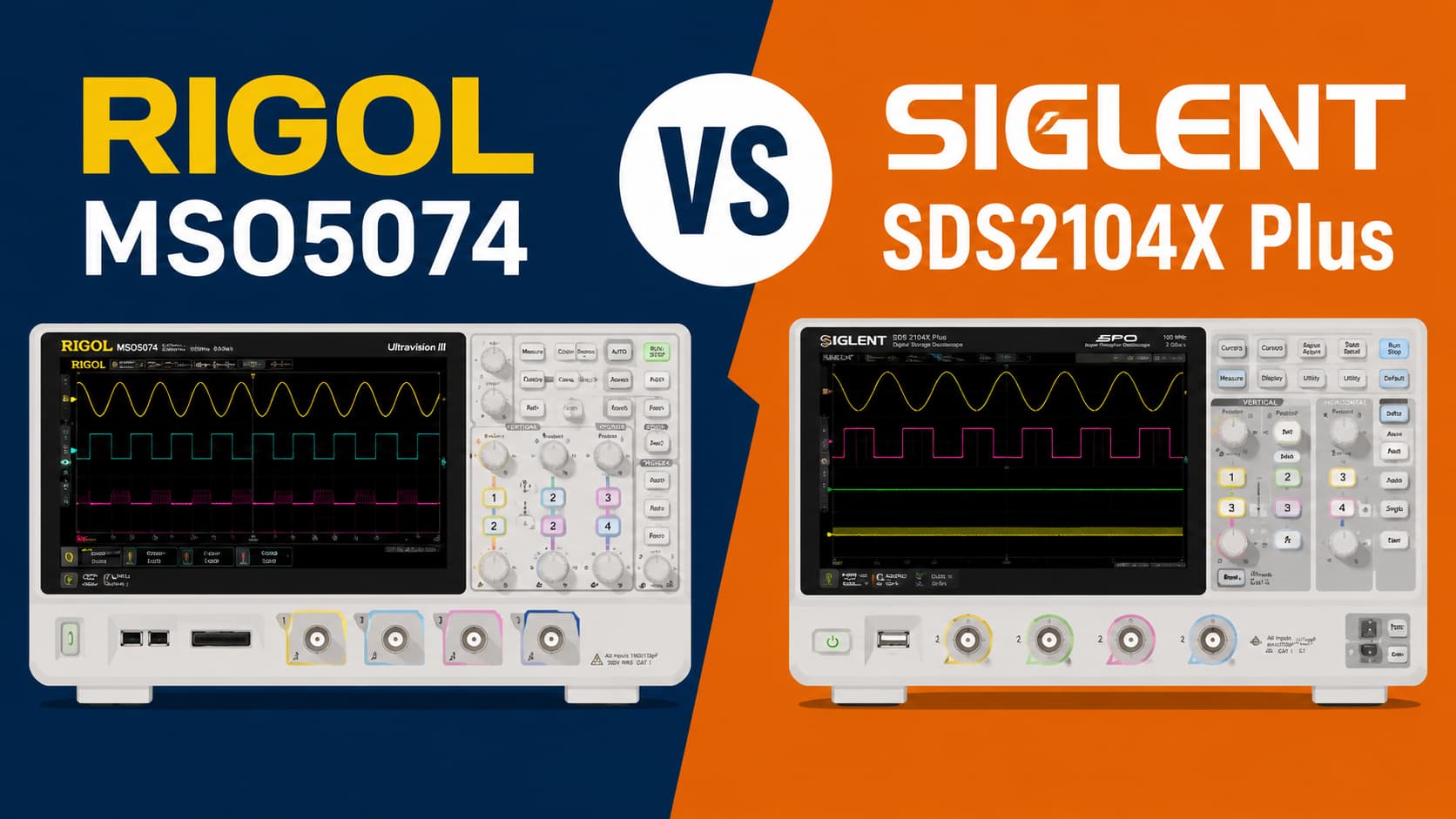
Bench oscilloscopes in the $900–$1,600 class have converged on similar-looking spec sheets, which makes the actual buying decision harder, not easier. The Rigol MSO5074 and Siglent SDS2104X Plus are two of the most frequently cross-shopped scopes in this bracket, and each one wins on paper depending on which line of the datasheet you’re reading first. The MSO5074 leads on raw sample rate and built-in instrument integration. The SDS2104X Plus leads on bandwidth, standard memory depth, and display real estate.
This comparison focuses on where those differences actually show up on a bench — capturing fast edges, digging into noisy signals, and running mixed-signal debug — instead of just repeating the marketing bullet points.
Short answer: if you want the most capability-per-dollar and value Rigol’s all-in-one instrument integration, the MSO5074 is the smarter default. If your work regularly pushes past 70 MHz signals or you want more standard memory depth and a larger display without buying options, the SDS2104X Plus is worth the step up.
Quick Pick: Which Bench Scope Fits Your Work?
Best for Most Buyers
Rigol MSO5074 — 8 GSa/s sample rate, 7-in-1 integrated instrumentation, and MSO-ready architecture at a lower entry cost.
Best Upgrade
Siglent SDS2104X Plus — higher standard bandwidth, deeper standard memory, 10-bit mode, and a larger 10.1″ touchscreen for detail-heavy debug work.
Quick Verdict
Both scopes are 4-channel, touchscreen digital oscilloscopes built for the same general audience: hobbyists graduating to serious bench work, R&D engineers, and educators who need a capable instrument without a five-figure budget. Neither is a toy, and neither is a top-tier lab reference scope. Where they diverge is in how each company chose to allocate its engineering budget.
Rigol built the MSO5074 around UltraVision II architecture that folds seven instruments — oscilloscope, logic analyzer, spectrum analyzer, arbitrary waveform generator, digital voltmeter, frequency counter, and protocol analyzer — into one chassis, backed by an 8 GSa/s sample rate that’s four times faster than the Siglent’s interleaved rate. Siglent built the SDS2104X Plus around a higher base bandwidth (100 MHz versus the Rigol’s 70 MHz), a deeper standard memory depth, a 10-bit high-resolution acquisition mode, and a larger 10.1-inch display.
If you’re chasing fast single-shot transients or want the flexibility of an all-in-one bench instrument, the sample rate and integration on the MSO5074 matter more than an extra 30 MHz of bandwidth. If you’re working with signals that live closer to the 70–100 MHz boundary, or you want more resolution on noisy analog measurements, the SDS2104X Plus’s bandwidth and 10-bit mode earn their higher price.
Rigol MSO5074 vs Siglent SDS2104X Plus: Full Comparison Table
| Feature | Rigol MSO5074 | Siglent SDS2104X Plus |
|---|---|---|
| Bandwidth | 70 MHz (upgradable via software option) | 100 MHz (200/350 MHz variants exist in the series) |
| Analog Channels | 4 | 4 |
| Sample Rate | Up to 8 GSa/s | Up to 2 GSa/s (interleaved), 1 GSa/s non-interleaved |
| Standard Memory Depth | 100 Mpts (200 Mpts with option) | 100–200 Mpts/ch depending on interleave mode |
| Max Waveform Capture Rate | Up to 500,000 wfm/s | 120,000 wfm/s normal mode, 500,000 wfm/s sequence mode |
| Vertical Resolution | 8-bit | 8-bit standard, 10-bit high-resolution mode available |
| Display | 9″ capacitive multi-touch | 10.1″ capacitive multi-touch |
| Digital Channels (MSO) | 16 channels, logic probe required | 16 channels optional, logic probe and software option required |
| Integrated Instruments | 7-in-1: scope, logic analyzer, spectrum analyzer, AWG, DVM, frequency counter, protocol analyzer | Scope plus optional AWG, protocol decode, and power/Bode analysis add-ons |
| Serial Protocol Decode | Optional: I2C, SPI, RS232/UART, CAN, LIN, and more | Standard: I2C, SPI, UART, CAN, LIN (CAN FD, FlexRay, I2S, MIL-STD-1553B optional) |
| Bode Plot / Loop Analysis | Supported (requires AWG option) | Supported (via built-in or standalone SIGLENT AWG) |
| Best Suited For | Fast transient capture, mixed-signal debug, all-in-one bench instrumentation | Higher-bandwidth analog work, noisy-signal resolution, larger display real estate |
| Relative Price Position | Lower entry cost for the feature set | Moderate step up for bandwidth and standard memory depth |
Rigol MSO5074 Overview
The MSO5074 sits in Rigol’s MSO5000 series, built on the company’s UltraVision II architecture and Phoenix chipset. Its headline number isn’t bandwidth — at 70 MHz it’s actually the lowest-bandwidth model in its own series — it’s sample rate. At 8 GSa/s, the MSO5074 samples four times faster than the Siglent’s interleaved 2 GSa/s rate, which matters when you’re trying to accurately reconstruct fast edges or catch narrow glitches without relying on equivalent-time sampling tricks.
What sets the MSO5074 apart functionally is how much instrument Rigol packs into one chassis. It folds a digital oscilloscope, 16-channel logic analyzer, spectrum analyzer, arbitrary waveform generator, digital voltmeter, frequency counter/totalizer, and serial protocol analyzer into a single 9-inch touchscreen unit. For engineers doing mixed hardware and firmware debug, that means fewer instruments cluttering the bench and fewer cables running to a single device under test.
The tradeoff is bandwidth headroom and standard memory depth. At 70 MHz, the MSO5074 is best suited to signals well under that ceiling with margin to spare; pushing close to the rated bandwidth on any scope reduces measurement accuracy on rise time and amplitude. Memory depth is also solid but not class-leading at 100 Mpts standard, requiring an option to reach 200 Mpts.
Rigol MSO5074 — Best for Most Buyers
Best for: Engineers and hobbyists who want fast sampling, mixed-signal debug capability, and integrated instrumentation without paying for bandwidth headroom they won’t use.
The MSO5074 delivers a genuinely all-in-one bench instrument — scope, logic analyzer, spectrum analyzer, and waveform generator in one box — at a lower entry cost than comparable higher-bandwidth scopes. If your signals live comfortably under 70 MHz and you value sample rate and integration over headline bandwidth, this is where your money goes furthest.
Don’t overbuy here: extra bandwidth beyond what your actual signals need doesn’t improve measurement quality, it just sits unused. If 70 MHz covers your work with margin, paying more for a higher-bandwidth model is money better spent on probes or a logic analyzer pod.
Rigol MSO5074 Pros
- 8 GSa/s sample rate, well ahead of the Siglent’s interleaved 2 GSa/s
- Genuine 7-in-1 instrument integration reduces bench clutter
- MSO-ready architecture with 16-channel logic analysis support
- Bode plot and loop analysis capability with the AWG option
- Lower entry cost relative to its feature set
Rigol MSO5074 Cons
- 70 MHz bandwidth is the lowest in its own product series
- Standard memory depth (100 Mpts) requires an option to double
- Serial protocol decoding is an added option rather than standard
- Smaller 9-inch display compared to the Siglent’s 10.1-inch screen
Siglent SDS2104X Plus Overview
The SDS2104X Plus is the entry point into Siglent’s third-generation SDS2000X Plus series, and it leads with a higher standard bandwidth than the Rigol at 100 MHz. Sample rate tops out at 2 GSa/s in interleaved mode, roughly a quarter of the MSO5074’s rate, but Siglent offsets that with a genuinely deep standard memory depth — up to 200 Mpts/ch in interleaved mode — and a 10-bit high-resolution acquisition mode that meaningfully improves measurement clarity on noisy or low-amplitude signals compared to the 8-bit-only MSO5074.
The 10.1-inch capacitive touchscreen is noticeably larger than the Rigol’s 9-inch panel, which matters more than it sounds like on a crowded bench when you’re reading multiple channels, a math trace, and an FFT simultaneously. Siglent also ships standard serial protocol triggering and decoding for I2C, SPI, UART, CAN, and LIN out of the box, where Rigol treats decoding as an add-on option.
The tradeoff is sample rate and out-of-the-box instrument integration. The SDS2104X Plus is fundamentally an oscilloscope-first instrument; the AWG, 16-channel logic analysis, and additional protocol decoders are options layered on top rather than included from the start the way Rigol bundles most of its 7-in-1 capability.
Siglent SDS2104X Plus — Best Upgrade Pick
Best for: Engineers working with higher-frequency analog signals, noisy or low-amplitude measurements, and anyone who wants more standard memory depth and screen real estate without stacking options.
The SDS2104X Plus earns its place as the upgrade pick on the strength of its higher standard bandwidth, deep memory depth, and 10-bit resolution mode — all of which show up directly in measurement quality rather than convenience. If your bandwidth margin against the Rigol’s 70 MHz ceiling is thin, this is the scope that removes that concern.
This isn’t a meter you need to justify twice: standard serial decode and a larger display are things you’ll use on essentially every project, not edge-case features.
Siglent SDS2104X Plus Pros
- Higher standard bandwidth (100 MHz) than the base Rigol MSO5074
- Deeper standard memory depth, up to 200 Mpts/ch interleaved
- 10-bit high-resolution acquisition mode improves clarity on noisy signals
- Larger 10.1-inch touchscreen display
- Standard serial protocol triggering and decoding included, not an add-on option
Siglent SDS2104X Plus Cons
- Sample rate (2 GSa/s interleaved) is well below the Rigol’s 8 GSa/s
- AWG, 16-channel logic analysis, and extended protocol decoders are optional rather than bundled
- Higher price point relative to the MSO5074’s entry cost
Key Differences Between the MSO5074 and SDS2104X Plus
Once you set aside the shared 4-channel, touchscreen, mixed-signal-capable foundation, the two scopes differ in a handful of concrete ways.
- Sample rate vs bandwidth priority: Rigol prioritizes sample rate (8 GSa/s) at a lower bandwidth ceiling (70 MHz). Siglent prioritizes bandwidth (100 MHz) at a lower sample rate (2 GSa/s interleaved).
- Instrument integration: The MSO5074 bundles more instrument functionality — spectrum analyzer, logic analyzer, waveform generator, DVM, and frequency counter — into its base architecture. The SDS2104X Plus treats most of that as optional add-on software.
- Resolution mode: The SDS2104X Plus offers a 10-bit high-resolution acquisition mode; the MSO5074 is 8-bit only.
- Memory depth and display: Siglent ships more standard memory depth and a larger touchscreen out of the box.
- Standard decoding: Siglent includes serial protocol decode standard; Rigol makes it an option.
Neither difference makes one scope categorically better — they represent two different engineering priorities aimed at overlapping but distinct use cases.
Real-World Performance Comparisons
On general-purpose digital and analog debug work well under 70 MHz — microcontroller I/O, power rail ripple, low-speed serial buses — both scopes perform comparably, and the difference in sample rate rarely shows up because neither scope is being pushed near its ceiling.
Where the MSO5074’s sample rate advantage becomes visible is on fast single-shot or narrow-glitch capture: switching transitions, ringing on fast edges, and other events where more samples per unit time directly improve the fidelity of the reconstructed waveform. The Rigol’s 8 GSa/s rate gives it meaningfully more resolution on these captures than the Siglent’s 2 GSa/s interleaved rate.
Where the SDS2104X Plus pulls ahead is on signals that approach or exceed 70 MHz, and on noisy or low-amplitude measurements where its 10-bit mode reduces quantization noise relative to the Rigol’s 8-bit-only acquisition. The larger, higher-resolution display also becomes a real advantage when you’re running several math traces, an FFT, and live channels at once — the extra screen space reduces the need to toggle between views.
For mixed-signal debug involving both analog and digital channels together, the MSO5074’s more integrated logic analyzer and protocol analyzer functions make setup slightly more streamlined, though both scopes require a separate logic probe purchase to actually enable the 16-channel digital inputs.
Customer Opinions: Amazon and Reddit Summary
Feedback on the MSO5074 across retail reviews and enthusiast forums consistently highlights the value of having a scope, logic analyzer, spectrum analyzer, and waveform generator in a single instrument, especially among users upgrading from simpler two-channel scopes. The high sample rate is frequently mentioned as a standout relative to the price point. Some longtime Rigol users note the touchscreen interface takes a bit of adjustment compared to older knob-and-button Rigol models, but generally describe it as intuitive once learned.
The SDS2104X Plus draws strong praise in electronics communities for its display quality and the clarity of its user interface, with several users specifically comparing it favorably against older-generation scopes from both Rigol and Siglent’s own prior lineup. The 10-bit resolution mode and deep standard memory come up repeatedly as reasons users chose it over lower-priced alternatives, and the low noise floor is cited as noticeably better than typical scopes in this price bracket. A recurring theme across both instruments is that buyers moving from either brand’s older base-tier models describe both the MSO5074 and SDS2104X Plus as a meaningful step up in usability and measurement confidence.
Which Should You Buy?
Buy the Rigol MSO5074 if…
- You want the highest sample rate available in this price bracket
- You value having a scope, logic analyzer, spectrum analyzer, and AWG in one integrated instrument
- Your signals stay comfortably under 70 MHz with margin to spare
- You want the strongest capability-per-dollar at a lower entry cost
Buy the Siglent SDS2104X Plus if…
- Your work regularly approaches or exceeds a 70 MHz bandwidth ceiling
- You want deeper standard memory and a 10-bit resolution mode for noisy or low-amplitude signals
- You’d benefit from a larger display for multi-trace, FFT-heavy workflows
- You want serial protocol decoding included standard rather than as an add-on
The value tradeoff comes down to which spec actually constrains your work today. If sample rate and integration matter more than bandwidth headroom, the MSO5074 is the better use of your budget. If bandwidth, memory depth, and resolution are the limiting factors on your current bench, the SDS2104X Plus’s higher price is easy to justify.
Final Recommendation: Match the Scope to Your Signals
Most buyers: Go with the Rigol MSO5074. Its sample rate and integrated instrumentation deliver the strongest overall value for general bench work at a lower entry cost.
Best overall / upgrade pick: Go with the Siglent SDS2104X Plus if bandwidth headroom, memory depth, or measurement resolution on noisy signals is a real constraint in your work.
Final Verdict
The Rigol MSO5074 and Siglent SDS2104X Plus both deliver serious, professional-grade capability well beyond entry-level bench scopes, but they optimize for different priorities. The MSO5074 leans into sample rate and all-in-one instrument integration at a lower cost, making it the stronger default for most buyers. The SDS2104X Plus leans into bandwidth headroom, memory depth, and measurement resolution, making it the better choice when your signals or your workflow specifically demand those advantages. Match the scope to the constraint that actually limits your bench today, not the spec that sounds most impressive on paper.
As an Amazon Associate, S3Semi earns from qualifying purchases. This article reflects publicly available manufacturer specifications and publicly available user feedback; product details are subject to change, so confirm current specifications on the manufacturer or retailer listing before purchase.