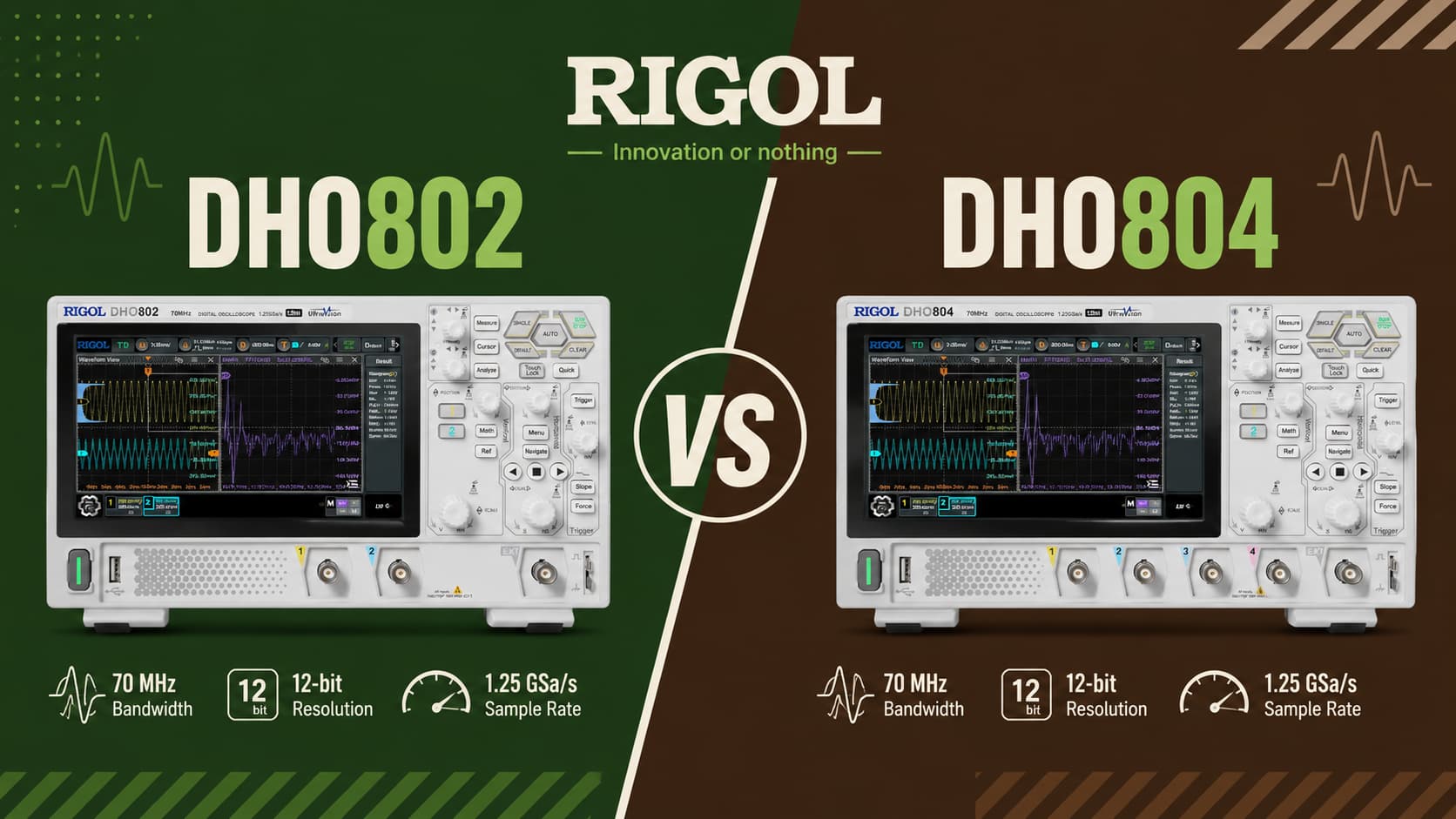
Rigol’s DHO800 series brought a real upgrade to the entry-level bench oscilloscope market: a 12-bit ADC, a modern capacitive touchscreen, USB-C power, and built-in protocol decoding — all at a price that competes directly with older 8-bit scopes. Within that same series, the Rigol DHO802 and Rigol DHO804 share nearly identical internals. The decision between them isn’t about bandwidth, resolution, or sample rate — it comes down to a single question: how many channels do you actually need on your bench?
Quick answer: if you mostly work with a single signal at a time — power rails, basic Arduino projects, audio, or general analog troubleshooting — the Rigol DHO802 gives you the full DHO800 experience for less. If you regularly need to view multiple signals together, especially for protocol debugging like SPI or I2C, the Rigol DHO804 is the better long-term buy for most people.
Same 12-bit ADC, touchscreen, and memory depth as the DHO804, in a 2-channel package. The right pick if your work rarely needs more than two signals at once.
The same platform with two extra channels — the difference that matters most for embedded debugging, protocol decoding, and multi-signal troubleshooting.
Quick Verdict
This comparison is unusually clean because these two scopes aren’t fighting over different specs — they’re fighting over channel count alone. Bandwidth, ADC resolution, memory depth, and sample rate are effectively identical across both models. That makes the decision less about “which is the better scope” and more about “how many signals do you need to see at the same time.” For single-signal work, the DHO802 delivers everything the DHO804 does at a lower cost. For anything involving correlated signals — clock and data lines, multi-rail power sequencing, or general embedded debugging — the DHO804’s extra two channels remove a real limitation rather than adding a luxury.
Comparison Table
| Spec | Rigol DHO802 | Rigol DHO804 |
|---|---|---|
| Analog channels | 2 | 4 |
| Bandwidth | 70 MHz | 70 MHz |
| ADC resolution | 12-bit | 12-bit |
| Max sample rate | 1.25 GSa/s | 1.25 GSa/s |
| Memory depth | Up to 25 Mpts | Up to 25 Mpts |
| Display | Capacitive touchscreen | Capacitive touchscreen (same panel) |
| Power | USB-C powered | USB-C powered |
| Protocol decoding | SPI, I2C, UART, CAN included | SPI, I2C, UART, CAN included |
| External trigger output | Included (standard on 2-channel model) | Not applicable |
| Best suited for | Single or dual-signal work, education, basic analog/embedded debugging | Multi-signal correlation, protocol debugging, general-purpose bench work |
| Price positioning | Entry point into the DHO800 platform | Modest step up for double the channel count |
Rigol DHO802 Overview
The DHO802 is Rigol’s entry point into the DHO800 line, and it’s worth being clear about what “entry point” means here: you aren’t giving up resolution, bandwidth, or memory depth to get the lower price — you’re giving up channels. The 12-bit ADC, the same capacitive touchscreen used across the series, USB-C power for portable use, and the full protocol decoding suite (including CAN, which many competitors charge extra for) all carry over unchanged. For anyone whose bench work centers on a single test point at a time — checking a power rail, verifying an audio signal, or confirming an Arduino output — the DHO802 delivers the full modern DHO800 experience without paying for channels that would sit unused.
Where it runs into real limits is protocol work that needs more than two probe points. SPI, for example, typically wants clock, MOSI, MISO, and chip-select visible together — with only two channels, you’re forced to choose which pair to watch at a time, which turns a five-minute debug session into several passes. If your work touches that kind of multi-line correlation even occasionally, it’s worth reading the DHO804 section below before deciding.
Best for technicians and hobbyists who mainly probe one or two signals at a time — general analog troubleshooting, audio work, basic embedded debugging, or education. This is the pick for best value because it puts the full 12-bit DHO800 platform within reach without paying for channels most single-signal work won’t use.
Don’t overbuy here: if you already know your projects involve multi-line protocols or simultaneous power-rail monitoring, the two extra channels on the DHO804 will save you far more time than the price difference costs.
- Same 12-bit ADC and touchscreen as the rest of the DHO800 line
- Full protocol decoding included, including CAN
- USB-C power makes it genuinely portable
- Lower cost of entry into the platform
- Only 2 channels limits multi-signal correlation
- SPI and similar protocols are awkward with only two probe points
- Less flexible if your projects grow in complexity
Rigol DHO804 Overview
The DHO804 is the same DHO800 platform with two additional channels, and that’s essentially the entire story — bandwidth, ADC resolution, memory depth, and sample rate all match the DHO802 spec for spec. What changes is what you can actually see on screen at once. Four channels means you can watch a clock line, data line, chip-select, and a power rail simultaneously, which is the difference between diagnosing an SPI timing issue in one capture versus reconstructing it across several.
For most people setting up a general-purpose bench — not a dedicated single-signal test station — four channels is the more future-proof choice. Embedded projects have a way of growing in complexity, and the moment a design adds a second peripheral on the same bus, two channels stop being enough. The DHO804 removes that ceiling for a modest premium over the DHO802, without asking you to compromise on any of the other specs that make the DHO800 series appealing in the first place.
Best for engineers and technicians who need genuine multi-signal visibility — embedded debugging, protocol decoding across multiple lines, or general bench work where you don’t want to think twice about channel count. This is the best overall pick in this comparison for most buyers.
Don’t overbuy here either: if your bench work is genuinely single-signal — one audio channel, one power rail, one basic digital output — the DHO802 gets you to the same measurement quality for less.
- 4 channels for genuine multi-signal correlation
- Same 12-bit ADC, memory depth, and bandwidth as the DHO802
- Much better suited to SPI and similar multi-line protocols
- More future-proof as projects grow in complexity
- Costs more than the DHO802 for the same core measurement capability
- Extra channels add no benefit if your work is genuinely single-signal
- Still shares the DHO802’s 70 MHz bandwidth ceiling
Key Differences
Unlike most oscilloscope comparisons, this one isn’t about trading off bandwidth against price, or resolution against sample rate. The DHO802 and DHO804 are, underneath the channel count, the same instrument. Same 12-bit vertical resolution, same 70 MHz analog bandwidth, same 1.25 GSa/s sample rate, same up-to-25 Mpts memory depth, same touchscreen interface, and the same built-in protocol decoders. That makes this an unusually easy comparison to reason about: the only real question is whether two channels or four channels better match how you actually use a scope.
The one other point worth noting is the external trigger output, which is standard on the 2-channel model — a detail that matters for niche synchronization setups but won’t affect most buyers’ decisions either way.
Real-World Performance Comparisons
In practice, the channel difference shows up fastest in protocol debugging. Trying to decode SPI on the DHO802 means picking either the clock-and-MOSI pair or the clock-and-MISO pair — workable, but it turns a single debug session into two passes if you need to see the full transaction. On the DHO804, all four lines sit on screen together, and the decoder can show a complete, correctly correlated transaction on the first capture.
The same pattern holds for power supply work. On the DHO802, you can watch input and output voltage together, but adding an enable signal or a second rail means swapping probes mid-test. On the DHO804, a full power-up sequence — input rail, output rail, enable signal, and a downstream load — can be captured in a single acquisition, which matters when you’re chasing an intermittent startup glitch that won’t repeat on command.
For genuinely single-signal work — checking an audio waveform, confirming a microcontroller’s output toggles correctly, or verifying a sensor’s analog output — both scopes perform identically, since the extra channels on the DHO804 simply aren’t in use.
Customer Opinions: Amazon and Reddit Summary
Feedback on the DHO802 across Amazon reviews and electronics forums tends to focus on how much modern capability it packs in for a 2-channel scope — the touchscreen, the 12-bit ADC, and the included CAN decoding come up repeatedly as unexpected value at this tier. The most consistent caveat, echoed by more experienced users, is that two channels feel restrictive the moment a project involves more than one active signal path, which lines up with the channel-count tradeoff discussed above.
The DHO804 draws similar praise for the same core platform strengths, but reviewers and forum commenters more often describe it as the “safer” or “no-regrets” choice specifically because of the four channels. A recurring theme in hobbyist and embedded-focused communities is that buyers who started with a 2-channel scope frequently mention wishing they’d gone straight to four, which is the kind of pattern worth weighing before deciding purely on the smaller price difference.
Which Should You Buy?
If you’re still weighing the two, the deciding factor really is how your bench work is structured. If you consistently work with one signal at a time — a single audio path, a single power rail, a single digital line — the DHO802 gets you the same measurement quality as its sibling for less. If your work involves anything with multiple correlated signals, even occasionally, the DHO804’s extra two channels tend to earn back their modest premium the first time you avoid a multi-pass debug session.
Buy the Rigol DHO802 if…
- Your work is mostly single-signal: audio, basic analog, or one digital line at a time
- You want the full DHO800 platform (12-bit ADC, touchscreen, decoding) at the lowest entry cost
- You’re using it for education or light hobby use where two channels are genuinely enough
- You need the external trigger output for a specific synchronization setup
Buy the Rigol DHO804 if…
- You regularly debug SPI, I2C, or other multi-line protocols
- You want to monitor multiple power rails or signals simultaneously
- Your projects tend to grow in complexity over time
- You’d rather not think twice about channel count on general bench work
Final Recommendation
For most buyers setting up a general-purpose bench, the Rigol DHO804 is the better overall pick — the extra two channels remove a real limitation for a modest premium, and nothing else about the platform changes. If your use case is clearly single-signal and you want to minimize cost, the Rigol DHO802 delivers the identical core measurement quality for less.
Final Verdict
The DHO802 and DHO804 make this comparison refreshingly simple: identical bandwidth, resolution, sample rate, and memory depth, with the entire decision resting on channel count. Choose the DHO802 if your bench work is genuinely single-signal and you want to minimize cost. Choose the DHO804 if you want the flexibility to correlate multiple signals without a second thought — for most general-purpose bench setups, that flexibility is worth the modest step up.