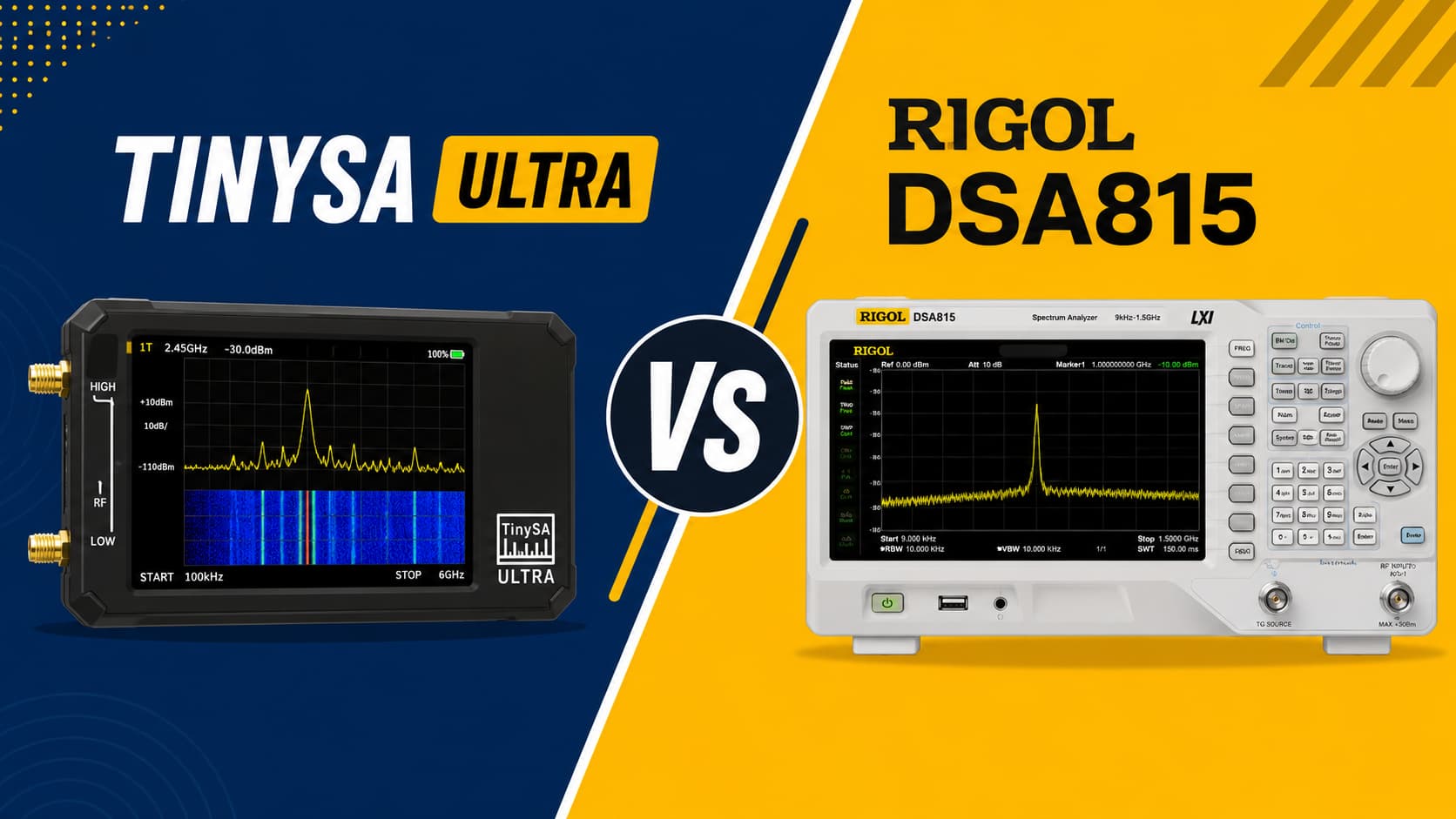
If you work with RF signals — whether you’re chasing interference, aligning an antenna, checking spurious emissions, or just trying to figure out what’s actually coming out of a mixer — a spectrum analyzer stops guesswork cold. Two instruments dominate the conversation for engineers and serious hobbyists on a budget: the TinySA Ultra, a pocket-sized analyzer that punches well above its size, and the Rigol DSA815, a proper bench-top instrument that’s become a staple in small labs and repair shops. They solve overlapping problems but serve very different workflows, and picking the wrong one for your use case means either overpaying for capability you won’t use or hitting a wall the first time you need real dynamic range.
Quick answer: if you need a field-portable, go-anywhere analyzer for general RF troubleshooting and don’t require lab-grade accuracy, the TinySA Ultra is the smarter buy for most people. If your work involves EMI pre-compliance, filter design validation, or anything where measurement accuracy and dynamic range genuinely matter, the Rigol DSA815 is worth the step up.
Pocket-sized, battery-powered, and capable enough for day-to-day RF troubleshooting, antenna work, and hobbyist projects. Excellent value for the frequency coverage it offers.
A real bench instrument with meaningfully better dynamic range, resolution bandwidth, and amplitude accuracy — the right call when your measurements need to hold up professionally.
Quick Verdict
These two instruments aren’t really competing for the same shelf space, and that’s the point. The TinySA Ultra is a triumph of miniaturization — a analyzer that fits in a jacket pocket, runs on battery power, and covers a genuinely wide frequency span for the money. It’s built around a low-cost architecture, so its dynamic range, noise floor, and amplitude accuracy trail behind a dedicated bench unit. The Rigol DSA815 is a conventional superheterodyne spectrum analyzer with a proper RF front end, a real display, and specifications you can actually put in a test report. It costs more, needs a bench and a power outlet, and covers a narrower top-end frequency range, but it measures like an instrument built for that job specifically. Neither is “better” in the abstract — the right choice depends entirely on whether you need portability or precision.
Comparison Table
| Spec | TinySA Ultra | Rigol DSA815 |
|---|---|---|
| Form factor | Handheld, battery-powered | Bench-top, mains-powered |
| Frequency range | ~100 kHz – 5.3 GHz (direct), extended via harmonics to higher ranges | 9 kHz – 1.5 GHz |
| Display | Small color touchscreen | Large color LCD, dedicated front panel |
| Dynamic range / noise floor | Adequate for troubleshooting; not lab-grade | Significantly better; suitable for pre-compliance work |
| Resolution bandwidth (RBW) | Coarser minimum RBW | Down to narrow RBW for fine signal separation |
| Tracking generator | Not available | Available on TG variant, useful for filter/amplifier sweeps |
| Power | Internal rechargeable battery | AC mains |
| Portability | Pocket-sized, field-ready | Requires a bench and stable surface |
| Best suited for | Field troubleshooting, antenna/RF hobby work, quick spot checks | Lab measurements, EMI pre-compliance, filter/amp design validation |
| Price positioning | Budget-friendly, hobbyist-accessible | Mid-range professional bench instrument |
TinySA Ultra Overview
The TinySA Ultra grew out of the open-source TinySA project and has become the default recommendation for anyone who wants spectrum analysis capability without committing bench space or a large budget to it. What makes it genuinely useful rather than a novelty is the frequency coverage: it handles both a low-band input path and a separate high-band input, giving it direct coverage well into the gigahertz range where most consumer wireless, ISM-band, and amateur radio activity lives. For antenna tuning, checking oscillator harmonics, confirming a transmitter is actually putting out a signal, or doing a rough EMI sanity check in the field, it gets the job done without dragging a bench analyzer along.
The tradeoffs are exactly what you’d expect from an instrument this small and this affordable. The dynamic range and noise floor aren’t in the same league as a superheterodyne bench unit, so weak signals near strong ones can be harder to resolve, and absolute amplitude accuracy is good for relative comparisons but not for certified measurements. The screen is small enough that detailed trace analysis benefits from exporting data to a PC. None of that erases its value — it just defines where it fits.
Best for engineers and hobbyists who need a portable, go-anywhere spectrum analyzer for general troubleshooting, antenna work, and RF spot-checks. This is the pick for most buyers because it covers the situations people actually run into most often — confirming a signal exists, checking rough frequency and level, spotting obvious spurious emissions — at a price that doesn’t require budget approval.
Don’t overbuy here: if your work never touches narrowband signal separation, calibrated amplitude readings, or formal compliance testing, spending more on a bench analyzer buys you accuracy you won’t use.
- Extremely portable, runs on battery
- Wide frequency coverage for the price
- Fast enough for field troubleshooting
- Low cost of entry for basic spectrum work
- Limited dynamic range compared to bench units
- Small screen makes detailed analysis harder
- No tracking generator option
- Amplitude accuracy is relative, not lab-grade
Rigol DSA815 Overview
The Rigol DSA815 is a conventional bench-top spectrum analyzer built around a real superheterodyne architecture, and it shows in the numbers that matter for serious work: dynamic range, resolution bandwidth, and amplitude accuracy are all in a different tier than what a pocket analyzer can offer. This is the instrument you reach for when a measurement needs to survive scrutiny — validating a filter’s rejection, checking harmonic content against a real compliance mask, or separating two signals that sit close together in frequency.
With the TG (tracking generator) variant, the DSA815 becomes a two-in-one scalar network analyzer, letting you sweep filters, amplifiers, and cables directly and see the frequency response on the same display. That’s a capability the TinySA Ultra simply doesn’t offer. The cost of all this is that the DSA815 is a bench instrument in every sense — it needs mains power, a stable surface, and it’s not something you’re tossing in a backpack for a rooftop antenna check.
Best for engineers who need lab-grade measurement confidence — filter and amplifier design validation, EMI pre-compliance screening, or any application where the number on the screen has to be defensible. This is the best overall pick when accuracy matters more than portability.
Don’t overbuy here either: if you mostly need to confirm “is there a signal, roughly where, roughly how strong,” the DSA815’s extra precision is capability you’re paying for and not using.
- Genuine bench-grade dynamic range and accuracy
- Narrower RBW resolves closely spaced signals
- Tracking generator option for filter/amp sweeps
- Large display suited to detailed trace work
- Not portable — bench and mains power required
- Top frequency range tops out below TinySA Ultra’s
- Higher price point than a pocket analyzer
- Overkill for casual or occasional spot-checks
Key Differences
The clearest way to separate these two instruments is by what they’re optimized for. The TinySA Ultra optimizes for reach — you can take it anywhere, and it covers a frequency span most bench analyzers in its price class can’t touch. The Rigol DSA815 optimizes for measurement quality within a narrower, more traditional RF range. That single distinction explains almost every other difference on the spec sheet: the DSA815’s superior dynamic range and RBW come from a more complex RF front end that isn’t practical to shrink into a handheld form factor, while the TinySA Ultra’s portability comes from simplifications that trade away some of that precision.
The tracking generator is worth calling out on its own, because it changes what class of problem an instrument can solve. Without one, you can observe a signal but not actively characterize a passive or active RF component’s frequency response. The DSA815-TG closes that gap; the TinySA Ultra doesn’t offer an equivalent path.
Real-World Performance Comparisons
In the field, the difference shows up fastest when you’re hunting for a weak signal near a strong one — say, a spurious emission close to a carrier, or a low-level interferer buried near a noisy switching supply’s fundamental. The DSA815’s better dynamic range and finer RBW options let it separate those signals cleanly, where the TinySA Ultra’s coarser noise floor can mask the smaller one entirely. On the other hand, for a quick “is my antenna resonant where I think it is” or “did this oscillator actually start” check, the TinySA Ultra’s speed of deployment — power on, point, read — wins outright, since setting up a bench instrument for a five-minute field check is rarely worth the hassle.
For repeatable lab work like verifying a bandpass filter’s insertion loss and rejection slope, the DSA815-TG’s ability to sweep and display the response directly removes a whole category of manual measurement and estimation that a TinySA Ultra user would otherwise do with a signal generator and separate readings.
Customer Opinions: Amazon and Reddit Summary
Buyer sentiment for the TinySA Ultra tends to converge on the same theme across Amazon reviews and RF-focused Reddit communities: people are consistently surprised by how much frequency coverage and usable functionality it packs into such a small, affordable package, especially for antenna work, general troubleshooting, and ham radio use. The most common caveats echo the technical limitations above — some buyers note the screen is small for detailed work and that it isn’t a substitute for a “real” lab analyzer when accuracy is critical, which tracks with how the instrument is designed.
The Rigol DSA815 draws a different kind of praise: reviewers and forum users frequently describe it as a workhorse that holds up well in small labs, repair shops, and university settings, with the tracking generator option called out repeatedly as a major value-add for anyone doing filter or amplifier work. Criticism tends to center on its bulk relative to newer competitors and the learning curve of a full-featured bench analyzer for users coming from simpler tools — less about raw performance and more about it being a bigger, more involved instrument to live with.
Which Should You Buy?
If you’re still deciding, the honest answer depends on what “spectrum analyzer” means in your day-to-day work. If it means occasionally checking whether a signal exists, roughly where, and roughly how strong — antenna tuning, RF hobby projects, quick field diagnostics — you don’t need the DSA815’s precision, and the TinySA Ultra will handle it while staying out of your way the rest of the time. If “spectrum analyzer” means producing a number that goes into a test report, validating a filter design against a spec, or doing EMI pre-compliance before a formal test house visit, the DSA815 is the instrument built for that, and a pocket analyzer will eventually leave you unsure whether a marginal reading is real.
Buy the TinySA Ultra if…
- You need something portable enough for field work and site visits
- Your main use case is antenna, hobby, or general RF troubleshooting
- You want broad frequency coverage without bench-analyzer pricing
- You don’t need certifiable or highly precise amplitude readings
Buy the Rigol DSA815 if…
- Your measurements need to hold up in a professional or academic setting
- You’re validating filters, amplifiers, or doing EMI pre-compliance work
- You want a tracking generator for frequency-response sweeps
- You have bench space and don’t need field portability
Final Recommendation
For the majority of buyers — hobbyists, field technicians, and engineers who need a capable general-purpose tool rather than a certified lab instrument — the TinySA Ultra remains the best overall value and the pick most people should make. If your work genuinely depends on dynamic range, resolution, and a tracking generator, the Rigol DSA815 is the upgrade that will actually pay for itself in measurement confidence.
Final Verdict
Both instruments are strong choices within the job they’re designed for. The TinySA Ultra earns its place as the default recommendation because most people’s spectrum analysis needs are occasional, field-based, and forgiving of some measurement imprecision. The Rigol DSA815 earns its place as the upgrade pick because when accuracy and dynamic range actually matter, there’s no substitute for a real bench architecture. Choose based on where your work actually happens — in the field or on the bench — rather than on spec-sheet numbers alone.