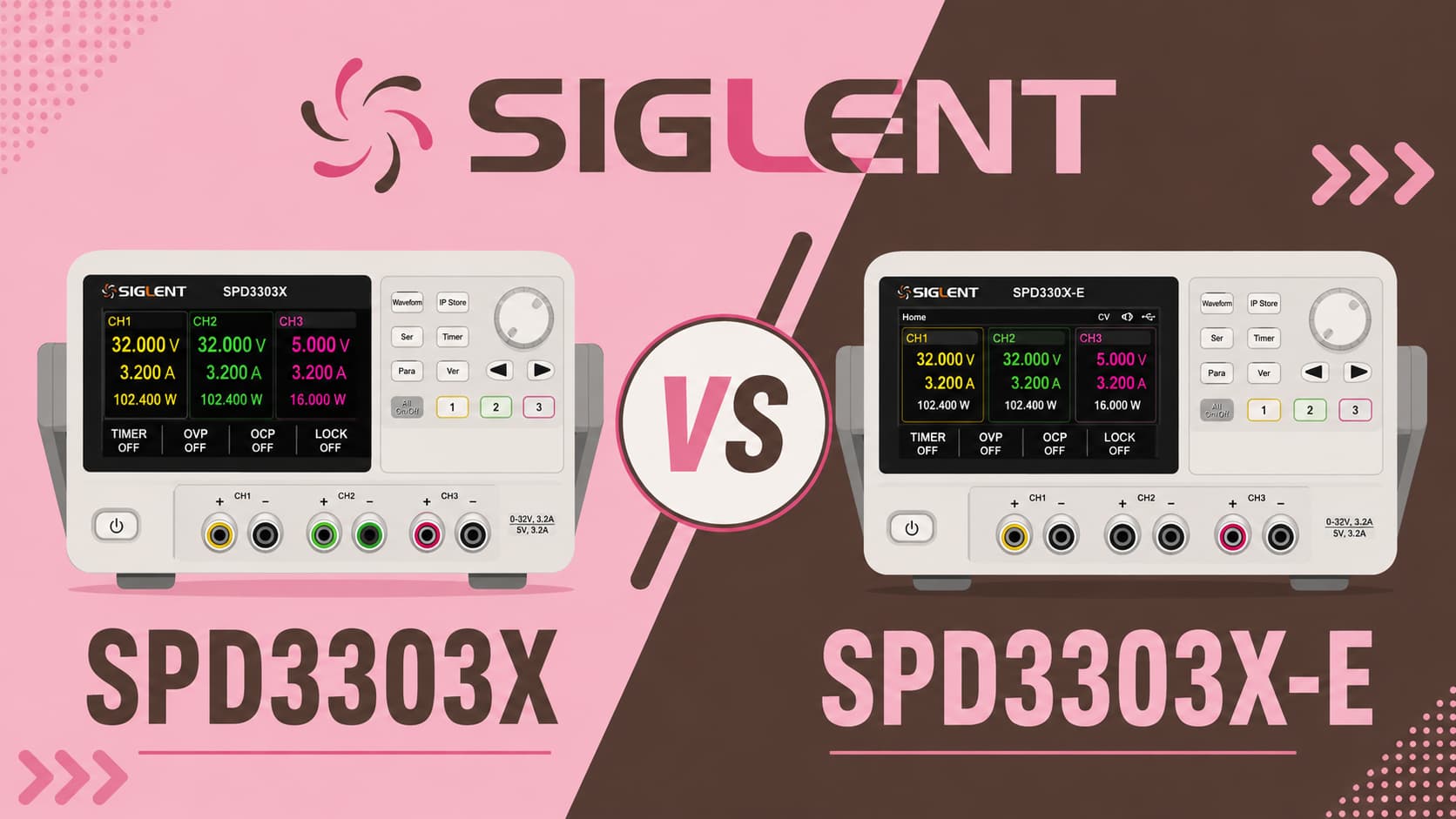
The Siglent SPD3303X and SPD3303X-E look nearly identical at a glance. Both share the same 4.3-inch colour TFT display, the same three-channel 220 W linear output architecture, the same LAN and USB connectivity, and the same real-time waveform display. On paper they are close enough that the comparison can feel like splitting hairs. In practice, they are separated by one specification that genuinely matters for a specific class of work: resolution and accuracy.
The SPD3303X-E resolves voltage in 10 mV steps with ±0.5% accuracy. The SPD3303X resolves voltage in 1 mV steps with ±0.03% accuracy — ten times finer resolution and approximately sixteen times tighter accuracy. If you are developing precision analog circuits, characterising sensor behaviour, or powering anything sensitive enough that a 10 mV setting error produces a measurable consequence, the SPD3303X is the appropriate instrument. If your work tolerates 10 mV resolution without consequence, the SPD3303X-E delivers the same display, connectivity, and workflow features for a lower outlay.
For most engineers buying a bench supply for general development, board bring-up, and production test work, the SPD3303X-E is the better value. For engineers doing precision analog design, audio characterisation, sensor work, or any application where supply accuracy directly affects measurement integrity, the SPD3303X is the correct tool and the price premium is genuinely justified.
Same TFT display, LAN, and waveform monitoring as the X. 10 mV resolution covers the vast majority of bench work. The sensible choice if precision accuracy is not a requirement.
1 mV resolution, ±0.03% accuracy. The precision model in this family, for work where supply accuracy directly affects results.
Quick Verdict
Bottom Line
The SPD3303X-E is the right supply for most engineers. Its 10 mV/10 mA resolution is adequate for general development, production test, and educational work, and its TFT display, LAN connectivity, waveform display, and timing function deliver everything a capable bench supply should offer at a reasonable price.
The SPD3303X is the right supply for engineers whose work is constrained by supply accuracy. If you are characterising a precision voltage reference, developing an audio DAC where supply ripple must be measured to sub-millivolt precision, or powering a sensor whose offset shifts with supply voltage, the X’s 1 mV resolution and ±0.03% accuracy remove the power supply as a source of error in your measurements. The X-E cannot make that claim at the same confidence level.
Every other feature — the TFT display, the LAN port, the waveform output monitor, the five-step timing function, the output modes — is shared between both models. The decision reduces to one question: does your application require 1 mV resolution and ±0.03% accuracy, or is 10 mV and ±0.5% sufficient?
Specifications Compared
| Specification | SPD3303X | SPD3303X-E |
|---|---|---|
| Display | 4.3″ colour TFT-LCD 480×272 | 4.3″ colour TFT-LCD 480×272 |
| Display Digits (V / I) | 5-digit voltage / 4-digit current | 4-digit voltage / 3-digit current |
| Voltage Resolution | 1 mV | 10 mV |
| Current Resolution | 1 mA | 10 mA |
| Voltage Accuracy | ±(0.03% + 10 mV) | ±(0.5% + 2 digits) |
| Current Accuracy | ±(0.3% + 10 mA) | ±(0.5% + 2 digits) |
| CH1 / CH2 Voltage | 0–32 V | 0–32 V |
| CH1 / CH2 Current | 0–3.2 A | 0–3.2 A |
| CH3 (fixed) | 2.5 V / 3.3 V / 5 V at 3.2 A | 2.5 V / 3.3 V / 5 V at 3.2 A |
| Total Output Power | 220 W | 220 W |
| Ripple & Noise | ≤1 mVrms | ≤1 mVrms |
| Series Mode Max | 64 V | 64 V |
| Parallel Mode Max | 6.4 A | 6.4 A |
| Connectivity | USB + LAN | USB + LAN |
| Remote Programming | SCPI via USB and LAN | SCPI via USB and LAN |
| Waveform Display | Real-time output waveform | Real-time output waveform |
| Timing Function | 5-step programmable sequences | 5-step programmable sequences |
| Save / Recall | 5 groups + external expansion | 5 groups + external expansion |
| Software | EasyPower + LabVIEW driver | EasyPower + LabVIEW driver |
Siglent SPD3303X Overview
The SPD3303X is the precision model in the SPD3303 family. It shares the physical platform, display, and feature set of the SPD3303X-E but is built around a more accurate measurement and setting architecture: 1 mV voltage resolution, 1 mA current resolution, and voltage accuracy specified at ±(0.03% + 10 mV). For context, at a nominal 5 V output, 0.03% accuracy means the actual voltage is within ±1.5 mV + 10 mV of the set point. At the same 5 V setting, the SPD3303X-E’s ±0.5% accuracy means an actual uncertainty of ±25 mV + the digit rounding.
The five-digit voltage display and four-digit current display are the most visible evidence of this precision focus. Where the SPD3303X-E shows 4.000 V, the SPD3303X shows 4.0000 V — the additional digit is not decorative, it reflects a genuine increase in setting granularity and measurement resolution that the hardware is capable of delivering.
In all other respects, the SPD3303X is identical to the SPD3303X-E. The same 4.3-inch TFT display, the same three-channel isolated output architecture (two adjustable channels plus one fixed logic rail), the same LAN and USB connectivity, the same real-time waveform output monitor, and the same five-step timing function. The core linear supply design — 220 W total, series/parallel modes, ≤1 mVrms ripple — is shared across the entire SPD3303 family.
The precision model in the SPD3303 family. 1 mV voltage resolution and ±0.03% accuracy distinguish it from the X-E in applications where supply accuracy directly affects measurement integrity or circuit performance. Full TFT display, LAN, waveform monitoring, and timing function are included — nothing is sacrificed for precision.
The SPD3303X commands a noticeable price premium over the SPD3303X-E. That premium is well spent for precision analog work, audio design, sensor characterisation, or any application where the supply’s own accuracy is a variable you cannot afford to leave uncontrolled. It is not well spent if your work comfortably tolerates 10 mV resolution — in that case the X-E delivers the same practical experience for less.
Skip it if: your typical application — board bring-up, digital circuit test, general development, or production test — does not require sub-10 mV setting accuracy. The SPD3303X-E provides the same working environment at a lower cost.
- 1 mV / 1 mA resolution — ten times finer than the X-E
- Voltage accuracy ±(0.03% + 10 mV) — approximately 16× tighter than X-E
- 5-digit voltage / 4-digit current display
- Same TFT display, LAN, and waveform features as X-E
- Correct choice for precision analog, audio, and sensor work
- Eliminates power supply as a significant accuracy variable
- 220 W, three isolated channels, series and parallel modes
- SCPI over USB and LAN with EasyPower and LabVIEW driver
- Costs more than the SPD3303X-E
- Precision features offer no benefit if work tolerates 10 mV resolution
- Same ripple specification as X-E — not a lower-noise design
- Same physical platform — no added ruggedisation or form-factor benefit
Siglent SPD3303X-E Overview
The SPD3303X-E is the mid-tier model in the SPD3303 family and the more popular choice for general engineering bench work. It matches the SPD3303X feature for feature on everything except resolution and accuracy: the 4.3-inch TFT display is the same, the LAN and USB connectivity is the same, the real-time waveform display is the same, and the five-step timing function is the same. For engineers whose work does not require sub-10 mV supply accuracy, buying the X-E over the X means paying for identical features rather than precision specifications that go unused.
At 10 mV voltage resolution and ±0.5% accuracy, the SPD3303X-E is a capable, well-specified instrument for the majority of development and test work. Board bring-up, digital and mixed-signal circuit development, functional production testing, and educational laboratory use all fall comfortably within its accuracy class. The four-digit voltage display resolves to 0.001 V — sufficient for all but the most accuracy-critical applications.
Where the SPD3303X-E genuinely excels is in the overall bench experience relative to its price. Engineers who step up from an LED-display supply to the SPD3303X-E consistently cite the colour TFT and network connectivity as transformative daily-use improvements. The waveform output display, which lets you observe voltage and current behaviour without reaching for a scope, and the timing function for automated power sequencing, round out a feature set that the SPD3303C — the entry-level model — cannot approach.
The SPD3303X-E delivers every feature that makes the SPD3303X a practical daily-use instrument — colour TFT display, LAN remote programming, real-time waveform display, and programmable timing sequences — at a lower price point than the precision X. For general engineering bench work, board bring-up, and production test, it is the stronger value proposition.
The 10 mV resolution is the honest limitation here. It is sufficient for the vast majority of bench applications. If you are unsure whether your work truly requires 1 mV resolution, ask this: have you ever needed to set a supply to a voltage between, say, 3.300 V and 3.310 V and had it matter to your circuit or measurement? If not, the SPD3303X-E resolution is not a constraint in your workflow.
Skip it if: your work involves precision analog characterisation, audio circuit design, low-offset sensor development, or any application where a 10 mV supply error is large enough to affect your results. In those cases the SPD3303X’s accuracy is what you are buying.
- Same TFT display, LAN, waveform, and timing function as the X
- More affordable than the SPD3303X
- 10 mV/10 mA resolution is sufficient for the majority of bench work
- Identical connectivity: SCPI over USB and LAN
- EasyPower software and LabVIEW driver included
- Same 220 W three-channel output with series and parallel modes
- Real-time waveform display and 5-step timing function
- 10 mV resolution vs 1 mV on the SPD3303X
- ±0.5% voltage accuracy vs ±0.03% on the SPD3303X
- 4-digit display vs 5-digit on the SPD3303X
- Not appropriate for precision analog or sensor characterisation work
Key Differences
Resolution: 1 mV vs 10 mV — and Why It Matters
The SPD3303X resolves to 1 mV. The SPD3303X-E resolves to 10 mV. In concrete terms, this means the finest voltage step the SPD3303X-E can set or display is ten times coarser than the SPD3303X. For a digital circuit powered at 3.3 V this is irrelevant — whether the supply reads 3.300 V or 3.310 V has no practical consequence. For a precision voltage reference output being characterised at 2.500 V, a 10 mV step represents a 0.4% uncertainty from the setting alone, before accounting for accuracy.
The practical test is whether your circuit or measurement responds detectably to a 10 mV supply change. If the answer is no — and for the majority of digital, mixed-signal, and general analog development it is no — the SPD3303X-E’s resolution is not a constraint. If the answer is yes, the SPD3303X’s finer resolution removes the supply from your uncertainty budget.
Accuracy: ±0.03% vs ±0.5%
Accuracy is a different consideration from resolution. Resolution defines what you can set; accuracy defines how close the actual output is to what you set. At a 5 V output the SPD3303X guarantees the actual voltage is within approximately ±11.5 mV of the set point. The SPD3303X-E guarantees it is within approximately ±27 mV. For most bench work this difference is inconsequential. For work where the supply voltage is a controlled independent variable in a measurement — characterising a temperature sensor’s voltage sensitivity, calibrating a precision ADC, or testing a voltage regulator’s regulation range — the SPD3303X’s accuracy is what makes the supply a trustworthy reference rather than a source of measurement uncertainty.
Display Digits: 5 vs 4
The SPD3303X’s five-digit voltage display directly reflects its 1 mV resolution. The SPD3303X-E’s four-digit display reflects its 10 mV resolution. This is not a cosmetic difference — the additional digit on the SPD3303X is carrying real information about the supply’s setting and output. Both instruments display this information on the same 4.3-inch TFT panel, so the readability advantage is identical between the two models.
Everything Else: Identical
Beyond resolution, accuracy, and display digits, there is no meaningful difference between the SPD3303X and SPD3303X-E. The 4.3-inch TFT, LAN port, USB connectivity, SCPI command set, EasyPower software, LabVIEW driver, real-time waveform display, five-step timing function, output modes, channel configuration, and underlying linear supply architecture are all shared. Buying the SPD3303X for any of these features over the SPD3303X-E produces no benefit — it is only the accuracy and resolution specifications that justify the premium.
Real-World Performance
Output Cleanliness
Both the SPD3303X and SPD3303X-E are specified at ≤1 mVrms ripple and noise. This shared specification reflects the same underlying linear supply topology and output filtering. Engineers who have measured both under representative loads report no meaningful difference in noise floor at the terminals. The SPD3303X’s precision advantage is in its setting and readback accuracy — it is not a lower-noise instrument.
The SPD3303X and SPD3303X-E produce indistinguishable ripple and noise at the output. The SPD3303X’s advantage is entirely in the accuracy and resolution of the voltage and current set points — not in the cleanliness of the supply rail itself.
Setting Accuracy Under Real Conditions
The difference in accuracy specifications becomes practically visible in precision-sensitive applications. At a nominal 10 V output, the SPD3303X’s ±0.03% accuracy means the actual output is within ±13 mV. The SPD3303X-E’s ±0.5% accuracy means it is within ±52 mV. For a circuit whose performance is sensitive to supply voltage — a precision reference, a low-dropout regulator being characterised at its dropout threshold, or a high-resolution ADC reference — this is the difference between a controlled experiment and an uncontrolled one.
Remote Programming Accuracy
Both models support SCPI remote programming over USB and LAN. The precision difference extends to programmatic operation: when setting voltages via SCPI commands, the SPD3303X accepts and executes 1 mV steps while the SPD3303X-E rounds to the nearest 10 mV. In automated test sequences where multiple voltage points are swept and measured, this granularity difference accumulates into a meaningful difference in test resolution.
Waveform Display and Timing Function
The real-time waveform output display and the five-step timing function are identical between the two models in implementation and capability. Both instruments display the same graphical output current and voltage traces on the same TFT panel. The timing function on both allows the same five programmable voltage/current steps with independently set dwell times. No functional difference exists between the models in either feature.
Customer Opinions: What Amazon and Forum Users Say
SPD3303X
The SPD3303X draws consistently strong reviews from engineers in precision-sensitive disciplines — RF circuit designers who need clean, accurate bias rails, audio engineers characterising amplifiers and DACs, and research technicians running automated sweep tests where supply accuracy is a controlled variable. The most common positive thread is that the instrument behaves as a genuine precision reference rather than an approximately-correct supply. The most frequent criticism from buyers who chose the SPD3303X without genuinely needing the precision is that they effectively paid for specifications they never use — a recurring theme in forum discussions that echoes the “don’t overbuy” point this comparison addresses directly.
SPD3303X-E
The SPD3303X-E receives strong user satisfaction from engineers who upgraded from an LED-display supply or from the SPD3303C. The colour TFT and LAN connectivity are the two features most consistently cited as daily-use improvements, and the waveform display is described as a practically useful addition that simplifies early-stage debugging. The 10 mV resolution limitation appears in negative reviews almost exclusively from users who purchased without realising the distinction from the SPD3303X — a confusion that arises from how similar the two models appear in catalogue listings. Users who bought the X-E knowing its resolution class are consistently satisfied with it as a daily bench instrument.
Which Should You Buy?
- Your work involves precision analog circuit design where supply accuracy is a controlled variable
- You are characterising voltage references, precision ADCs, DACs, or sensor outputs
- You develop audio circuits where supply voltage affects measurement results
- You run automated sweep tests where 10 mV voltage steps are too coarse for your test grid
- You need remote SCPI programming at 1 mV granularity
- Your application’s performance is measurably sensitive to 10–30 mV supply changes
- You want the supply itself eliminated as a meaningful uncertainty source
- Your work is general bench development — digital, mixed-signal, firmware bring-up
- Production test setups where supply voltage is set once and tolerance is >10 mV
- Educational and teaching lab environments
- You want a TFT display and LAN connectivity without paying for precision accuracy you will not use
- Your circuit’s performance does not measurably respond to 10–30 mV supply changes
- You are equipping multiple benches and per-unit cost is a meaningful constraint
- You are upgrading from an LED-display or USB-only supply and want a meaningful feature improvement
The honest version of this decision is not about which instrument is better — the SPD3303X is objectively the more capable supply. The question is whether the capability difference is relevant to your actual work. An SPD3303X powering a Raspberry Pi development board operates identically to an SPD3303X-E in that role. An SPD3303X-E characterising a precision 4.096 V reference introduces accuracy uncertainty that the SPD3303X would not.
For most engineers, the SPD3303X-E is the right bench supply. It delivers every practical working feature — colour TFT, LAN, waveform display, timing function, three isolated channels, 220 W — at a lower cost than the SPD3303X. If your work tolerates 10 mV supply resolution without consequence, you are paying for identical daily-use performance at the X-E’s price point.
The SPD3303X is the right instrument when your work genuinely requires 1 mV resolution and ±0.03% accuracy. Precision analog design, sensor characterisation, audio engineering, and automated sweep testing where voltage granularity matters directly are the use cases the SPD3303X was built for. In those roles the price premium is justified by what it removes from your measurement uncertainty budget — the supply itself.
1 mV resolution, ±0.03% accuracy. The precision model — for work where supply accuracy is a controlled variable.
Same TFT, LAN, and waveform features. 10 mV resolution covers most bench work. The smarter spend if precision accuracy is not a requirement.
Final Verdict
The Siglent SPD3303X and SPD3303X-E are built on the same platform and share every feature except the one that defines the difference between them: resolution and accuracy. The SPD3303X resolves to 1 mV with ±0.03% accuracy. The SPD3303X-E resolves to 10 mV with ±0.5% accuracy. Every other specification — the TFT display, the LAN port, the waveform output display, the timing function, the output architecture — is identical.
That means the buying decision is unusually straightforward compared to most instrument comparisons. Work out whether your application requires 1 mV setting granularity and ±0.03% supply accuracy. If it does, the SPD3303X is the correct tool and the price premium buys you something real. If it does not, the SPD3303X-E delivers the same practical working experience at a lower cost, and any additional spend on the SPD3303X produces no benefit in your actual workflow.