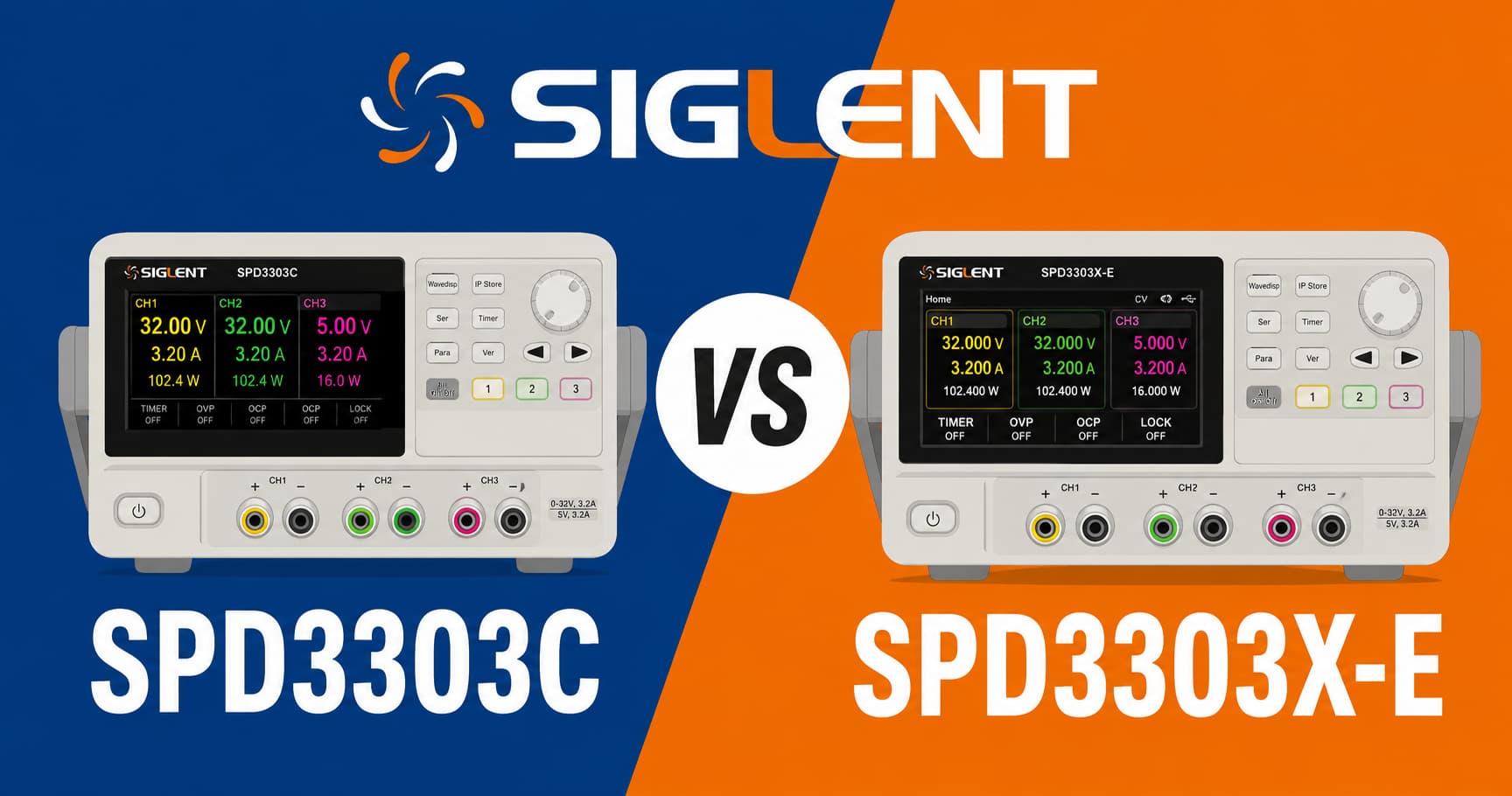
Siglent’s SPD3303 family has become one of the most trusted 3-channel linear bench power supply lines in its class. Two models routinely land in the same shortlist for engineers and technicians looking for a capable 220 W supply: the SPD3303C, a no-frills LED-display unit with USB-only connectivity, and the SPD3303X-E, which adds a 4.3-inch colour TFT display, a LAN port, and a real-time waveform output display for a noticeable but meaningful step up in usability.
The core power delivery hardware is essentially identical. Both supplies offer two independently adjustable channels and one selectable fixed logic rail at 2.5 V, 3.3 V, or 5 V. Both are linear designs with the same low ripple floor, the same 220 W total output, and the same independent, series, and parallel operating modes. The question is not whether one outperforms the other at the bench output — it is whether the usability and connectivity upgrades in the X-E are worth the additional cost for how you actually work.
For most engineers who plan to use this supply on a permanent bench and occasionally need network-based remote control or want to monitor output waveforms visually, the SPD3303X-E is the better long-term buy. If you need a straightforward programmable supply for a teaching lab, a production test station, or a secondary bench where LAN access is irrelevant, the SPD3303C delivers everything that matters at a lower price.
Same linear performance, same three-channel output — LED display and USB only. Ideal if LAN and a colour display are not priorities.
Colour TFT display, LAN port, and waveform monitoring. The more practical long-term choice for a permanent engineering bench.
Quick Verdict
Bottom Line
The SPD3303X-E is the better instrument for most bench engineers. Its 4.3-inch colour TFT display makes day-to-day operation noticeably more comfortable, its LAN port opens up proper network-based remote programming, and the real-time waveform output display gives you visibility into power rail behaviour that the SPD3303C simply cannot provide.
The SPD3303C is not the wrong choice — it is the right choice for users who have no need for LAN connectivity, prefer a compact LED display, or are equipping multiple stations on a fixed budget. The output performance you care about at the load is the same either way.
Specifications Compared
| Specification | SPD3303C | SPD3303X-E |
|---|---|---|
| Display | 4-digit LED (voltage), 3-digit LED (current) | 4.3″ colour TFT-LCD 480×272 |
| CH1 / CH2 Voltage | 0–30 V | 0–32 V |
| CH1 / CH2 Current | 0–3.2 A | 0–3.2 A |
| CH3 (fixed) | 2.5 V / 3.3 V / 5 V at 3.2 A | 2.5 V / 3.3 V / 5 V at 3.2 A |
| Total Output Power | 220 W | 220 W |
| Resolution (V / I) | 10 mV / 10 mA | 10 mV / 10 mA |
| Ripple & Noise | ≤1 mVrms | ≤1 mVrms |
| Series Mode Max | 60 V | 64 V |
| Parallel Mode Max | 6.4 A | 6.4 A |
| PC Connectivity | USB only | USB + LAN |
| Remote Programming | SCPI via USB | SCPI via USB and LAN |
| Waveform Display | No | Real-time output waveform |
| Timing Function | No | 5-step programmable output sequences |
| Save / Recall | 5 groups internal + external expansion | 5 groups internal + external expansion |
| Overload Protection | Short-circuit and overload | Short-circuit and overload |
| Mains Compatibility | 100 / 120 / 220 / 230 V | 100 / 120 / 220 / 230 V |
| Software | EasyPower (free) | EasyPower + LabVIEW driver |
Siglent SPD3303C Overview
The SPD3303C is the straightforward entry point into the SPD3303 family. Strip away the colour display and the LAN port and what remains is a well-executed linear bench supply with the same three-channel, 220 W output architecture that makes the broader product family popular. It delivers two independently adjustable channels at up to 30 V and 3.2 A each, plus a fixed selectable rail at 2.5 V, 3.3 V, or 5 V — a direct logic supply for digital boards that removes one common source of bench clutter.
The LED display presents four digits of voltage and three digits of current per channel. At 10 mV and 10 mA resolution this is perfectly workable for most development, test, and production applications where you are not tracking millivolt-level transients. The rotary encoder-based control interface is fast and precise for the vast majority of users.
Remote programming is available through USB via the SCPI command set, and the free EasyPower PC software covers the most common automation and logging use cases for a solo workstation. For a bench that is only ever controlled from one machine over a direct USB connection, the absence of a LAN port is rarely noticed in practice.
Full 3-channel linear output, 220 W, SCPI programmable over USB, and five groups of save/recall — everything a bench supply needs to do, delivered at the lower price point in this family. If you do not need LAN access or a colour display, this is the sensible buy.
Skip it if: you want to control the supply over a network, need the waveform display to troubleshoot power rail behaviour, or plan to use the 5-step timing/sequencing function. The SPD3303X-E covers all three.
- Same low-ripple linear output as the X-E
- Three isolated channels including fixed logic rail
- Series (60 V) and parallel (6.4 A) operating modes
- SCPI programmable over USB with free EasyPower software
- Five-group parameter save/recall with external storage support
- Universal mains input (100–230 V)
- Short-circuit and overload protection on all outputs
- Compact and lightweight for its output class
- LED display is harder to read at a distance
- No LAN — USB is the only remote control path
- No waveform output display
- No timing or step-sequence programming
- Lower max voltage on adjustable channels (30 V vs 32 V)
- Resolution identical to X-E; neither approaches the X’s 1 mV/1 mA
Siglent SPD3303X-E Overview
The SPD3303X-E builds on the same core hardware as the SPD3303C and adds three features that meaningfully change the experience of working with the instrument: a 4.3-inch colour TFT display, a LAN port enabling SCPI control over a network, and a real-time waveform display that lets you visualise output voltage and current behaviour directly on the front panel.
The colour TFT is more than cosmetic. Four-digit LED displays require you to mentally parse each channel’s readout independently; the TFT’s graphical interface presents both channels simultaneously with clear colour-coded readouts, remaining easy to read across a bench at normal working distance. For any supply that stays powered throughout a working session, this is a genuine daily-use improvement.
The LAN port opens up network-based SCPI control, which matters for two scenarios: automated test setups where the supply sits on a shared instrument network rather than connected to a single control PC, and remote access situations where you need to adjust or monitor the supply without being physically at the bench. The free EasyPower software and LabVIEW driver work over both USB and LAN. A five-step timing function, not present on the SPD3303C, allows simple power sequence programming directly from the front panel without any PC connection.
The SPD3303X-E brings a colour TFT display, LAN remote programming, real-time waveform display, and a 5-step timing function over the SPD3303C — at the same underlying linear output quality. For a permanent engineering bench, the usability difference over a full day’s work is real and cumulative.
If you are deciding between the SPD3303X-E and the SPD3303X (the premium model), understand that the X-E shares the same 10 mV/10 mA resolution as the SPD3303C. The SPD3303X offers 1 mV/1 mA resolution and significantly tighter accuracy — a meaningful gap if you are characterising precision analog circuits.
Skip it if: you genuinely will never need LAN access and the LED display on the SPD3303C is sufficient for your workflow. The extra spend is not justified by the bench output hardware alone — it is justified by the interface and connectivity additions.
- 4.3-inch colour TFT display — far easier to read than LED
- LAN port for SCPI control over a network
- Real-time output waveform display on front panel
- 5-step timing/sequence programming without a PC
- 32 V max per adjustable channel (vs 30 V on the C)
- LabVIEW driver included alongside EasyPower
- Same low-ripple linear output as the SPD3303C
- Series (64 V) and parallel (6.4 A) modes
- Higher price than the SPD3303C
- Resolution is still 10 mV/10 mA — same as the budget C
- Not the precision SPD3303X: does not reach 1 mV/1 mA
- Waveform display is useful but basic compared to a scope
- LAN adds complexity for setups that only need USB
Key Differences
Display: LED vs Colour TFT
This is the most immediately apparent difference and the one that most directly affects daily usability. The SPD3303C’s segmented LED display shows one channel’s readings at a time and requires close reading under normal bench lighting. The SPD3303X-E’s 4.3-inch TFT presents all channels simultaneously in a graphical format that remains readable from a comfortable working distance. Over the course of a full day’s bench session, this is not a trivial difference. Engineers who have used both consistently cite the display as the deciding factor.
LAN vs USB-Only Connectivity
If your test setup ever requires the supply to share a control network with other instruments — a common arrangement in automated test equipment environments — the SPD3303C’s USB-only interface becomes a genuine constraint. The SPD3303X-E’s LAN port allows it to participate in a standard SCPI-over-LAN instrument network, accessible from any machine on the same subnet. For a solo bench with one control PC, USB is sufficient and the LAN port offers no immediate advantage.
Waveform Display and Timing Function
The SPD3303X-E can display a real-time graphical output of voltage and current behaviour on its front panel — useful for quickly identifying capacitive charging curves, current limiting transitions, or load-step behaviour without reaching for an oscilloscope. The five-step timing function allows simple power sequencing (defined voltage/current steps with programmable timing) directly from the front panel, which covers a common use case in board bring-up without needing EasyPower running on a connected PC. Neither feature is present on the SPD3303C.
Resolution: A Tie, and a Context You Should Know
Both the SPD3303C and SPD3303X-E share the same 10 mV/10 mA minimum resolution. This is sufficient for the vast majority of bench development, production test, and educational applications. It is not the precision-grade SPD3303X, which delivers 1 mV/1 mA resolution alongside significantly tighter accuracy specifications. If your work involves characterising precision analog circuits, low-noise sensors, or sub-10 mV supply sensitivity, the SPD3303X is the correct model — neither the C nor the X-E applies there.
Real-World Performance
Bench Output Quality
Both supplies deliver the same rated ≤1 mVrms ripple and noise specification. This linear design characteristic is what makes the SPD3303 family appropriate for audio, RF, and sensitive analog work, and it is consistent across both models. Users who have measured both under representative loads report no meaningful difference in output cleanliness at the terminals.
The SPD3303C and SPD3303X-E produce identical output quality at the load. The performance differences between them exist entirely in the display, the connectivity layer, and the front-panel features — not in the power hardware.
Transient Response and Load Regulation
As linear supplies, both models respond quickly to load changes without the switching artefacts that characterise switch-mode designs. Load regulation performance is effectively the same between the two models, governed by the same underlying linear architecture. Engineers who have cross-tested both confirm that output measurements under dynamic loads are indistinguishable between the C and X-E.
Fan Noise
Both models use an intelligent temperature-controlled fan that ramps only when thermal conditions require it. At low-to-moderate output levels the fan is either inaudible or very quiet on both units. At high sustained loads both can become audible, and user reports suggest the behaviour is comparable between models.
Channel 3 Fixed Rail
The selectable fixed rail (2.5 V, 3.3 V, or 5 V) is mechanically selected on both models and its current limit is not software-adjustable. It is a convenient logic supply for digital boards but not a programmable precision rail. This is a consistent characteristic of the SPD3303 family and not specific to either model in this comparison.
Customer Opinions: What Amazon and Forum Users Say
SPD3303C
Amazon and EEVblog forum users consistently rate the SPD3303C highly for value and reliability. The most common positive theme is the excellent price-to-output-quality ratio: buyers note that the linear output is clean and stable, the overload protection works as expected, and the USB remote programming via SCPI performs reliably. The most frequent criticism is the LED display — users who have upgraded to the X-E often single out the display as the primary reason for doing so, and those who regret their SPD3303C purchase typically wish they had spent more to get the colour screen from the start. For educational and lab environments where multiple units are deployed and cost is a significant constraint, the SPD3303C draws consistent praise.
SPD3303X-E
The SPD3303X-E receives strong reviews from engineers who use it as a primary bench instrument. The colour TFT display and LAN connectivity are the two features most frequently mentioned as justifying the higher price. A minority of users note that the 10 mV/10 mA resolution is unchanged from the SPD3303C and caution that buyers seeking greater precision should look at the SPD3303X instead. The waveform display is described as genuinely useful for quick power rail checks but not as a replacement for a dedicated oscilloscope. Overall sentiment is that the X-E represents a meaningful daily-use upgrade over the C for anyone who will spend significant time at the bench.
Which Should You Buy?
- You are equipping multiple bench stations and cost per unit is a priority
- You only need USB remote control and will never access the supply over a network
- The supply will be used infrequently or as a secondary instrument
- You are purchasing for an educational lab where feature parity across units matters more than individual feature richness
- The LED display is sufficient for your workflow and viewing distance
- You do not need programmable output timing sequences
- This will be your primary bench supply used daily
- You want or anticipate needing LAN-based remote control
- A colour display that is easy to read across a bench matters to you
- You want to visualise output waveform behaviour without connecting an oscilloscope
- Your workflow includes any automated test environment where network instrument control is standard
- You want the 5-step timing function for simple power sequencing
One note on not overbuying: if your application genuinely requires sub-10 mV voltage resolution or tighter accuracy than ±0.5%, neither the SPD3303C nor the SPD3303X-E is the right instrument. The SPD3303X is the model in this family with 1 mV/1 mA resolution and precision-grade accuracy specifications. Buying the X-E expecting precision-grade performance will leave you disappointed — but for the broad middle ground of development, production test, and educational work where 10 mV resolution is entirely adequate, the X-E is the better-equipped of these two.
For most engineers equipping a primary bench, the SPD3303X-E is the right call. The colour TFT display and LAN connectivity represent genuine, cumulative improvements to the working experience over the course of a day’s bench session, and the waveform display and timing function add real capability that the SPD3303C cannot offer. The output hardware is identical; you are paying for a significantly better interface and a more flexible remote control architecture.
The SPD3303C remains the correct choice wherever cost per unit is the primary constraint — multi-station teaching labs, secondary bench supplies, or situations where LAN access and a colour display simply are not needed. The underlying linear supply performance is exactly the same.
Full 3-channel linear performance, USB-programmable via SCPI, LED display. The sensible option when LAN and colour TFT are not priorities.
Colour TFT, LAN, waveform display, and timing function on the same proven linear platform. The better long-term bench instrument for most engineers.
Final Verdict
The Siglent SPD3303C and SPD3303X-E are, at their core, the same linear bench power supply — the same 220 W three-channel output, the same low-ripple linear design, the same 10 mV/10 mA resolution, and the same underlying performance you will see at the terminals. The SPD3303X-E costs more and delivers nothing additional at the output connector. What it delivers is a meaningfully better instrument to spend a working day with: a colour TFT display that presents information clearly without demanding close attention, a LAN port that fits naturally into any networked instrument setup, and front-panel features — the waveform display and timing function — that extend what you can do without additional hardware or software.
If you are equipping a primary engineering bench and plan to use it regularly, the SPD3303X-E is the better investment. If you need multiple units for a teaching lab or a secondary role where the additional capabilities go unused, the SPD3303C delivers the supply performance you need at a lower price. Either way, the output quality is not the variable — it is the same across both models.