📶 If you’re experiencing dropped calls or slow mobile data, a cell phone signal booster might seem like the perfect solution. But before you invest, it’s important to understand where these boosters work best — and the environmental factors that affect their performance.
In this guide, we’ll explore how signal boosters behave in different settings and help you determine whether one will work in your area.
🌄 Signal Strength in Rural Areas
Signal boosters are especially helpful in rural or remote areas where cell towers are sparse.
How They Help:
- They amplify weak outdoor signals, even those as low as -110 dBm.
- Boosters take that faint signal, amplify it inside your home or vehicle, and rebroadcast it for your phone to use.
Limitations:
- No signal = no boost. A booster can’t create a signal where none exists.
- If you’re in a deep valley or far from any cell tower, even a booster may struggle unless combined with a high-gain directional antenna.
✅ Tip: Stand outside and test your signal using field test mode on your phone. If you have at least 1 bar (or -110 dBm), a booster can likely help.
🏙️ Urban Challenges
You might assume boosters aren’t needed in cities — but that’s not always true.
Common Urban Signal Issues:
- High-rise buildings can block or reflect signal.
- Dense construction materials (concrete, metal) often degrade signal indoors.
- Network congestion during peak hours can weaken your reception.
Signal boosters in urban areas can:
- Improve reception in apartments and condos
- Help basement offices or inner rooms with poor indoor coverage
- Bypass local interference from surrounding networks
✅ Tip: Window-mounted outdoor antennas often work best in cities — they avoid roof access hassles and reduce line-of-sight obstructions.
🏔️ Geographical Factors That Affect Signal
Several physical and environmental elements influence whether a signal booster will perform well in your area:
1. Elevation
- Being lower than surrounding terrain can block signals.
- Boosters placed on rooftops or poles help overcome elevation issues.
2. Obstacles
- Thick trees, hills, or buildings between you and the tower can weaken signal.
- Directional antennas (like Yagi antennas) can help focus on distant towers through obstructions.
3. Carrier Infrastructure
- Some rural areas may be served only by one or two carriers.
- Your booster needs to support the frequency bands your carrier uses in your region.
✅ Tip: Use online tools like CellMapper or OpenSignal to check tower locations and signal quality in your area.
List of Recommended Home Cell Phone Boosters
🏆 Best Budget Pick: Phonetone Home Kit
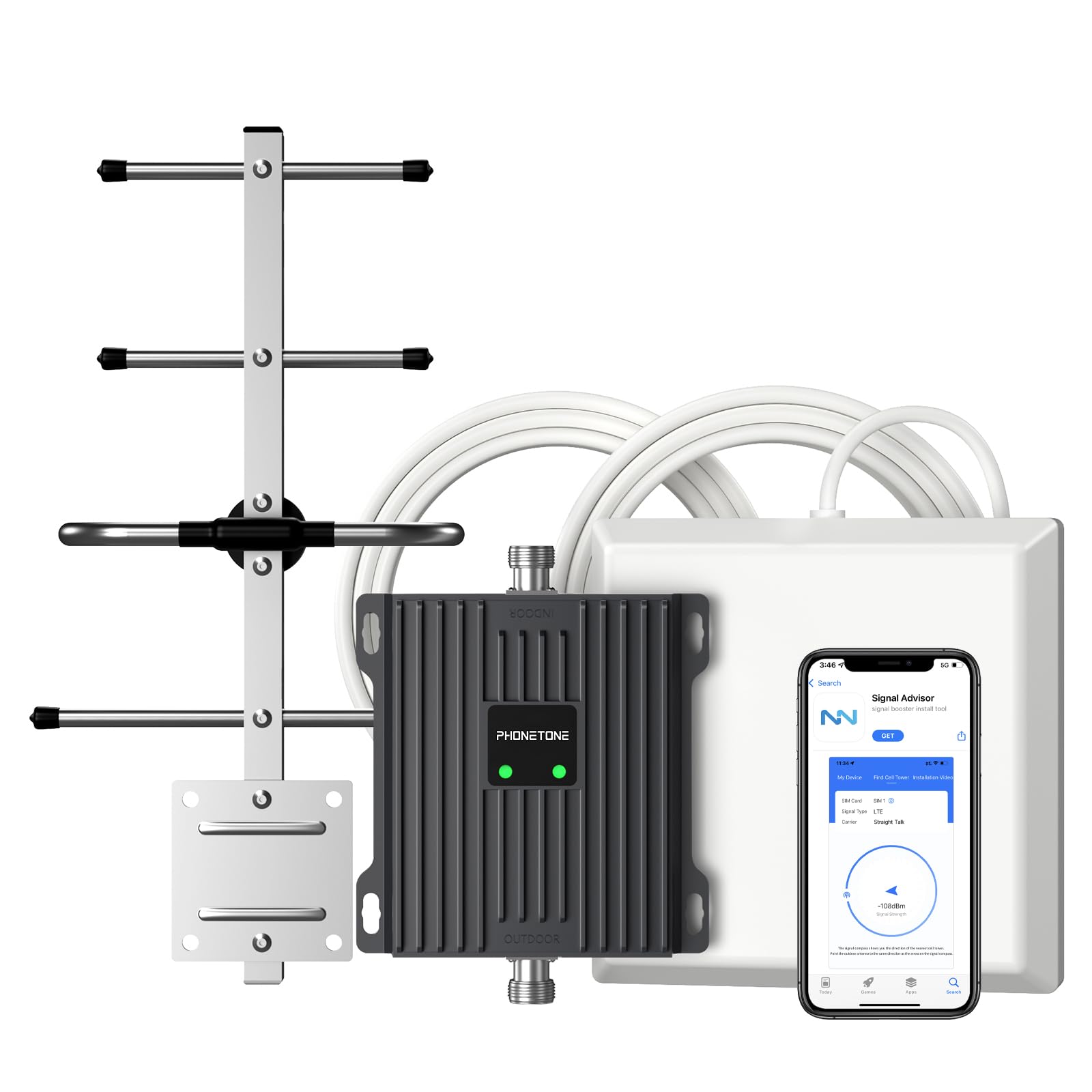
If you’re on Verizon or AT&T and want the lowest-cost signal booster that actually works, the Phonetone Home Kit is our top recommendation.
- ✅ Best value for Verizon and AT&T users
- ✅ Covers up to 4,500 sq ft
- ✅ Supports 4G LTE and selected 5G bands
- ✅ Smart gain control automatically adjusts signal strength
- ✅ Easier setup than many competing budget boosters
Not recommended for T-Mobile users. The lower price comes from supporting a narrower set of frequency bands (12, 13, and 17), making it a great fit for Verizon and AT&T households but the wrong choice for T-Mobile customers.
Check Price on Amazon⚖️ Best for Easy Installation: SNDcellup Home & Office
If you want a signal booster that’s easy to install and works with all major carriers, the SNDcellup Home & Office is one of the simplest options in this guide.
- ✅ Works with Verizon, AT&T, T-Mobile, and other major carriers
- ✅ Up to 5,500 sq ft coverage in ideal conditions
- ✅ Clear step-by-step installation instructions
- ✅ Great for small homes, apartments, and home offices
- ✅ Minimal setup frustration compared to many budget boosters
Best for users with at least some outdoor signal already available. If your outdoor signal is very weak, expect coverage to be limited to one or two rooms rather than the full advertised area.
Check Price on Amazon📺 Best for Large Homes: Metarepeater Home
If you have a larger home and want to avoid the frustration of antenna alignment, the Metarepeater Home stands out thanks to its built-in LCD signal meter.
- ✅ Works with all major carriers
- ✅ Up to 5,000 sq ft coverage
- ✅ Built-in LCD screen shows real-time signal strength
- ✅ Makes antenna positioning much easier
- ✅ Great choice for larger homes and multi-room coverage
The biggest challenge with any signal booster is aiming the outdoor antenna. The Metarepeater’s LCD display helps you find the strongest signal source faster, reducing setup time and improving the chances of getting the best possible performance.
Check Price on Amazon🚀 Best for Multi-Room Coverage: Nstcell Multi-Room
If you need reliable signal throughout a large home, across multiple floors, or in difficult areas like basements, the Nstcell Multi-Room is the strongest home booster in this guide.
- ✅ Works with all major carriers
- ✅ Designed for homes up to 7,000 sq ft
- ✅ Includes two indoor panel antennas
- ✅ Better coverage across multiple rooms and floors
- ✅ Ideal for larger homes, thick walls, and basements
What makes it different? Most budget boosters use a single indoor antenna, which limits coverage to one area. The Nstcell includes two indoor panel antennas, allowing the boosted signal to be distributed throughout a larger portion of your home. For real-world multi-room coverage, antenna count often matters more than the advertised square footage.
Check Price on Amazon💰 Best for One Problem Room: Amazboost Home
If your goal is simply to fix a weak-signal bedroom, home office, or other single dead zone, the Amazboost Home is the most affordable all-carrier solution in this guide.
- ✅ Works with all major carriers
- ✅ Covers up to 2,500 sq ft in ideal conditions
- ✅ Affordable, no-frills design
- ✅ Great for a single room or small coverage area
- ✅ Ideal for home offices and isolated dead zones
Buy this if your problem is one room, not your entire house. The Amazboost is designed to improve coverage in a specific area rather than distribute signal across multiple floors or large homes. If you need whole-home coverage, consider a multi-room system instead.
Not recommended for apartments where you cannot install an outdoor antenna, or for vehicles.
Check Price on AmazonComparison Table
| Booster | Best for | Carriers | Coverage | Indoor antennas | Setup help |
|---|---|---|---|---|---|
| Amazboost Home | One room or a single dead zone | All major | ~2,500 sq ft | 1 | Instructions |
| Phonetone Home Kit | Cheapest fix for Verizon/AT&T homes | Verizon, AT&T only | ~4,500 sq ft | 1 | Smart gain, LED |
| SNDcellup Home & Office | Simple setup in a small home/office | All major | ~5,500 sq ft | 1 | Clear guide |
| Metarepeater Home | Large home, easiest antenna aiming | All major | ~5,000 sq ft | 1 | LCD display |
| Nstcell Multi-Room | Multi-floor or multi-room houses | All major | ~7,000 sq ft | 2 panels | Instructions |

🧭 Conclusion
Will a signal booster work in your area? That depends on a few key things:
| Factor | How It Affects Performance |
|---|---|
| Existing Signal | At least 1 bar needed outside |
| Terrain | Hills and valleys can block signals |
| Obstacles | Dense trees, metal, and concrete limit effectiveness |
| Tower Distance | Farther towers = weaker signal to boost |
| Urban Density | More interference, but also more infrastructure |
| Antenna Setup | Correct antenna placement makes a big difference |
In short: If you have any signal outside, a signal booster can help bring it indoors or strengthen it in your vehicle. By understanding your local terrain, building materials, and carrier network, you’ll be well-equipped to decide whether a booster is the right solution for your location.
